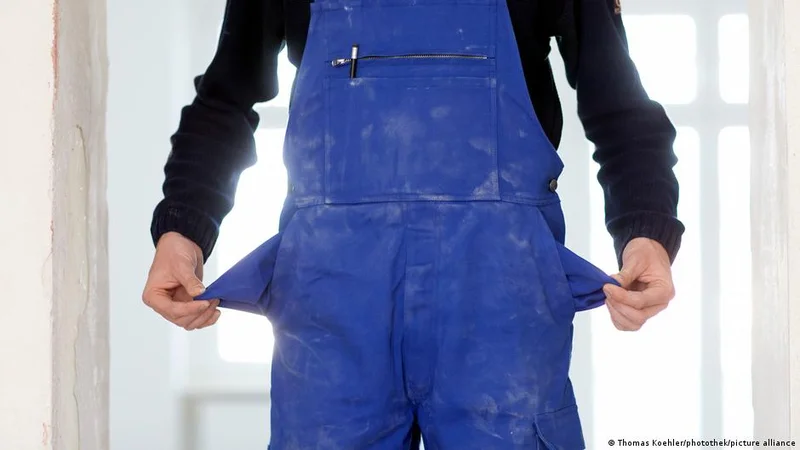
How bad are Germany's economic problems? One commonly used indicator is the number of company insolvencies and recent figures have produced worrying headlines.
According to a study by the Halle Institute for Economic Research (IWH), the insolvency rate among partnerships and corporations in Germany was 80% higher in June than in an average June between 2016 and 2019, the period before the COVID-19 pandemic.
Sole proprietors, freelancers and very small businesses were not included in these figures because they are considered less relevant to the overall labor market. Partnerships and corporations account for about 90% of jobs affected by insolvencies and 95% of the claims involved.
The number of company bankruptcies in the second quarter of 2026 reached its highest level in 20 years, according to Steffen Müller, head of insolvency research at IWH. This wasn't much of a surprise, since increasing numbers of firms have been going bankrupt for several quarters now.
Industrial job losses on the rise in Germany
Germany's economy has been struggling for years, and the recovery that had been expected for this year is now likely to result in only weak growth. This fits with announcements from major companies about significant job cuts.
Volkswagen has reportedly indicated that up to 100,000 jobs could disappear worldwide over the coming years. Auto supplier ZF plans to eliminate 14,000 positions by 2028.
VW is bringing out the axe
[](https://hlsvod.dw.com/i/vps/webvideos/ENG/2026/BUSI/BUSIENG260714_QWIVWZwickauCMS2_02SMW_,AVC_480x270,AVC_512x288,AVC_640x360,AVC_960x540,AVC_1280x720,AVC_1920x1080,.mp4.csmil/master.m3u8)
Bosch also intends to cut more than 20,000 jobs in Germany alone by 2030. But the difficulties are clearly not limited to the automotive industry.
After more than 100,000 industrial jobs were lost last year, a further 100,000 positions could be cut in industry during 2026, according to a study by consulting firm Horvath. The reductions are expected not only in automotive manufacturing, but also in mechanical engineering and construction.
A market correction or structural weakness?
The key question is whether Germany is experiencing a necessary market correction or a deeper structural weakness in its economy.
Insolvencies can have positive effects, too. When unproductive companies leave the market, workers, capital, and expertise become available for more productive sectors. This can promote economic growth through the process that economist Joseph Schumpeter called "creative destruction."
If people who lose their jobs because of insolvencies can quickly find new employment elsewhere, it would suggest a healthy market adjustment rather than economic decline. And in fact, unemployment in Germany has only been rising slowly.
Most people who lose their jobs are able to find new positions.
However, Müller notes that this is partly because many members of the baby-boom generation are now retiring and immigration from within the EU has slowed. As a result, workers are not necessarily moving from less productive companies to more productive ones.
Growing number of startups provides some hope
It is important to look not only at insolvencies but also at the number of newly founded businesses, according to Jutta Rüdlin, a board member of the German Association of Insolvency Administrators and Trustees (VID).
"Young companies fail more often than average, and there has been an increase in the number of startups compared with the previous year," said Rüdlin.
According to the German Federal Statistical Office (Destatis), over 10% more businesses were founded in the first quarter of 2026 than in the same period a year earlier.
"We've actually seen an increase in growth-oriented startups for many years," said Müller.
"That is good news. Many of them are active in the field of artificial intelligence, which gives reason for optimism," Müller added.
In his view, this suggests that Germany is currently undergoing a structural transformation.
The causes behind insolvencies are diverse
On the other hand, no single sector appears to be bearing the brunt of the problem.
"About a year and a half ago, there were many large insolvencies in manufacturing," said Müller.
But this is no longer the case. This time, the trend is affecting almost all industries, which points more toward a structural weakness in the economy.
Rising interest rates and a sluggish economy are especially weighing on the German construction industryImage: Florian Wiegand/Eibner-Pressefoto/picture alliance
Construction and housing development have been hit particularly hard by higher interest rates. Restaurants are struggling with rising minimum wages, energy-intensive industries with increased energy costs, and retailers with changing consumer spending habits.
Rüdlin emphasizes that insolvencies usually do not have one single cause.
In the past, healthy companies have generally proven resilient to external shocks. Major events like the conflict involving the US and Iran tend to act as catalysts for businesses that were already facing fundamental problems, such as outdated business models, delayed management decisions, or a failure to adapt to changing conditions.
The delayed effects of the COVID-19 pandemic
Another factor supporting the market-correction argument is the lingering effect of measures introduced during the COVID-19 pandemic.
Many companies received financial support at that time and must now repay it. Some of these businesses might not have survived even under normal market conditions at the time.
Jutta Rüdlin therefore believes that delayed effects from the COVID-19 era are still playing a role in company insolvencies. In her view, market correction and structural weakness are overlapping phenomena.
IWH researcher Steffen Müller takes a somewhat more drastic view of the situation.
"I think this is more than just a market correction. The real question is what direction the German economy will take in the future," he said, describing insolvency levels as being in the danger zone.
"We are not yet seeing a domino effect in which one company's problems spread to other businesses or banks," said Müller. "But we are in the middle of a major structural transformation."
This article was originally written and published in German.