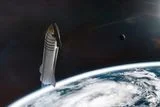
Amateur astronomers will want to keep their eyes peeled for a rare sight on the Moon come Aug. 5, 2026. That’s because it might be possible to see the aftermath of an accidental impact on the Moon’s surface. And what’s crashing into the Moon isn’t an asteroid — it’s a chunk of a SpaceX rocket that’s nearly as tall as a five-story building.
Back in January 2025, a SpaceX Falcon 9 rocket launched two lunar lander missions to the Moon: Blue Ghost and Hakuto-R. Fast forward to today, and the rocket’s upper stage, the section that helped propel the landers into their orbits, is on a collision course with the Moon after spending the past year in space.
The Falcon 9 upper stage is expected to hit the Moon at around 2:35 a.m. on Wednesday, Aug. 5, at 5,400 MPH, giving astronomers a chance to watch an artificial impact unfold in real-time.
“We hope to understand more about the dynamics of impact processes on the Moon, especially to understand more about natural meteoroids which we don’t know the properties of independently,” Benjamin Fernando, a postdoctoral fellow at Los Alamos National Laboratory and one of a recent arXiv paper's study authors, told Discover.
Predicting an Impact on the Moon
After the launch of the Falcon 9 rocket, four of its components split apart from each other in space: Blue Ghost, Hakuto-R, a payload canister that held the landers together, and the rocket’s upper stage.
Blue Ghost landed on the Moon on March 2, 2025, while Hakuto-R crashed after an unsuccessful landing attempt on June 5, 2025. The payload canister re-entered Earth’s atmosphere on March 15, 2025, as a bright meteor near the border between Argentina and Chile.
That left the upper stage. Bill Gray, an independent astronomer who has been tracking the upper stage, said in a statement that it kept orbiting Earth, but ultimately didn’t re-enter Earth’s atmosphere. Gray ended up making the prediction that it would impact the Moon on Aug. 5, 2026, computing its orbit with his own software.
The upper stage — possibly having a mass of around 4 and a half tons if its propellant is spent — will impact the lunar surface near the Einstein crater, on the sunlit side of the Moon.
According to an arXiv paper released on July 17, 2026, in which researchers outlined how the impact will likely go down, amateur astronomers ideally need to be in a dark area to catch the impact. Those in South America and the eastern U.S. and Canada will have the best chance to observe the impact.
Read More: NASA Unveils Roadmap for Permanent Moon Base and Increased Missions to the Moon
Watching for a Flash and Plume
When the upper stage impacts the Moon, astronomers will be looking for two visual signs through telescopes: an impact flash and an ejecta plume.
In a situation like this, the impact flash normally comes first. But the researchers behind the July 17 arXiv paper wrote that the flash will likely not be easy to detect.
One reason is that the impact is occurring on the sunlit side. But the researchers also note that the brightness of an impact flash depends largely on the velocity of whatever’s impacting the Moon. Compared to the upper stage’s 5,400 MPH, meteoroids typically travel at speeds between 45,000 and 160,000 MPH before hitting the Moon, according to NASA.
Because the upper stage is traveling much slower than a meteoroid would, its impact flash won’t be as intense, and it will only last under a second. The brightness will also depend on the orientation of the upper stage upon impact, as well as the material it impacts (lunar regolith or bedrock).
While the impact flash may or may not be visible to astronomers, the ejecta plume will be easier to observe.
A separate arXiv study published on July 27, 2026 simulated how the plume could behave, estimating that a vertical column of ejecta could extend as high as roughly 46 to 62 miles above the impact point. The researchers wrote that the plume could potentially be visible, and that the impact spot may be bright enough to see against the dark sky.
A Rare Lunar Research Opportunity
The crater made by the upper stage impact won’t be visible from Earth, but there are plans to observe it with orbiting spacecraft, like NASA’s Lunar Reconnaissance Orbiter. According to the July 17 arXiv paper, the crater is expected to have a diameter of around 88 feet and a depth of around 16 feet.
The paper’s researchers said that the lunar material disrupted by the impact could be excavated and imaged later on. They also emphasized that this impact event presents a prime opportunity to understand how impacts on the Moon contribute to critical seismic data, an important factor in studies of the Moon’s inner structure.
For most, one question probably remains: Should we be worried at all about this lunar impact? Fortunately, Gray wrote that there’s nothing to worry about — the only potential concern is that ejecta could hit other spacecraft, but this is only a slight risk. However, when humans do make it back to the Moon in the coming years, potential impacts could turn into more of an issue.
Read More: Hectic Mini-Moon Collisions in the Early Solar System Produced the Grains Packed Inside Meteorites
Article Sources
Our writers at Discovermagazine.com use peer-reviewed studies and high-quality sources for our articles, and our editors review for scientific accuracy and editorial standards. Review the sources used below for this article:
- This article references information from an arXivpaper:Observational planning for the 2026 August 5 Falcon 9 Upper Stage lunar impact
- This article references information from NASA: Lunar Impact Monitoring Program
- This article references information from an arXivpaper: Predicted Ejecta Dynamics and Observability of the 2026 Falcon 9 Upper Stage Lunar Impact