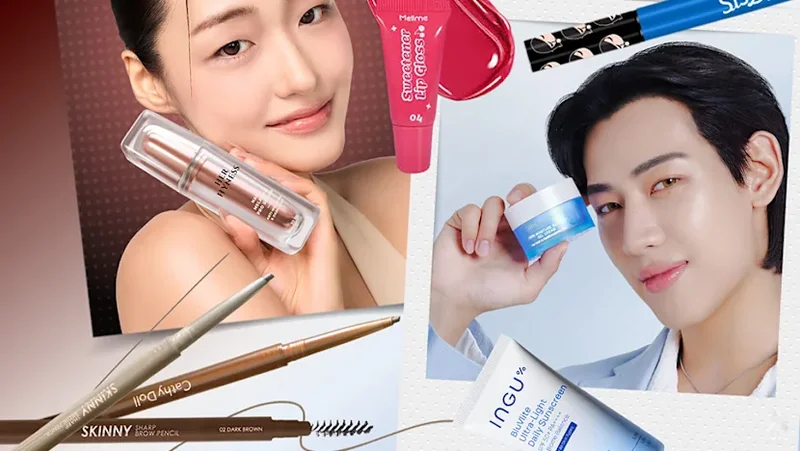
T-beauty explained: Why Thailand’s beauty brands are taking Southeast Asia by storm
Once a Bangkok shopping secret, Thai beauty has become one of Southeast Asia’s fastest-growing beauty exports. Here’s how products designed for tropical skin and humid climates are carving out an identity all their own.
If you’ve ever flown home from Bangkok with a mysteriously heavier suitcase, chances are it was stuffed with Gentlewoman totes, ChaTraMue milk tea mixes – and a healthy haul of beauty buys.
For decades, Thailand’s beauty industry had evolved largely under the radar. Heritage names like Srichand, founded in 1948, and mass-market giant Mistine, which emerged in the late 1980s, developed products tailored to local consumers rather than chasing global trends.
By the 2000s, Bangkok had become one of Asia’s favourite beauty-shopping destinations. Visitors returned with suitcases filled with lightweight sunscreens, oil-control powders and affordable makeup discovered in local pharmacies and beauty stores.
The 2020s marked a turning point. As TikTok and Instagram turned holiday finds into viral recommendations, beauty brands found themselves reaching audiences far beyond Bangkok. Today, many of those once hard-to-find products are just a click away, with Thai labels landing on pharmacy shelves in Singapore and expanding across Asia through e-commerce.
The movement has become known as T-beauty. But unlike South Korea's K-beauty, which popularised multi-step skincare routines, or Japan's J-beauty, favoured for its minimalist approach, Thailand isn’t staking its claim on a single viral ingredient or aesthetic. Instead, it’s earning a reputation for products designed around life in the tropics: sunscreens that withstand relentless humidity, makeup that survives sweltering commutes, and skincare formulated for the realities of Southeast Asian skin.
Thai beauty has developed its own identity by focusing on functionality.
The timing couldn’t be better. Thai soft power is enjoying unprecedented global visibility, fuelled in part by the international success of dramas. Actors like Bright Vachirawit and Win Metawin have become global stars, earning luxury ambassador roles with Burberry and Prada, respectively, while introducing international audiences to a broader wave of Thai fashion, food and lifestyle.
Beauty is another cultural export riding the momentum. Thailand’s beauty and personal care market generated THB270 billion (US$8.08 billion) in retail sales in 2025, according to market research firm Euromonitor International, while the Commerce Ministry has identified cosmetics as one of the country’s “rising star” industries after new beauty company registrations jumped 20 per cent.
So what exactly defines T-beauty, and why is it resonating with consumers well beyond Thailand?
MADE FOR THE TROPICS
Thailand’s climate has shaped its beauty industry in ways few other markets can claim.
“What makes T-beauty distinctive is that our products are developed for real-life tropical conditions – high heat, humidity, strong UV exposure, and long wear throughout the day,” said Wongwiwat Theekhakhirikul, managing director of Karmarts, which has a portfolio that includes Cathy Doll, Skynlab+ and Browit.
“That creates products with very practical performance requirements: Lightweight texture, oil control, sweat resistance, and durability," he said, in an email interview with CNA Lifestyle.
That brief runs through the beauty conglomerate’s portfolio, which is sold in over 36 countries. It is most evident in products such as Cathy Doll’s Ultra Light Sun Fluid, which pairs high SPF with a finish light enough to disappear under makeup.
What makes T-beauty distinctive is that our products are developed for real-life tropical conditions – high heat, humidity, strong UV exposure, and long wear throughout the day.
“When consumers live in 35-degree weather with high humidity, products simply cannot behave the same way they do in colder climates,” added Theekhakhirikul. “This expertise gives Thai brands a major advantage across Southeast Asia because many neighbouring markets share similar climates and consumer concerns.”
For Srichand, one of Thailand’s oldest beauty brands, that understanding is distilled into what it calls “T-Skin” – skin that lives in tropical conditions.
“T-Skin faces unique challenges including excess sebum, UV exposure, pollution and increasingly demanding lifestyles,” said Rawit Hanutsaha, CEO of Srichand United Dispensary, in an email. “Rather than adapting products developed for other markets, we start by solving these specific concerns.”
Srichand’s bestselling Skin Moisture Burst Gel Cream, for example, delivers hydration through a lightweight gel texture better suited to tropical climates rather than a rich cream. This climate-first approach is precisely what gives T-beauty its identity, according to Hanutsaha.
“K-beauty is admired for trend-driven innovation and layered skincare routines, while J-beauty is known for simplicity and craftsmanship,” he said. “Thai beauty has developed its own identity by focusing on functionality… formulations are designed to be lightweight, breathable, long-lasting and highly effective without feeling heavy on the skin.”
REWRITING THE RULES
Over the past decade, the industry’s definition of beauty has slowly shifted as consumers began moving away from whitening products and towards healthier, more resilient skin.
Few understand that transition better than Kanyachat “Elle” Lerttanapaiboon.
Before co-founding clean beauty brand Her Hyness in 2016, the former L’Oréal executive found herself chasing the same beauty standards that had dominated much of Asia for decades.
“I was using strong acids without adequately protecting my skin barrier, chasing brighter, fairer skin – a beauty ideal that’s deeply embedded in our culture,” she recalled in an email. “The result was skin that became fragile, reactive, and genuinely painful to manage. That experience forced me to confront something I wish someone had told me sooner: Fair skin and healthy skin are not the same thing.”
Lerttanapaiboon’s lesson became the foundation of Her Hyness, which now develops products that prioritise skin health while tackling concerns common among Southeast Asian consumers, including pigmentation, melasma and barrier damage.
Take its Nano Melasma Pro serum. While most brightening products target melanin – the pigment commonly associated with dark spots – Lerttanapaiboon said her team also focused on lipofuscin, an age-related pigment that contributes to discolouration.
“Melasma is one of the most common skin concerns across Southeast Asia. But when we studied the market, we noticed most brands were only targeting melanin while completely overlooking lipofuscin. We developed a formulation that addresses both, with efficacy and gentleness working together rather than in tension.”
That same rigour shapes how she sees “clean beauty” more broadly. Shoppers, she said, increasingly expect brands to explain the science behind their formulations rather than lean on the label alone. “They’re no longer accepting ‘clean’ as a vague promise. They want to know exactly what it means and whether it actually works.”
A MAKEUP ARTIST’S T-BEAUTY SHOPPING LIST
For Singaporean celebrity makeup artist Larry Yeo, Thailand has become one of Asia’s most rewarding beauty destinations. Every Bangkok trip includes a stop at beauty megastore Eveandboy, where he happily spends “three or four hours” browsing the latest launches.
He first discovered Thai brands through friends, but now deliberately leaves room in his luggage before flying home. “I’ll buy a few to test first," he laughed. "If it works, I’ll come home with 30.”
For those curious about exploring T-beauty, these are the categories he recommends.
Sunscreens
Yeo is a fan of brands such as Mistine, MizuMi and Ingu, which have earned loyal followings for lightweight, water-resistant formulas that sit comfortably under makeup.
“They feel good on the skin and work well as a primer in our weather,” he said.
Ingu BluVlite Ultra-Light Daily Sunscreen +Biome Balance, S$34.78.
Available at Shopee.
Setting powders
A longtime favourite is Srichand’s Bare To Perfect Translucent Powder, which Yeo reaches for when he needs to keep shine under control without dulling the complexion.
“It has a wonderful texture and finish while keeping oil at bay without disrupting your makeup.”
Srichand Bare To Perfect Translucent Powder, S$18.
Available at FaceandBody.
Waterproof eye makeup
Thai brands also excel at long-wearing eye products built to withstand heat and humidity. One standout is the Sis2Sis Super Sharp Eyeliner, which Yeo first discovered at a convenience store.
“I was impressed by the formula, it lasted the whole day with minimal smudging.”
Sis2Sis Super Sharp Eyeliner, THB49 (S$1.87)
Available at selected 7-Eleven, Watsons and Eveandboy stores in Thailand.
Brows
For naturally defined brows, Yeo recommends Cathy Doll’s Skinny Soft Brow Pencil.
“It’s great for creating hair-like strokes that look natural. It comes in eight shades, but I’d avoid the warmer browns as they can pull a little too red on our skin.”
Cathy Doll Skinny Soft Brow Pencil, THB99 (S$3.78)
Available at selected 7-Eleven, Watsons, Boots, Beautrium and Eveandboy stores in Thailand.
Lip products
Another staple is Mellme’s Sweetener Lip Gloss, which he describes as an affordable alternative to luxury lip oils.
“It leaves behind a soft stain that lingers for a few hours, so you get both shine and lasting colour in one product.”
Mellme Sweetener Lip Gloss, THB18 (S$0.69)
Available at selected Eveandboy stores in Thailand.
Not every category translates perfectly, however. Thai colour cosmetics, Yeo noted, often lean warmer than Singaporean consumers typically prefer, reflecting local preferences for peachier blushes and tangerine-toned makeup.
A CATEGORY OF ITS OWN
Despite inevitable comparisons, the brands CNA Lifestyle spoke to aren’t interested in becoming “the next K-beauty”. Instead, they want to define a category rooted in tropical expertise and Southeast Asian consumers.
“For T-beauty to achieve global recognition, we need stronger storytelling,” said Karmarts’ Theekhakhirikul. “The world must understand what T-beauty stands for and why it matters.” That, he added, will also require sustained investment in R&D and globally recognisable brands.
Srichand’s Hanutsaha argued that the industry’s next challenge is proving T-beauty has staying power. As Thai brands expand beyond ASEAN, Hanutsaha said success will depend on maintaining high standards in research, quality and innovation while continuing to build from an authentic understanding of tropical consumers.
“The future of T-beauty isn’t about following trends,” he said. “It’s about demonstrating that Thailand has its own distinctive beauty philosophy, one built on performance, innovation and a deep understanding of consumers living in tropical environments.”
For Her Hyness co-founder Lerttanapaiboon, local understanding is Thailand’s greatest competitive advantage.
“The future of clean beauty in Asia won’t be written by Western brands adapting their formulas for us,” she said. “It’ll be written by us, because we have the advantage of true local insight… our climate, our skin biology and our cultural relationship with beauty.”