WASHINGTON — With a Falcon 9 upper stage set to hit the moon this week, SpaceX says it is working with NASA on ways to prevent similar collisions in the future.
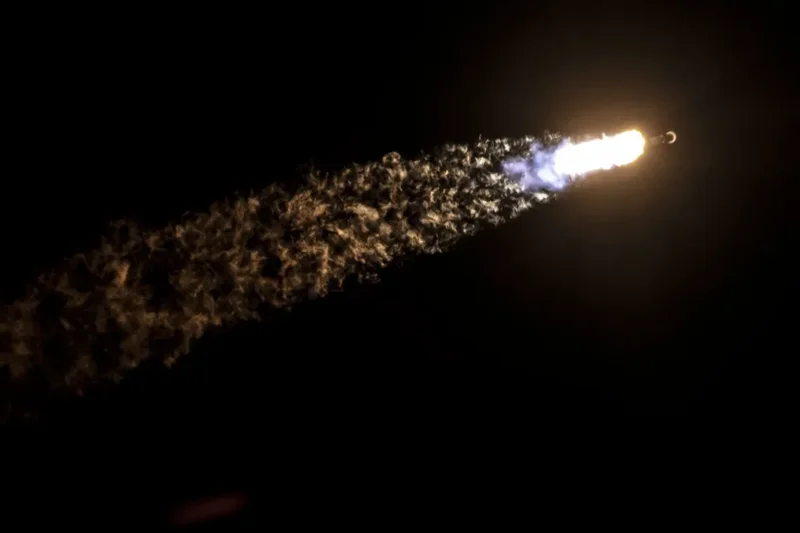
The Falcon 9 upper stage used for the January 2025 launch of lunar landers built by Firefly Aerospace and ispace is on a trajectory to collide with the moon Aug. 5 at 2:35 a.m. Eastern.
The upper stage is expected to impact near a crater named Einstein on the western limb of the moon, according to Bill Gray, an astronomer who has tracked the stage and was the first to report the projected collision in April. The impact itself, with an estimated energy equivalent of two to three tons of TNT, is unlikely to be visible from Earth, but it may create a plume that can be seen by telescopes.
The impact is not intentional. “What has happened is essentially a mixture of solar activity and gravity forces have put it on a path toward the moon,” said Julianna Scheiman, director of NASA science and Dragon programs at SpaceX, during an Aug. 3 NASA briefing about the upcoming Crew-13 mission to the International Space Station.
She said the company followed best practices in passivating the stage “per the appropriate rules and regulations,” noting that for a launch on a high-energy trajectory like this, it is not possible to deorbit the stage, which the company does for missions to low Earth orbit.
This will not be the first upper stage to hit the moon. In 2022, the upper stage from the 2014 Long March 3B launch of the Chang’e-5 T1 mission hit the moon. That impact left a double crater, thought to correspond to the engines at one end of the stage and a payload adapter or other equipment at the other end.
In 2009, the Centaur upper stage of an Atlas 5 rocket deliberately hit Cabeus crater near the lunar south pole, creating a plume studied by NASA’s Lunar Crater Observation and Sensing Satellite, or LCROSS, spacecraft before LCROSS itself hit the moon. Those observations provided scientists with evidence of water ice in the south polar region.
During the Apollo program, the third stages from several Saturn 5 launches were also directed to collide with the moon. Seismometers placed on the lunar surface by Apollo missions detected the impacts to help scientists understand the structure of the lunar interior.
However, with the growing interest in lunar exploration, including plans for lunar bases, there is concern that future unintentional impacts by upper stages could pose a small but nonzero risk to spacecraft or astronauts on the moon.
“One of the things that we’re working on in partnership with NASA and the other appropriate agencies is what is the best future disposal path for high-energy missions that are in the sun-Earth-moon system,” Scheiman said. She didn’t elaborate on how disposal of upper stages on future launches might differ from that used on the Firefly-ispace launch.
NASA is planning to observe the impact site with its Lunar Reconnaissance Orbiter — launched on the same Atlas 5 as LCROSS in 2009 — after the impact, comparing the site with images taken before the impact. South Korea’s space agency, the Korea AeroSpace Administration, or KASA, said Aug. 3 that its Danuri lunar orbiter will also attempt to observe the stage’s impact.