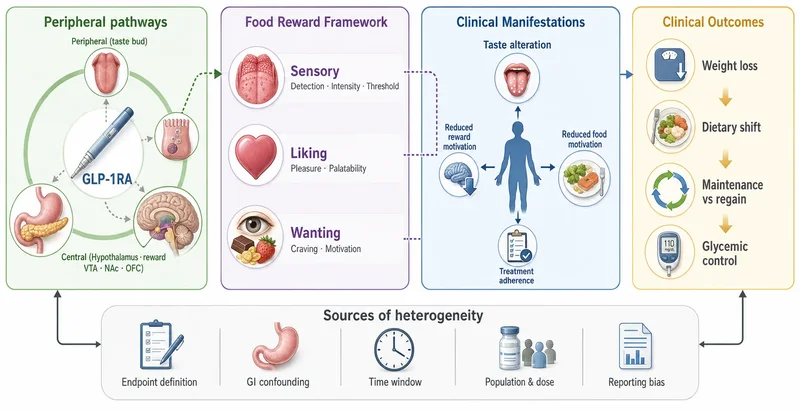
From altered flavors to fading cravings, researchers map the overlapping sensory and reward pathways that may change how food feels during GLP-1RA therapy.
Review: Altered eating experience during GLP-1 receptor agonist therapy: a sensory–liking–wanting framework for food preference and nutritional behaviour
In a recent review published in the journal Frontiers in Nutrition, the authors conducted a structured narrative review of current evidence on how glucagon-like peptide-1 receptor agonists (GLP-1RAs) influence sensory perception, food enjoyment, and food motivation using a sensory-liking-wanting framework.
Some individuals taking GLP-1RAs report that their favorite foods become less enjoyable or tempting, without this necessarily reflecting impaired basic taste function. Obesity is a chronic, progressive metabolic disease with growing global prevalence, increasing the demand for effective long-term treatment options.
GLP-1RAs are widely used for obesity treatment because they enhance satiety, delay gastric emptying, reduce energy intake, and support meaningful weight loss. Some patients also report that food tastes different, feels less enjoyable, or no longer seems tempting. These experiences are often called "taste changes," but they may reflect several biological processes rather than a single taste disorder. Further research is needed to understand these mechanisms and improve nutritional care during treatment.
Looking Beyond Appetite Suppression
GLP-1RAs have changed the way obesity is managed by reducing energy intake and supporting meaningful weight loss. However, growing clinical experience shows that their effects extend beyond reducing hunger.
Some patients describe food tasting different, reduced eating pleasure, or lower cravings for high-calorie foods. The review suggests that these experiences should not be treated as simple taste disturbances but as a combination of three components related to eating behavior: sensory perception, liking, and wanting.
The Three Components of Eating Behavior
Eating begins with sensory perception, which includes detecting taste, smell, and food texture. This stage determines how food is initially recognized.
The second component is liking, defined as the subjective pleasure or hedonic value associated with eating and influenced by flavor, prior experience, context, cognitive factors, and physiological state.
The third component, wanting, describes the motivation or craving to seek and consume food. Separating these components helps explain why patient-reported "taste changes" may actually reflect different biological processes.
How GLP-1RAs May Influence Food Reward and Eating Experience
GLP-1RAs may influence eating behavior through interconnected biological pathways rather than by directly changing taste. Preclinical studies indicate that endogenous glucagon-like peptide-1 (GLP-1) is produced by some mammalian taste bud cells and may modulate taste signaling. However, these findings do not establish that GLP-1RA treatment directly alters taste in humans, and limited human studies have produced inconsistent results.
Taste signals are integrated in the nucleus of the solitary tract (NTS) before reaching brain regions involved in appetite and reward. Human studies have associated GLP-1RA treatment with reduced craving and weaker neural responses to calorie-dense food cues in some participants, findings that are more consistent with altered food valuation and motivation than with impaired basic taste.
Gastrointestinal issues, including nausea and early satiety, may also reduce eating pleasure, making it difficult to distinguish altered food reward from true changes in taste perception.
Evidence From Clinical Studies
Randomized controlled trials usually focus on body weight and metabolic outcomes, while eating-related experiences are rarely included as prespecified measures and are more often captured sporadically as adverse events.
Patient-reported outcome questionnaires may provide a more sensitive window into changes in food enjoyment and preference, but assessment methods vary considerably between studies. Real-world evidence presents additional challenges, as reports of “taste alterations” may encompass several distinct sensations, including olfactory changes, dry mouth, gastrointestinal discomfort, and other symptoms that are difficult to distinguish clinically.
Spontaneous reporting databases can identify safety signals but cannot establish incidence or risk. In contrast, cohort studies provide better-defined populations and follow-up but remain vulnerable to subjective reporting and confounding.
Because this was a narrative review rather than a systematic review or meta-analysis, the authors did not conduct a formal risk-of-bias assessment.
A Framework for Understanding Patient Experiences
According to the review, while on GLP-1RA treatment, alterations in the eating experience should not be regarded solely as a biological phenomenon but understood as the interaction between different processes.
Peripheral taste pathways, brainstem integration, central reward networks, interoceptive state, and learned behavior may all contribute. Their relative importance may differ between individuals and across treatment stages. A patient’s report of a “taste change” may therefore not correspond to a clinically defined gustatory disorder.
The authors also note that alternative explanations, including nausea, delayed gastric emptying, altered satiety, behavioral adaptation, and medication adherence, should be considered when interpreting eating-related changes.
The framework also accommodates limited treatment response, persistent appetite, weight regain after treatment withdrawal or interruption, and rare atypical or paradoxical responses.
Clinical Relevance and Future Directions
The review highlights that patient-reported changes in eating experience should not automatically be classified as taste abnormalities. Healthcare professionals may find it useful to determine whether patients report altered taste perception, reduced eating satisfaction, or diminished interest in food, as these experiences can reflect distinct processes.
The authors present these points as translational implications rather than formal clinical recommendations. The authors also propose a stage-dependent pattern in which these experiences may change over time.
Early during treatment, gastrointestinal discomfort and enhanced satiety may reduce food appeal, whereas later stages may involve a more persistent reduction in motivation toward highly rewarding foods in some individuals.
Importance of Nutrition and Obesity Management
The proposed sensory-liking-wanting framework has practical implications for obesity treatment and nutritional counseling. Understanding whether a patient experiences altered sensory perception, reduced food enjoyment, or lower motivation toward food may support more individualized dietary guidance and improve communication between patients and healthcare providers.
The review also highlights that the existing body of evidence is heterogeneous due to differences in endpoint definitions, measurement methods, populations, drugs, doses, and follow-up periods. Much of the human evidence is observational, secondary, or exploratory, and many studies were not designed to separate sensory function from liking and wanting. Current findings are therefore better interpreted as a conceptual framework for organizing available evidence rather than proof of a single causal pathway.
Future studies using standardized, multimodal assessments and longer follow-up may help clarify how these eating-related changes influence food preferences, dietary behavior, long-term weight management, and treatment adherence.
Conclusion
The review concludes that altered eating experiences during GLP-1RA therapy are more consistent with changes in food reward, hedonic evaluation, and motivational drive than with a uniform impairment of taste function, although peripheral taste-pathway modulation may contribute in some cases.
Current evidence supports interpreting patient-reported "taste changes" within a sensory-liking-wanting framework that distinguishes sensory perception from food enjoyment and craving. Because responses vary among individuals and available evidence remains heterogeneous, the proposed framework should be considered a conceptual model rather than definitive proof of causality.
Longitudinal, multimodal human studies measuring sensory function, hedonic response, motivational drive, and state-related symptoms in parallel are needed to clarify these effects and their implications for nutrition, dietary behavior, treatment adherence, and long-term obesity management.