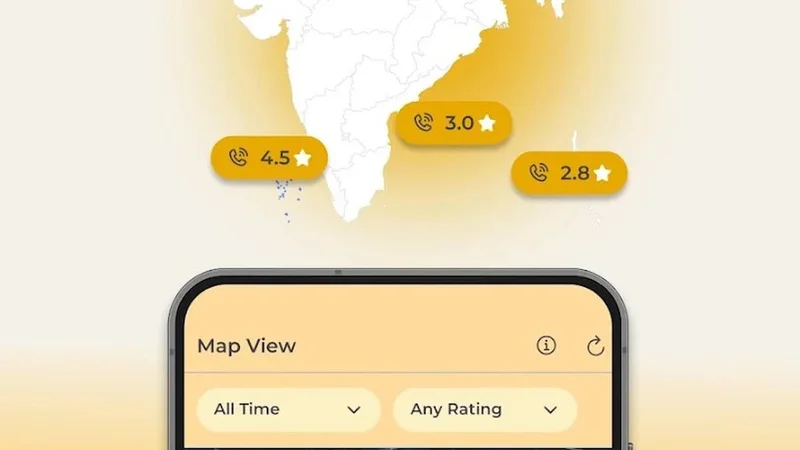
On Monday (August 3, 2026), the Telecom Regulatory Authority of India (TRAI) relaunched a call quality rating app it first released in 2017. The app, MyCall, retrieves records of recent calls and allows users to rate the quality from one to five stars, and sends anonymised reports to telecom operators to help them improve their networks.
“While we are calling it revamped, let me tell you it is practically a new application where we have borrowed the name of the older app,” TRAI chairperson Anil Kumar Lahoti told presspersons at the launch for the app. The 2017 app had drifted out of compatibility with recent handsets, much like the DND app for reporting spam SMS messages and calls; that app too was refreshed in recent months.
The app is currently only available on Android. The iOS version will come after certain “technical issues” are sorted out between TRAI and iPhone maker Apple. (In the last decade, TRAI and Apple had a high-profile privacy dispute on the DND spam reporting app, since that application required message and call logs in full, something the tech giant balked at.)
When a user rates a call three stars or below, the app offers a few options that cover the range of everything that may have gone wrong in a call: audio lag, the other party couldn’t hear, the call was completely silent, there was echoing, the call dropped, “voice breaking,” “cross connection,” and “call took too long to connect”. The app also asks users whether they were indoors, outdoors or traveling when the call happened, and collects the user’s location during the call for the reporting. In addition, the app automatically fetches data like signal strength during the call in its reporting.
Pre-installing the app is not mandatory
Responding to a question, Mr. Lahoti said that pre-installing the app wouldn’t be mandatory. “This is completely voluntary,” Mr. Lahoti said. “We do not want to make it a mandatory thing... consumer is the king. If they want to give the feedback [on their calls], they have the option to download the app. Mandating the mobile phone manufacturers to integrate this feature, we do not think will be the right approach. We want to continue to keep it a voluntary option of the consumer.”
While TRAI has not mandated any app to be pre-installed on phones, the question came up due to the uproar over the Sanchar Saathi scam call reporting app, which the Department of Telecommunications (DoT) had briefly required to be pre-installed before a furore forced the government to reverse course.
The data collected by the app would be stored on TRAI’s servers, and shared with telcos in an anonymised format. The data TRAI sends telcos “complements the data which the service provider is getting from its [own] network,” Mr. Lahoti said, enabling them to make adjustments to their network architecture.
Call drops
Call drops and other quality issues mainly happen because while telecom networks have grown increasingly sophisticated, calls between different operators use older analogue switching technologies. This is why VoLTE calls within a given network (marked HD or HD+ on some handsets) face fewer quality issues than inter-telco calls.
Such so-called Time-Division Multiplexing (TDM)-switched calls have an upper ceiling on quality even under the best of circumstances. This problem is especially acute when on an anonymised call between customers and service providers on platforms such as Uber and delivery services, since the call is switched twice over this older technology, from each party to a virtualised landline service, and vice versa.
In 2016, telcos successfully argued against a TRAI penalty framework for call drops in the Supreme Court. Since then, TRAI has instituted a sampling based quality of service system, wherein telcos audit their own networks and submit detailed reports. Thresholds for call quality were set, and TRAI also performs its own “drive tests” across different States. Financial disincentives (essentially fines) are imposed when telcos fall short of the standards.
Last year, TRAI suggested that IP-based interconnection be mandated between telcos. “We will come out with our regulatory framework about … mandating IP-based interconnection,” Mr. Lahoti said in response to a query on that mandate on Monday.
Published - August 04, 2026 10:45 am IST