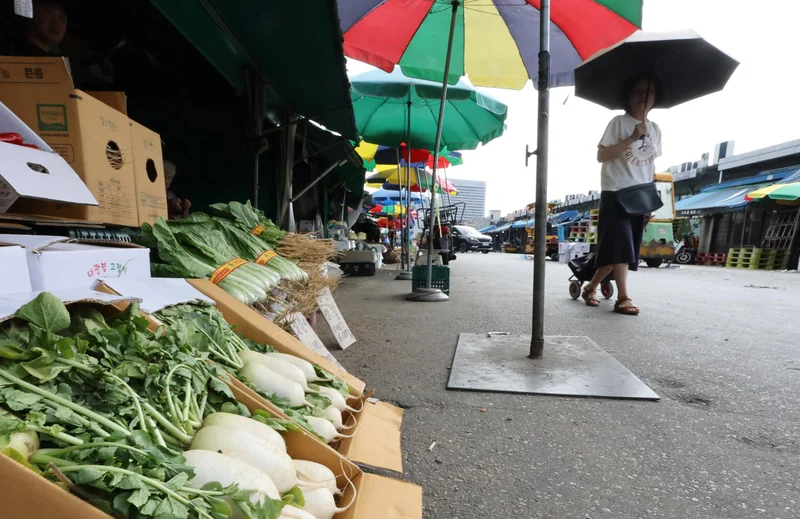
Kim, a 54-year-old barbecue restaurant owner in central Seoul's Myeong-dong, said business had slowed sharply since late July.
"It's not just dinner customers. Office workers used to come here for lunch, but we've seen a sharp drop since a few weeks ago," Kim said. "I think it's because of both the summer vacation season and the extreme heat. People just aren't coming out as much, while many are cutting back on dining out because of rising prices."
Declining sales have come alongside rising operating costs, he lamented.
His air conditioners have been running almost nonstop to keep the restaurant cool, pushing electricity bills to nearly double their usual level, while higher ingredient costs continue to weigh on profit margins.
Similar concerns have surfaced across online communities for small business owners, where they say the prolonged heat has become yet another burden on top of weak consumer demand.
"Delivery companies are charging higher fees because of the extreme heat. Business is already slow and now we're paying even more to get orders delivered," one user wrote on a Naver online community for self-employed business owners.
"The streets are practically empty during the day because of the heat. I know it's the summer vacation season, but business has been far worse than I expected. Weekend sales are down by half," another user wrote.
The complaints come as Korea endures one of its most intense heat waves on record.
On Tuesday, the Korea Meteorological Administration issued Seoul's first "serious heat wave warning" since the highest-level alert system was introduced in June. The warning is issued when the perceived temperature reaches at least 38 degrees Celsius or the daytime high exceeds 39 degrees, prompting authorities to advise people to avoid unnecessary outdoor activities.
The nation has been sweltering under record-breaking temperatures in recent days, with Yangsan in South Gyeongsang Province recording 42.5 degrees on Sunday, the highest temperature ever recorded during modern weather observations, which began in 1904.
The record-breaking heat appears to be reshaping consumer behavior.
More people are choosing to stay indoors, leaving eateries, cafes and traditional markets with fewer customers and adding to the pressure on businesses already grappling with sluggish domestic demand.
Many small business owners were already under financial strain before the heat wave.
According to a survey of 500 self-employed people released in June by the Federation of Korean Industries, nearly 60 percent said business conditions had worsened this year compared with a year earlier. Respondents cited weak consumer spending, rising operating costs and mounting debt burdens as their biggest concerns.
Higher borrowing costs have also added to the burden on self-employed borrowers.
The delinquency rate on loans extended to self-employed borrowers at domestic banks rose to 0.84 percent in May, according to the Financial Supervisory Service. The figure was up 0.06 percentage point from the previous month, marking the highest level since May 2013.
Financial pressure could intensify further as the Bank of Korea raised its benchmark interest rate by 25 basis points to 2.75 percent last month, with markets expecting another rate hike as early as this month.
Experts say the government should provide targeted support for small business owners, warning that prolonged weakness in the sector could weigh on the broader economy.
"Small business owners are often the first to feel the impact when consumers cut back on spending," said Lee Eun-hui, a professor of consumer science at Inha University.
"With inflation, high borrowing costs and extreme heat weighing on their businesses, the government should consider targeted support measures, such as temporary relief on electricity bills or measures to ease loan repayment burdens," she said.