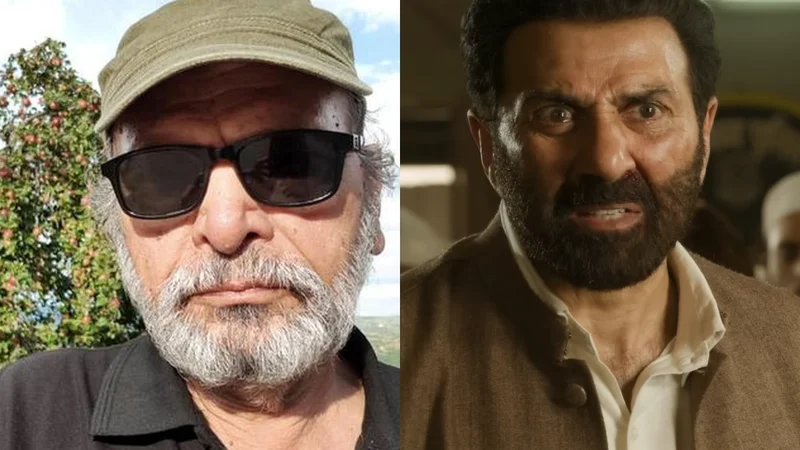
The story of an unexpected home, an unyielding mother, and a bond that defies a line drawn in blood, Syed Asghar Wajahat’s Jis Lahore Nai Vekhya, O Jamyai Nai remains a timeless exploration of compassion, identity, and what truly makes us human. This Independence Day, the celebrated Hindi play will get a cinematic life as filmmaker Rajkumar Santoshi brings the characters that have become familiar names on stage across the world in Batwara 1947, his adaptation of Wajahat’s most popular work.
As we discovered with the quiet success of Main Vaapas Aaunga, the unresolved trauma of Partition remains one of the most potent and enduring themes of our art. We could hear an echo of Wajahat’s voice in Imtiaz Ali’s film. Wajahat, whose mellow exterior hides a deeply sensitive soul and whose tentative half-smile holds a quiet reservoir of human insight, says Partition as an idea has not been discussed enough in Indian society.
“There has not been a discourse between hard Hindutva and soft Hindutva. There has been no discussion in the public domain where Hindus and Muslims shared their grievances. Only politicians across parties have exploited the sentiments. That is why it remains unresolved, and that’s why wounds remain fresh. Not many people read literature. The confidence-building must emanate from within the communities,” says the Hindi scholar who retired as the head of the Hindi Department of Jamia Millia Islamia.
Written in the 1980s, Jis Lahore… was first staged by Habib Tanvir and then took the theatre world by storm. Even today, hardly any month passes when the Mirzas, the Maulvi and Mai don’t make their voices heard in some part of the world. Wajahat remembers that since the first production in 1989, many filmmakers were keen on securing its rights. “Eventually, Govind Nihalani took the rights. But for the next seven-eight years he could not make it.” Then one day, noted playwright and screenwriter Ranjit Kapoor told him that Rajkumar Santoshi was eager to make a film on the play. “As Govindji was his guru, Santoshi was sure that he would pass on the rights, but Govindji refused. Ultimately, I had to step in to request him. He agreed, but a new issue emerged.”
Santoshi, whose last film Gandhi-Godse-Ek Yudh was also an adaptation of Wajahat’s play, is known for big-scale, larger-than-life cinema with strong subjects. He saw in Jis Lahore a 100-125 crore film, but the producers, Wajahat says, were not willing. “They pushed him to make a small film. By the time we had also reached a period where violence, sex and jingoism became parameters to green light a big project. Eventually, it was Aamir Khan, who could see box office potential in offbeat subjects, who decided to back the film,” says Wajahat.
Set during the Partition, the plot of Jis Lahore revolves around the Mirzas, a Muslim refugee family migrating from Lucknow to Lahore. They are allocated a sprawling haveli left behind by a Hindu family, only to find an elderly Hindu woman still living inside. She fiercely refuses to leave her home and, over time, develops a bond with the Mirzas, much to the chagrin of the fanatics. Wajahat, who grew up on the farms of Fatehpur in Uttar Pradesh before moving to Aligarh Muslim University for education, says Lahore had its own charm: once upon a time, it was the biggest centre of education, fashion, and music in the North, nurtured by the British on the lines of Calcutta. But the Mirzas are besotted with Lucknow.
Wajahat was moved by the poetry of Nasir Kazmi, who had migrated from Ambala and captured the psychological grief of losing one’s home in his ghazals. For him, Ambala was everything. ‘Ambala Ek Shehar Tha, Main Hun Usi Mite Huye Kareene Ki Roshni (Ambala was a city; I am the flickering light of that erased civility),. “I had also read memoirs of people, some of whom were distant relatives from Fatehpur, who were forced to shift by circumstance or due to the unwritten orders of the government. I was also triggered by M.S. Sathyu’s Garm Hava, which also has an old lady who refuses to cross the border.”
Mai, or the mother, he says, is central to his story and is the unifying factor between the two communities. Wajahat underlines that in his work, mother is not an abstract concept like a particular ideology tries to present her. “Every creative work demands conflict. So I created a fanatic who sought division in the name of Islam. The communalist is offset by a Maulvi who speaks of the true meaning of the holy book. And in between, I slipped in a real-life poet. When he was on his deathbed, Kazmi gave a long interview where he questioned the formation of Pakistan. This blend of four points of view created a space for the play in popular imagination. For Kannada theatre practitioners, Partition is not their lived reality, but I found out they stage it regularly. Human emotions appeal to everybody.”
Wajahat admits there is a change in the presentation of Sikandar Mirza, played by Sunny Deol, but praises Santoshi for keeping the thrust of the play intact. “The thought, action and emotion have translated effectively. Sunny has an image that needs to be catered to; otherwise, his fans will get disappointed. My Sikandar is not as strong.” Had he been, he would not have had to leave Lucknow. He would have punched sense into the heads of the people. Wajahat laughs. “I don’t see my words as verses of the Gita and Quran. It is a medium of expression. When it travels to another medium, the thought should fulfill the requirements of that medium. The most important thing is that the spirit of tolerance, coexistence, and human relationships is intact.”
All praise for the dedication and devotion of Shabana Azmi in essaying the mother of Rattan. Wajahat, who was present on the sets, says she would perform the whole night covered in blankets in the humidity of Mumbai. “And at dawn, moved by her performance, when the entire crew would clap, she would call up Santoshi for his nod and offer to repeat the process the following night if it didn’t match the standards they have set.”
However, certain standards are still brittle. For someone who battled stereotyping of a Muslim Hindi writer all his life, Wajahat says he found it amusing when the costume department gave the poet Kazmi a cap. “Both Santoshi and I had a laugh.”
Batwara 1947 will be released in theatres on August 14
Published - August 04, 2026 12:47 pm IST