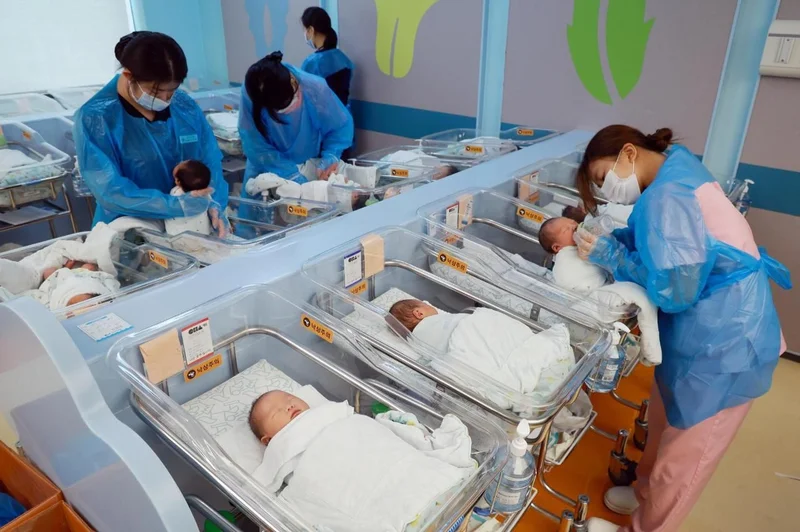
Korea’s rebound in births is reviving interest in the market for prenatal insurance, prompting insurers to broaden coverage and introduce new policy riders as they compete to lock in young families as long-term customers, according to industry officials, Tuesday.
Over the January-May period, 122,694 babies were born, up 15.2 percent from the same period a year earlier, according to the Ministry of Data and Statistics.
The country’s total fertility rate — the average number of children a woman is expected to have over her lifetime — also rose to 0.85 in May from 0.75 a year earlier. The improvement has been attributed in part to a postpandemic rise in marriages and a temporary increase in the number of women in their 30s, the country’s prime childbearing years.
In light of this, insurers are stepping up competition in the prenatal insurance market.
The product is typically structured as a children’s insurance policy purchased during pregnancy, with optional riders covering risks before and after birth, such as congenital disorders and premature birth.
For companies, these policies are an effective way to secure customers early. Because they naturally convert into children’s insurance plans that remain in force for 20 to 30 years after birth, winning a customer during pregnancy often translates into a long-term relationship.
Demand has already been picking up. The country’s 10 major nonlife insurers sold 482,586 policies last year, up 9.7 percent from a year earlier.
Insurers are responding by broadening both fetal and maternal coverage.
Hyundai Marine & Fire Insurance, which has been the market leader for two decades, has expanded its flagship children’s insurance policy to cover not only congenital abnormalities and newborn hospitalization, but also complications affecting expectant mothers, including preeclampsia and placental abruption.
DB Insurance offers coverage for extremely low-birth-weight infants and related hospitalization, while also providing riders for pregnancy- and childbirth-related medical treatment.
Samsung Fire & Marine Insurance has likewise expanded optional coverage for pregnancy and childbirth risks affecting both mothers and newborns.
Still, industry observers caution against reading too much into the recent rebound in births, saying it is too early to conclude that Korea’s long-term decline in fertility has reversed.
Some demographers argue the statistical increase reflects a temporary demographic bulge, as the relatively large cohort born between 1991 and 1996 enters its peak marriage and childbearing years, rather than a lasting improvement in the country’s population outlook.