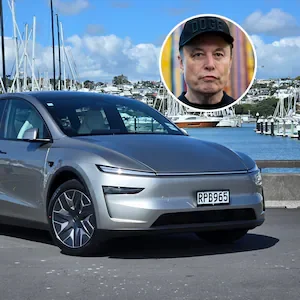
Pent-up demand for the refreshed Tesla Model Y has helped to offset political backlash against Tesla chief executive Elon Musk (inset). Photos / David Linklater, Getty
Pure electric and plug-in hybrids accounted for more than one in three new car sales in New Zealand during July.
But the market was near-flat overall, according to Motor Industry Association (MIA) figures, with 11,663 new vehicles registered. The total was 25 (0.2%) more than in July 2025 as commercialvehicle sales fell sharply.
The figures reflect vehicles delivered to buyers, rather than those ordered or sitting on lots.
The EV segment continued its recent boom, which began after February 28 as the Iran conflict led to a spike in petrol and diesel prices, despite the war easing and fossil fuel prices coming off their highs.
In the passenger vehicle segment, battery electric vehicles accounted for 22.3% of sales and plug-in hybrids for 14.4%, giving the two technologies a combined share of 36.7% in July.
Year-to-date, battery electric and plug-in hybrid passenger vehicles represented 28.5% of new registrations, more than double the 12.8% share at this point last year.
On track for new sales record
The figures put electric vehicle sales on track for a new annual high in market share.
EV sales surged to just over 20% of the market in 2023 at the height of the clean car discount, which offered a rebate of up to $8265 on a new EV, before halving in 2024 as the rebate was axed and road user charges were introduced.
Tesla’s well-reviewed, refreshed Model Y was again the top-selling EV. Elon Musk’s company recorded a bump in revenue worldwide in the June quarter, but investors were disappointed at a profit miss and delays to its robotaxi rollout and other projects, which meant its stock, down 26.5% for the year, continued to slump.
Along with SpaceX’s dive from a post-IPO closing high of US$201.80 (about $344) to a recent US$104.83, Musk has lost his world’s-first-trillionaire status and is now worth “only” US$690 million, according to Forbes’ real-time wealth tracker.
Zeekr, brought into New Zealand to bolster Giltrap Group’s expanding EV line-up, had the second best-selling model in July.
Commercial vehicle slump
“The July result reflects a resilient market, but with increasingly divergent performance across vehicle segments,” MIA chief executive Aimee Wiley said.
“Strong passenger vehicle registrations offset a significant decline in commercial vehicle registrations during the month.”
Light commercial registrations fell by 28.2% from a year ago and heavy commercial registrations were 20.9% lower.
EVs only have a marginal share in the heavier vehicle categories.
Wiley is cautiously optimistic about the overall market.
“The broader economic outlook is gradually improving, creating a more supportive foundation for new vehicle demand over time,” she said.
“Lower fuel cost pressures and a more moderate interest rate outlook are expected to improve affordability and support household purchasing and business investment.”
Top-selling pure EVs in NZ in July
Tesla Model Y: 403
Zeekr 7X: 151
BYD Atto 3: 131
Geely EX5: 111
BYD Sealion 7: 99
Top-selling plug-in hybrids
Toyota RAV4: 515
GWM Haval H6: 105
BYD Sealion 6: 131
BYD Sealion 8: 93
BYD Sealion 5: 49
Top-sellers overall
Ford Ranger: 738 (July 2025: 837)
Toyota RAV4: 699 (600)
Toyota Hilux: 608 (868)
Tesla Model Y: 403 (103)
Mitsubishi Triton: 335 (276)
Source / MIA
Chris Keall is an Auckland-based member of the Herald’s business team. He joined the Herald in 2018 and is the technology editor and a senior business writer.