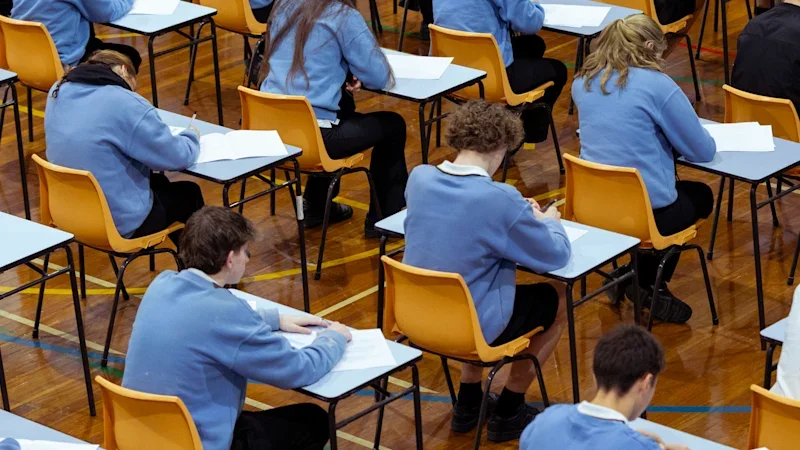
Ranking schools has never been a reliable measure of educational quality because it tells us far more about who enrols than what a school actually contributes (“Hidden truths of HSC data keep us all in the dark”, March 4). Schools with selective entry or affluent communities will almost always outperform schools serving disadvantaged communities, regardless of the quality of teaching. Publishing more HSC data, as advocated in your editorial, simply creates more sophisticated league tables that reward student intake rather than educational excellence. A meaningful assessment of schools would focus on the value they add: how much students improve over time, how effectively schools support diverse learners, student wellbeing and post-school pathways. Parents indeed deserve better information, but reducing schools to exam rankings reinforces a narrow definition of success. Education should be about growth, opportunity and equity, not another annual competition for the top of a league table. Denise McHugh, Tamworth
Your editorial rightly calls for clearer educational reporting, but its core assumption that the best system is simply one that offers “real choice” falls short. Choice does not intrinsically make a system “best” unless we ignore equity and shared community well-being in favour of a market-driven system. Furthermore, publishing raw HSC averages or median ATARs across sectors will still fail parents. Without adjusting for socio-educational advantage and structural selection bias (inherent in both selective public and fee-paying independent schools), league tables merely measure who enters a school, not what the school adds. If the Herald truly wants to illuminate educational performance, it should advocate for value-added metrics rather than pushing raw data, which simply turns Sydney’s socio-economic map into a school ranking. Richard Davies, Paddington
There is more to education than HSC data. Schools and parents, as well as Herald readers, have become obsessed by it. Teachers are made to feel failures if their Year 12 class fails to get enough Band 6 results to satisfy expectations, despite the fact that there is little between a mark of 89 and one of 90, except a mention in the newspaper. Education means much more than that. For many boys, their sports are the pinnacle of high school experience, for others it is the friendships they make. Girls are often very eager to meet expectations of parents and teachers, but many struggle with fear of failure. High school experience should be more rounded than this, and public schools are as much to blame, if not more so, because of the selective system and grading within most schools. Education is more than STEM, and more than HSC rankings, yet we have become driven by those lists in the paper. Vivienne Parsons, Thornleigh
It is naive to suggest that school choice for families is increased merely with greater information. For most families, HSC “leaderboards”, school rankings or even average student marks have little bearing on where their children are sent to school, with the concept of choice a mere fantasy. Lack of alternative schools in regional, country and new growth areas denies families choice. The best education system is not one that merely offers “real choice” as your editorial suggests, but one that delivers for all, equitably across sectors and with funding that levels the communities within it. Janice Creenaune, Austinmer
God’s grace
There is a parallel between the decline in support for the Liberal Party and its exposure of ultra-conservative Christian organisations whose predominantly covert activities to support the Liberals suggest misconduct. The Catholic movement Opus Dei appears to have had a strong influence on the actions of the Liberal Party’s Reformers group, whose actions are now being exposed by the ICAC. Far from being a “factional hit job”, as claimed by Tony Abbott, the ICAC is NSW’s saviour, and potentially Australia’s political rescuer (“Abbott says ICAC a factional hit job as Taylor faces questions”, August 3). The Plymouth Brethren also supports the Liberal Party. Its descent on voting booths at the last federal election was counter-productive. The Labor Party’s subsequent landslide victory was of biblical proportions. In truth, the Liberal Party, state and federal, is on the nose. Its self-destruction continues as it embraces extreme Christian groups with Tony Abbott as its president. It is now in a death spiral. Australia needs an alternative, credible opposition party to preserve our democracy. That rules out One Nation. Therefore, the Liberals urgently need a stable statesman as leader. Step up, Andrew Hastie, it’s past time. Gerardine Grace, Leura
Tony Abbott’s politically driven attack on the ICAC is particularly unwise. Evidence to date has included allegations of covert meetings, phones deliberately left behind, discussions about co-ordinating accounts, prohibited donors and false invoices. These are allegations still being tested, not findings of corruption, but they are plainly matters that an anti-corruption commission is entitled to investigate. Dismissing the entire inquiry before it concludes is not ethical leadership, it is factional advocacy dressed as judgment. (Heard in the corridors of federal opposition: “Ethics is a small county immediately to the east of London”.) Bill Leigh, West Pennant Hills
Shortly before the ICAC Commissioner accepted the suggestion by the counsel assisting that it was a suitable time to pause her cross-examination of shadow attorney-general Damien Tudehope, it was amusing to see him described in the audio stream as Mr Chewed Up. This was most apt considering the stress he’s been under during his meticulous grilling by Peggy Dwyer, SC. Louise Dolan, Birchgrove
Stop the abuse, now
National Child Protection Week in September should focus a “whole-of-Australia” blowtorch on the festering sickness of child abuse in our society (“Abuse of children is ‘an epidemic’”, August 3). The callout by NSW Police Assistant Commissioner Scott Cook replicates and sadly adds to the latest recommendations of yet another Queensland inquiry into the state’s child protection system. Ten-year-old delinquents are treated as grown men who understand the consequences of their anti-social and destructive behaviour: remand, jail, and a life destroyed. Rehabilitation in the absence of habilitation is ineffective. The Northern Territory, with a horrific history of systemic racism and child detention, is poised to ignore community fears that it will take more children away from their families. What happens in the NT affects all of us. Protecting Australian children from harm is a national priority deserving of a Human Rights Act. Federal leadership is essential. This current real-life crisis needs more than the inadequate, inappropriate piecemeal state and territory policy and resourcing. The rights of the child are cruelly breached every day, in every part of the nation. It must be stopped. Frederika Steen, Chapel Hill (Qld)
What’s good for the gander ...
It seems reasonable for our mainstream legacy news publishers to expect some payment when their original material is repurposed by online outlets, but that principle cuts both ways (“Late changes to tech giant rules anger publishers”, August 4). For more than 20 years, journalists have been using free services such as Google and Wikipedia to complete research tasks in minutes that would have taken them far longer in the pre-digital era. Those short-cuts save their publishers huge amounts of staff time and money. Meanwhile, social media platforms provide editors with an endless source of quotes and images to use. Attempts to set truly fair net monetary values, or revenue shares, on this unregulated (and unmeasurable) interchange of content are on shaky logical ground. David Salter, Hunters Hill
Renters under a bus
I agree with your correspondent that the May budget has thrown renters under the bus and the media has abandoned them (Letters, August 4). New investors have been effectively excluded from existing properties to increase housing supply, which will force up the prices and rents of new stock. Meanwhile, many existing investors are selling this year to avoid the increase in capital gains tax. Renters are facing a perfect storm of reduced supply and increasing rents. William S. Lloyd, Denistone
Grounded jet set
To remain in controlled airspace, aircraft operating from Western Sydney International Airport must maintain a minimum altitude of 4000 feet over most of the lower Blue Mountains, increasing to 6000 feet from about Lawson westbound. Your correspondent, who considers this “an assault on the health and wellbeing” of Blue Mountains residents (Letters, August 4), must be devastated for people living in Sydenham and Kurnell, who regularly have A380s pass overhead below 1000 feet. As for jet fuel “spraying over people, flora and fauna”, I wouldn’t be too concerned about that until dumping fuel at low altitude becomes more economically viable than simply burning it in the engines. Col Burns, Lugarno
Modern slavery
After watching this week’s Four Corners investigation into modern slavery and the global food industry, I can’t help but agree (surprisingly) with Donald Trump’s criticism of Australia for not doing enough to stop forced labour. Slavery might not exist as it did in America, but we are paying slave wages to migrant workers who live in appalling conditions. As the program proceeded, I was crossing off my shopping list all the produce these workers picked and packed. By the end of the show there was hardly anything I could eat in good conscience. It seems a pity that this subject was not on the agenda of the Labor Party’s recent conference. Carole Hayes, Newtown
A toll on us all
Giant corporations must relish the opportunity to deal with governments in Australia. Look at the agreement between the NSW government and toll road operators – another glaring example of the failure of privatisation (“Tolls cut on Sydney’s motorways after billion-dollar negotiations”, August 3). Since their inception, toll roads have led to a massive increase in traffic congestion and prohibitive charges. The savings from the latest deal won’t even cover the cost of a coffee to a regular user, yet the cost to taxpayers is about $1 billion. The WestConnex, which services the fastest-growing areas of Sydney, is excluded from the deal, with the minister admitting it was “too big and too complex” to get a deal for taxpayers. In other words, the operator knows this is their pot of gold and refuses to give any of it up. **Mike Kenneally, Manly **
The irony of the opposition now citing certain figures regarding toll road charges is not lost on this little duck. It was the Berejiklian Liberal state government that did a deal with Transurban when the M8 motorway opened. The original M5 East between King Georges Road and Marsh Street had been free. However, Transurban won the lottery under the Berejiklian government whereby it could charge tolls on the already existing piece of free infrastructure. So, for the past six years, motorists have paid for a “wait for it, there’s more” deal executed by the Liberal state government. Coalition transport spokeswoman Natalie Ward should do some homework. **Bernadette Scadden, Earlwood **
Plastic future unclear
It’s good to see companies moving away from plastic packaging, but disappointing that federal and state governments are failing to agree on national packaging standards or harmonise their bin collection systems (“The new products popping the plastic bubble”, August 4). Clothing does not need to be made of plastic, yet so much of it is. It is extremely difficult, if not impossible, to recycle. Why is the federal government failing to act to address this large, and growing, source of micro and nano plastic pollution? Jill Robinson, Randwick
It’s excellent news that companies are finally making progress on plastic‑free packaging, but the fact that more than a million tonnes of fossil fuel-derived polluting plastic packaging still ends up in landfill every year is a national disgrace. The Albanese government has had four years to deliver mandatory national packaging standards and has failed to do so. Australia needs clear standards, genuine plastic replacements and plans to reduce and even eliminate packaging altogether. Until national standards are in place, our packaging system will remain a monument to waste. Karen Lamb, Geelong (Vic)
I was in Malaysia recently and found the drinking straws they use there are made from rice. After 20 minutes in liquid, the straw becomes soft and eventually totally dissolves. Alternatively, you can eat it. Keith Masnick, Woollahra
At oil’s behest
Rodger Shanahan writes that no one really understands why Donald Trump went to war with Iran (“Trump’s ‘short war’ is spiralling out of control”, August 3). The answer is simple: to repay the US oil interests who contributed heavily to his election campaign. The average price of oil has been higher and American oil output has massively increased since it became too risky to ship oil through the Strait of Hormuz. Rich Americans who own the oil companies have been making out like bandits. “Drill, baby, drill, and Trump will give you billions at the expense of everyone else.” The irony is that the higher oil prices are also a windfall for the Chinese government – a reward for their investment in electric vehicle production. Alan Stanley, Upper Corindi
We now have the Gulf states considering paying a shipping toll in the Strait of Hormuz, a consequence of Trump’s idiotic war, so they can sell oil again at an inflated price that includes the added toll cost. This, of course, will speed up the world’s drive away from oil and into electric vehicles. Trump may have inadvertently done something good for our environment after all. Who would have thought? Chris Hornsby, Warriewood
Close tax loophole
With Qantas wanting to throw another 1000 Australians on the scrap-heap to make even greater profits, perhaps it is time to change taxation laws so that the costs of those offshore contracts can no longer be claimed as a business tax deduction in Australia (“Qantas mulls offshoring up to 1000 jobs to India”, August 4). Graeme Finn, Campsie
- To submit a letter to the- Sydney Morning Herald, email letters@smh.com.au. Click here for tips on how to submit letters.
- The Opinion newsletter is a weekly wrap of views that will challenge, champion and inform. Sign up here.