Your support helps us to tell the story
From reproductive rights to climate change to Big Tech, The Independent is on the ground when the story is developing. Whether it's investigating the financials of Elon Musk's pro-Trump PAC or producing our latest documentary, 'The A Word', which shines a light on the American women fighting for reproductive rights, we know how important it is to parse out the facts from the messaging.
At such a critical moment in US history, we need reporters on the ground. Your donation allows us to keep sending journalists to speak to both sides of the story.
The Independent is trusted by Americans across the entire political spectrum. And unlike many other quality news outlets, we choose not to lock Americans out of our reporting and analysis with paywalls. We believe quality journalism should be available to everyone, paid for by those who can afford it.
Your support makes all the difference.
Read more
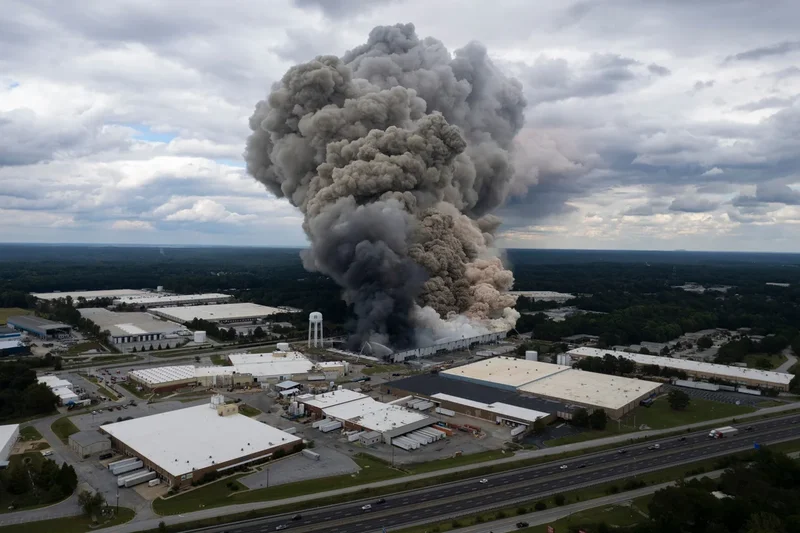
More than twice the amount of swimming pool chemicals as planned were improperly stored at a Georgia plant, setting conditions for a fire in 2024 that sent a huge plume of orange and black smoke into the sky and forced residents to shelter in place, a federal agency report concluded.
The U.S. Chemical Safety and Hazard Investigation Board found that components of a sprinkler system inside the BioLab plant “had been experiencing significant corrosion and leaking” since 2019. That was shortly after the company began storing the chemicals at the plant, the agency said in its final report on the fire Tuesday.
The huge sacks “would naturally off-gas chlorine fumes that combined with ambient humidity in the warehouse and condensed as hydrochloric acid droplets” on the metal sprinkler heads, the report said.
During a sprinkler inspection in December 2023 at the plant in Conyers, about 25 miles (40 kilometers) southeast of downtown Atlanta, over 1,100 sprinkler heads were found to be corroded, it said.
On the day of the fire, Sept. 29, 2024, a corroded sprinkler system component failed. Water came into contact with the chemicals and set off a decomposition reaction that generated heat, causing the release of smoke, toxic vapors and fire.
“The conditions and circumstances at the Bio-Lab Conyers warehouse were completely unacceptable,” Steve Owens, board chairperson, said. He said about 14 million pounds (6.3 million kilograms) of reactive chemicals were stored without proper safeguards.
“These hazardous chemicals were packaged in roughly 5,000 giant sacks, each weighing more than a ton, and some of them were stacked in such a way in the warehouse that responders were not able to keep the initial situation from developing into a catastrophic fire and massive plume of toxic smoke that put thousands of people potentially at risk.”
BioLab makes chemicals that kill algae and bacteria in water, primarily for swimming pools and hot tubs. The company is a subsidiary of Lawrenceville, Georgia-based KIK Consumer Products.
The company decided last year not to rebuild the plant. It was cited by the U.S. Department of Labor for six violations, including four serious ones, and more than $60,000 in proposed penalties.
The board called for expanded regulatory coverage of the chemicals.
A BioLab spokesperson said in an emailed statement that the company cooperated fully with the board and is reviewing the final report.
“We will carefully consider its recommendations as part of our ongoing commitment to safety and continuous improvement,” it said. “The health and safety of the communities where we operate is a top priority, and we worked collaboratively with first responders and relevant authorities to complete the emergency response in October 2024.
“We also completed the clean-up of the site affected by the fire and established resources dedicated to supporting area residents and business owners.”