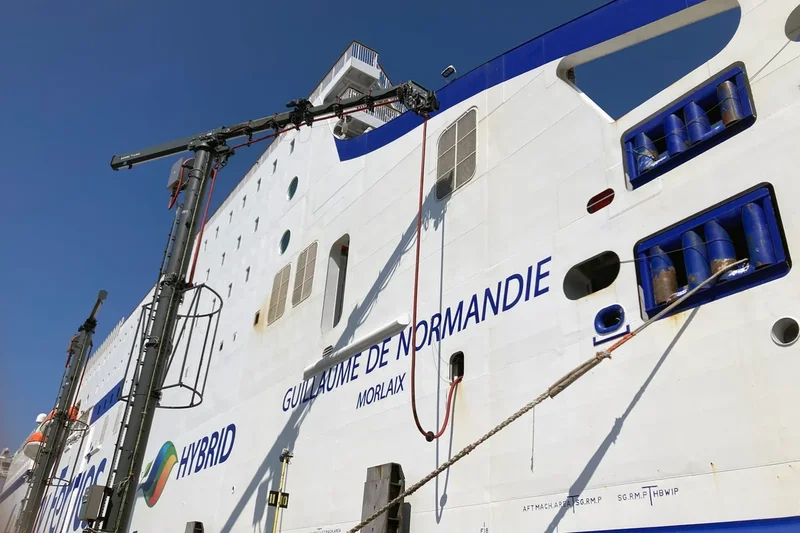
The first cross-Channel ferry has left the UK for France charged with electricity from Portsmouth quayside.
Brittany Ferries’ liquified natural gas (LNG)-electric hybrid vessel Guillaume de Normandie departed for Caen on Monday morning after two hours of charging at Portsmouth Port’s new £24.4 million shore power facility.
The system allows ships to switch off their engines and plug into electricity when berthed to cut carbon emissions and noise pollution while recharging batteries.
Vessels including Guillaume de Normandie can then use electric power to manoeuvre out of Portsmouth Harbour for Normandy.
The ships will then switch to hybrid LNG-electric once clear of the port entrance on the route to the eastern edge of Sword Beach.
Sister ship Saint-Malo will also be able to recharge its batteries at the facility following two months of shore power testing at the port.
Three large ships can plug in at the same time, using the equivalent amount of electricity as half the entire city, according to the BBC.
Brittany Ferries said that plugging in at the port “costs more than running engines” due to high electricity costs and connection charges.
The ferry service thanked Portsmouth International Port for reaching a 12-month-long deal to help offset some of the additional cost.
Christophe Mathieu, CEO of Brittany Ferries, said: “This is a huge milestone for our business, and one that we’ve reached thanks to a team effort by all partners involved. It means we can now realise the full potential of the greenest vessels in our fleet. We’re better neighbours to Portsmouth, and we’re leading the sector on sustainability.
“But this doesn’t come without a cost. We’re urging the new government to consider tax breaks to offset the additional expense of plugging in while alongside. Without that support, the lead taken by Portsmouth International Port and Brittany Ferries is unlikely to be followed by others in the drive to net zero.”
Read more: ‘Urgent’ government support needed to help UK aviation meet net zero by 2050