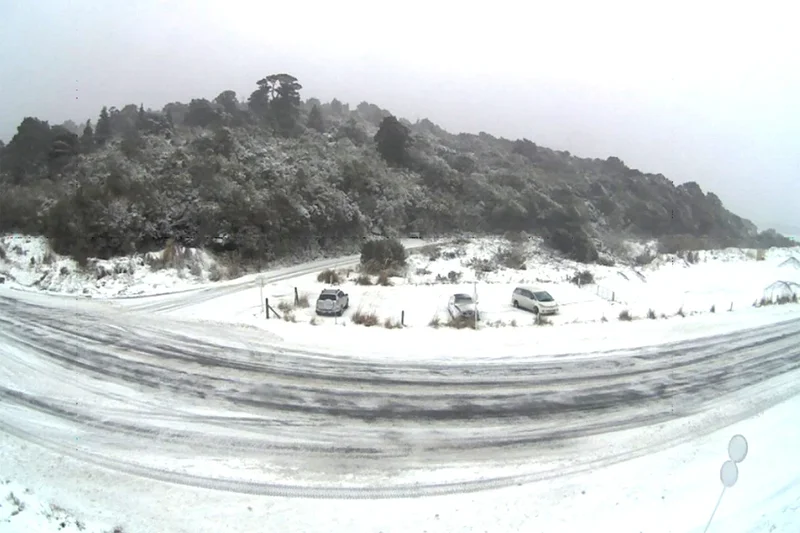
An Antarctic polar blast swept across New Zealand's South Island on Tuesday, bringing snow to sea level and freezing temperatures that led to widespread road closures and school disruptions.
Dunedin, the South Island's second-largest city, was blanketed in snow, prompting police to issue urgent warnings for residents to avoid non-essential travel due to treacherous icy roads.
New Zealand Police wrote in a social media post: "Police have received a number of reports of crashes across Dunedin this morning, with some vehicles sliding off the road. Thankfully, there have been no injuries."
Amidst the disruption, striking scenes emerged as skiers and snowboarders took to Dunedin's Baldwin Street, which is known as the world's steepest residential street.
Further north, snow was seen on the sand at Christchurch's New Brighton Beach.
Snowfall at sea level is uncommon for Dunedin, though its hill suburbs occasionally experience it during severe cold snaps.
Authorities confirmed the cancellation of all bus services within the city, while ferry crossings between New Zealand's North and South islands were suspended due to powerful winds and heavy swells.
MetService, the country’s weather bureau, anticipates the cold snap will persist for another two days, bringing further snow or sleet to near sea level across the eastern South Island.
Thursday morning is forecast to deliver the coldest temperatures of the year for many regions across the country.
New Zealand has had a winter of wild weather.
In late June, a storm knocked out power to thousands of households and triggered floods and landslides.
MetService issued multiple severe weather warnings as a low-pressure system swept across the country.
It warned of heavy rain and gusts up to 120kph after recording winds exceeding 150kph in parts of the country overnight.
The storm forced the cancellation of 200 flights in and out of Wellington, the nation’s capital.
Earlier in June, Wellington waterfront residents were ordered to evacuate their homes after a state of emergency was declared over a “significant swell”.
Emergency management spokesperson Dan Neely warned people to avoid beaches and coastal areas.
“The sun might be shining, but the swells could bring debris and surface flooding to roads, especially around high tide at midday,” he said.
“The public is urged to avoid Wellington’s south coast roads as well as coastal roads around Wairarapa. Extreme caution should be taken if you have to drive on these roads.”