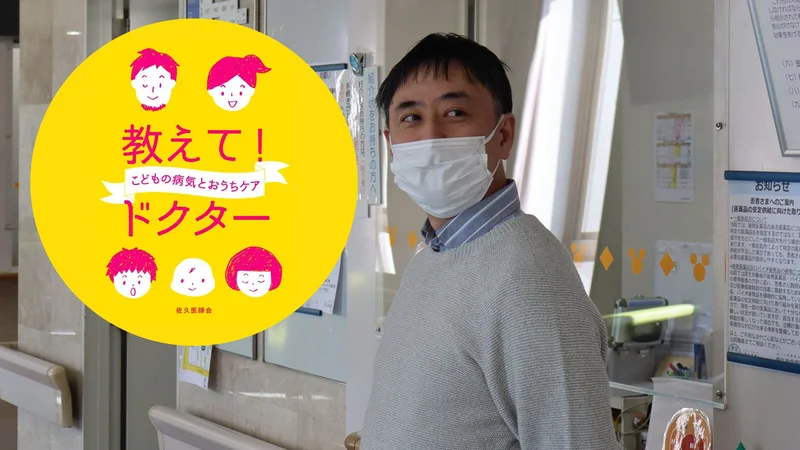
'A silent pandemic': How Japan is curbing antibiotic resistance, $5 at a time
This is the fourth story in a series about antibiotic use in Japan and the U.S. I've explored how a Japanese program reduces antibiotic misuse, what research shows about the social dynamics behind the problem, and what pediatricians and parents think about the issue. Now, I'll spotlight a doctor with a passion for educating parents about children's health. This report was supported by a fellowship from the Association of Health Care Journalists and The Commonwealth Fund.
One winter night in 2011, pediatrician Dr. Masahiko Sakamoto met two parents and a feverish infant who would shape the course of his career.
Sakamoto was working at a rural hospital in Japan's Fukushima prefecture, roughly 160 miles (260 kilometers) northeast of Tokyo. Around midnight, as a heavy snowfall coated the ground outside, two parents arrived with their young child. The infant had a mild fever but was otherwise in good shape, Sakamoto determined. There were no signs of an emergency that warranted a doctor's attention.
Then, Sakamoto learned that the parents had driven 1.5 hours from a small mountain village to reach the hospital.
"Driving a car, with such snow accumulated on the road — that's a very risky behavior," Sakamoto said. He told me he was shocked by the "imbalance" between the infant's mild case and the parents' decision to make a three-hour round trip on dangerous roads out of concern that their child might need emergency medical care.
The experience alerted Sakamoto to a broader pattern: Parents with a limited understanding of childhood illnesses can become especially anxious when their child gets sick and end up seeking unnecessary medical care. Pediatricians in both Japan and the U.S. have described a similar trend to me in the context of antibiotics; parents sometimes request antibiotics that aren't needed, in part because they believe the drugs will alleviate their child's suffering.
Many doctors make the effort to explain the basics of childhood illnesses and appropriate antibiotic use to children's caregivers. But given that they're pressed for time and those conversations can be tricky to navigate, doctors told me that it would be helpful if parents came to appointments equipped with that information. Since that snowy night, Sakamoto has made it his mission to help educate parents about childhood illnesses before they arrive at a medical facility.
"What I am currently most interested in as a pediatrician," he said, "is how to provide accurate medical information to the parents or guardians of the children."
Sakamoto is based in the department of pediatrics at Saku Central Hospital, located in the highland city of Saku.
The pediatric department of Saku Central Hospital, where Sakamoto has worked since 2014.
Materials at the pediatric department's check-in desk, including educational materials for parents co-written by Sakamoto and a book featuring the story of how Sakamoto became a pediatrician (left).
Sakamoto and I (left) meet for lunch in Saku. The region is known for Shinshu soba, a type of thin noodle made from buckwheat.
Building a pocket-size doctor
By the time parents arrive at a doctor's office or hospital, the chance to avert an unnecessary visit has been missed, Sakamoto recognized. So he wanted to help give caregivers the information needed to weigh whether a visit is necessary. He hoped to relay which symptoms of serious disease should prompt medical intervention and teach them appropriate at-home care for mild symptoms.
He started giving public lectures on these topics. Later, he wrote manuals of childhood illness, featuring adorable illustrations and plain-language explanations. In 2016, those manuals went digital. The free "Oshiete! Doctor" app, whose name translates to "Teach me! Doctor," has been downloaded more than 500,000 times in Japan, with approximately 100,000 active users, Sakamoto told me.
"It's quite famous around here," Risa*, a mother of two in Saku, Japan, said of the app. Sakamoto now works at Saku Central Hospital, and the city provides funding for the app's operation and promotes its use at health centers and events aimed at children and their caregivers.
"As a parent, I'm really grateful to have something like that — a resource that makes it easy to access information — right at my fingertips," said Rie Shinohara, another mother of two in Saku.
The app's content gets updated annually and applies to children and teens up to about 15 years old. It provides information on hygiene, immunization schedules and disaster preparedness, such as how to care for kids' health while evacuating for a natural disaster. (The team translated the app's disaster preparedness content for caregivers affected by the war in Ukraine.)
The app also includes guidance on when children should visit a hospital and explanations of common childhood illnesses and injuries, such as what medications might reasonably be prescribed and how to manage mild symptoms at home.
For similar help with differentiating emergencies from minor ailments, parents in Japan can also look to online resources from The Japan Pediatric Society, or call #8000, a hotline that gives caregivers advice about whether to bring their child to a hospital. Japan's Ministry of Health, Labour and Welfare has recognized the "Oshiete! Doctor" app as a helpful complement to its national #8000 hotline and also awarded the app's developers for its design and impact.
Sakamoto and colleagues have studied the app's impact on caregivers. For instance, they've found evidence that app users utilize the emergency department more appropriately than nonusers do. In that study, 87% of users said the app made it easier to decide whether to visit the hospital, and 94% said they'd recommend it to others.
Challenges of educating parents
The team has also studied how the app's users feel about fever — the symptom that compelled the infant's parents to drive on snow-laden roads that night.
"The phenomenon known as 'fever phobia' among parents has long been recognized, and it is not unique to Japan," Sakamoto said. Notably, the American Academy of Pediatrics offers similar guidance to the "Oshiete! Doctor" app regarding fever, emphasizing that the symptom doesn't always require medical care and giving tips for when a doctor should be called.
Parents' worries about pediatric fever can be outsize compared with the threat it poses. Most fevers in kids are caused by viral infections that go away on their own, Sakamoto said, but caregivers can be compelled to seek care because they're concerned about fever triggering seizures or brain damage. This is especially true of first-time parents and parents with other children who'd had febrile seizures in the past, he added.
"With the first child, you just don't know. Why does he have a fever?" Shinohara noted. Of her firstborn, she added, "I probably took him to the doctor more often than necessary." But by her second, she felt she developed a better sense of when to seek medical care. Sakamoto's hope is that his app can help fill that information gap sooner.
The homepage of the "Oshiete! Doctor" app. The different buttons allow parents to contact emergency medical services; search for guidance by symptoms or disease name; review vaccine schedules; and access information about how to plan for natural disasters.
This page describes fevers. The topmost checklist includes criteria that indicate a child needs a doctor immediately; for example, it advises that children should be brought to a doctor if they are poorly responsive, unable to take in fluids, or under 3 months old and have a fever of 100.4 degrees Fahrenheit (38 degrees Celsius) or higher. If a fever doesn't meet these criteria for an emergency but lingers for three or more days, the child can be brought to a clinic during normal hours, it notes lower down.
This page explains that there's usually no need to rush to reduce a fever with medicines, such as acetaminophen, and that most fevers in children are caused by infections that clear on their own in a few days. However, it adds that fever accompanied by certain symptoms — repeated vomiting, lethargy and poor responsiveness — could signal an infection affecting the brain that warrants quick attention. A different page describes what to do in the case of convulsions, which can be brought on by fever in young kids.
In a survey-based study, Sakamoto and colleagues polled hundreds of caregivers in Saku about their understanding of fever, taking stock of which parents had downloaded "Oshiete! Doctor." Between 2017 and 2024, a greater proportion of parents understood that fever alone does not necessarily mean a child needs medical care. Plus, a lower percentage of parents thought that antibiotics are always needed to treat fever. On the latter point, users of the app were most likely to answer correctly, although nonusers also improved between the two survey years.
Sakamoto credits some of that improvement to the incentive offered to pediatricians to avoid unnecessary antibiotics, which requires that doctors explain appropriate antibiotic use to caregivers. He thinks the message is likely more powerful for parents when it comes from their pediatrician, rather than government information campaigns. That said, Sakamoto emphasized that it's important to have strong educational materials available to help support doctors' explanations to parents.
Despite these improvements, Sakamoto also observed that parental anxiety about fever complications increased between the two survey years — although, notably, the COVID-19 pandemic took place in that time frame, which could be a piece of the puzzle.
"Their knowledge about fever, how to manage fever, and also the appropriate use of antibiotics was enhanced, whereas the fear about the children's fevers worsened," Sakamoto said. "Even when knowledge improves, emotional anxiety does not easily disappear; this is one of the challenges of public education."
Related stories
Other challenges include the rising use of AI chatbots among parents, Sakamoto noted. He's encountered parents whose anxiety was triggered by erroneous information from a chatbot that suggested their child's prognosis was worse than it was, for instance. "It is rather rare to see that the parents have holistically accurate information from AI," he told me.
If he can secure more funding for "Oshiete! Doctor," Sakamoto hopes to someday make the app multilingual. In the long run, he remains committed to providing parents with this vetted information to both alleviate their worries and optimize their use of the healthcare system.
"We have the responsibility to check how the information is delivered to the parents or guardians and how it leads to behavioral changes," Sakamoto said. "So it is not just us disseminating information but whether or not it is truly received."
Editor's note: Risa (marked with an asterisk) asked that only her first name be used for privacy.
This article is for informational purposes only and is not meant to offer medical advice.
Nicoletta Lanese is the health channel editor at Live Science and was previously a news editor and staff writer at the site. She is a recipient of the 2026 AHCJ International Health Study Fellowship, with a project focused on antibiotic stewardship practices in Japan and the U.S. They hold a graduate certificate in science communication from UC Santa Cruz and degrees in neuroscience and dance from the University of Florida. Beyond Live Science, Lanese's work has appeared in The Scientist, Science News, the Mercury News, Mongabay and Stanford Medicine Magazine, among other outlets. Based in NYC, she also remains involved in dance and performs in local choreographers' work.