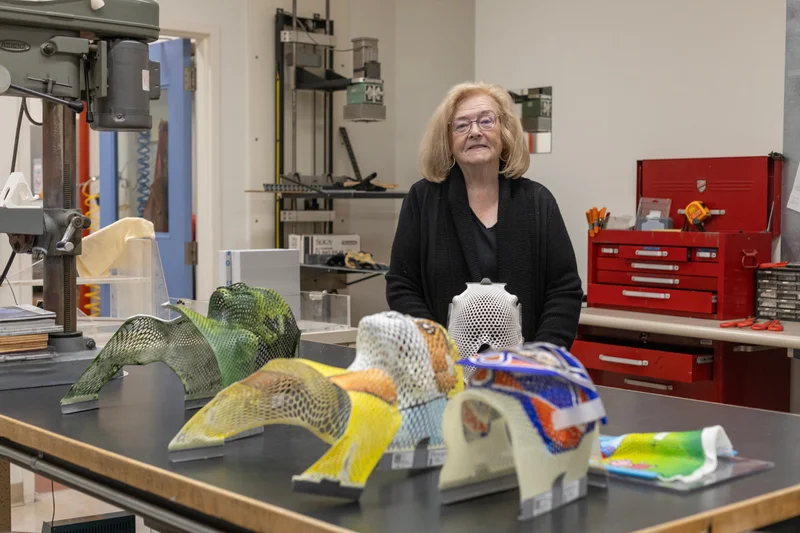
Before five-year-old cancer patient Karter Bourgeault began treatment, a volunteer at Edmonton’s Cross Cancer Institute spent hours painting his radiotherapy mask to model Oilers player Connor McDavid, with a bright blue and orange 97 emblazoned on what looked like a helmet.
The colourful mask was carefully placed over Karter’s head to help him stay still for each radiation session. His mom, Nicole Fraser, said wearing a mask inspired by his idol made the experience less scary for her son. She jokingly called him Karter McDavid.
Karter wore this mask – and, later, one inspired by former Oilers defenceman Tyson Barrie – to two rounds of radiation, totalling 41 sessions, in his fight against diffuse intrinsic pontine glioma, a rare and aggressive brain tumour. He died on July 23, 2023, at six years old.
But those masks, which were carefully moulded to the curves of Karter’s face, have helped preserve a part of him. Ms. Fraser and Karter’s grandad now keep one mask at each of their homes, running their hands along the plastic shell in times of needed comfort.
“I can touch my son’s face. I can kiss my son’s lips. And that’s a huge thing when your children are gone,” Ms. Fraser said, her voice shaking. “They mean more than people realize.”
Marilyn Kimura, 72, is the volunteer responsible for transforming the rigid thermoplastic shells into animated masks. Since 2019, Ms. Kimura has painted 52 masks for children between age two and 16, bringing comfort and joy to what can otherwise be a scary experience.
Pediatric patients can choose any design they want, from superheroes, sports teams and television characters to fantasy creatures, flowers and all sorts of animals. Two of her favourites have been Chase, a German Shepherd from Paw Patrol, and a piece that featured tons of vibrant butterflies.
Ms. Kimura described the masks, prior to decoration, as creepy, like something you “may wear at Halloween to scare the neighbours.” But with a palette of bright paints, she is able to provide patients with a one-of-a-kind shell that serves as a distraction or comfort.
“I made a cheetah mask for a little six-year-old girl, and I heard that she liked it so much she didn’t want to take it off, which was probably the first time in history that anyone has not wanted to take off one of these horrible, stiff, uncomfortable, claustrophobic things,” she said.
When children are more relaxed, so are their parents, which makes the job of radiation therapists easier.
Most pediatric cancer patients in Edmonton are treated at the Stollery Children’s Hospital but are referred to the Cross to receive radiation therapy.
There, the first person they’ll often meet is radiation therapist Brandon Aboughoche. He’s responsible for treatment preparation and making any needed accessories, including immobilization shells that attach to the table.
These mesh shells, designed to cover any part of the body receiving radiation, are made of a plastic polymer that softens like pasta when submerged in water. The material is then draped over a patient’s face, for example, and moulds to their features before cooling and hardening.
Mr. Aboughoche said most children feel intimidated at the initial appointment. One welcome distraction is when he tells them about how Ms. Kimura can customize their mask however they want.
“Usually, it stops them for a second, and all of a sudden, I notice that their eyes light up and they really start thinking about it. They usually get a smile on their face,” he said. “A big fan favourite is Oilers.”
Other requests have been for Peppa Pig, Lamborghinis, Elsa from the movie Frozen, family pets, unicorns – and the list goes on and on.
Ms. Kimura, whose career was in visual arts before retiring, was inspired to lend her artistic talents to the Cross after being sent a British newspaper article about a similar program.
The Edmonton clinic was quick to accept her help and, in 2019, she decorated her first mask (Spider-Man). Ms. Kimura is now a familiar face at the Cross, where she tucks into whatever room is available.
“There’s usually a very short turnaround time to do these. Sometimes it can be as short as two days. If I’m lucky, I have about a week or 10 days,” said Ms. Kimura.
After mapping out a design, her first step is to coat the yellowish shell with a bright white primer so that every colour pops. Then comes the difficult part: transferring her design onto the mask, making sure the image is not distorted by the countless tiny perforations.
Ms. Kimura then colours the mask with non-metallic acrylic paint before outlining the image so the artwork pops.
“It’s a very pleasurable challenge for me because this is nothing like painting a picture,” she said.
Because the masks are stored on-site, she starts her day early at the Cross and stays for a full shift, day after day until the project is complete. She even brings some work home, scrounging together materials to make the masks three-dimensional – for example, she has crafted dog ears and a snout; a headband with paper butterflies that bobble on metal wires; and a cardboard cut-out to replicate the rectangular head of a Minecraft creeper.
“The attachments make it look real, make it look exciting or dramatic or sweet,” said Ms. Kimura.
She doesn’t get to meet the children or their parents when the masks are handed over. But this doesn’t bother Ms. Kimura, who is just happy to know she is making a difference.
“It certainly can’t compare to the work of the staff at the Cross – the doctors, the radiotherapists and so forth. But in a small way, knowing that it is helping to make the process a little easier, that’s a nice feeling.”
Care Between the Lines is a summer series, which will introduce you to volunteers in health care who fill gaps and provide compassion in a system that can be isolating and scary.