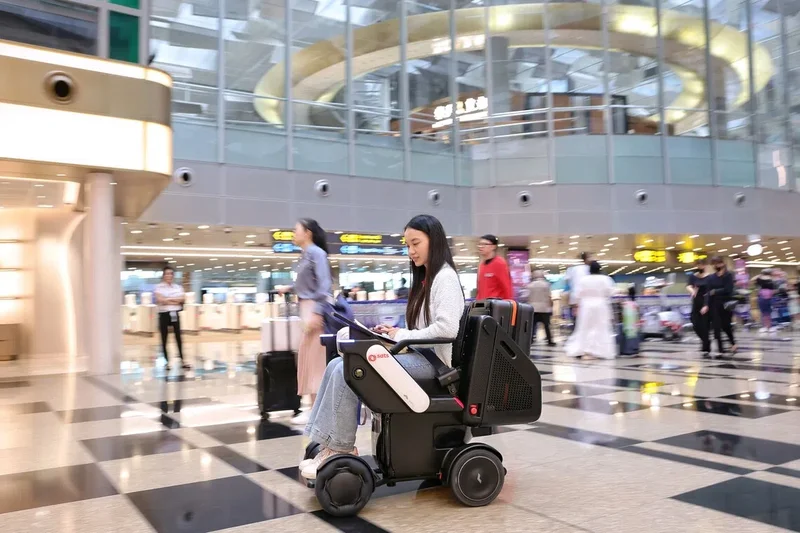
Autonomous wheelchairs available at Changi Airport for transfer passengers with walking difficulties
AI generated
SINGAPORE – Travellers who cannot walk long distances or climb stairs when making flight transfers in Changi Airport can now get around the terminals on autonomous wheelchairs that no one needs to push.
The wheelchairs are an option for those travelling on airlines like Singapore Airlines (SIA) and Air India that operate from Terminals 2 and 3 and are using SATS baggage handling services.
Demand for autonomous wheelchairs – now rolled out after trials from March 2025 to June 2026 – is up by about 20 per cent from 2023 to 2025, said Changi Airport Group (CAG) at a demonstration for reporters on Aug 4.
In the first phase, up to 18 autonomous wheelchairs – nine in Terminal 2 and another nine in Terminal 3 – will be rolled out in stages across the transit areas, mainly for transfer passengers with connecting times of more than 1½ hours between flights.
An average of four in five of mobility assistance requests for travellers with walking issues – out of about 2,300 requests each day – come from transfer passengers, said CAG.
Passengers with mobility issues need to ask for assistance when they book their air tickets, and they can choose either an autonomous wheelchair, a manual wheelchair, a buggy that can seat five or a caddy that fits three.
The autonomous wheelchairs can be used only by passengers who are able to walk short distances by themselves but require mobility assistance over longer distances, said CAG and SATS in a press briefing.
Service staff from SATS will identify suitable passengers in advance, based on information provided by the airline – including the passenger profile and travel itinerary – to use these wheelchairs.
Equipped with safety features, the autonomous wheelchairs can only move when the seatbelt is securely fastened. Passengers can also activate an emergency stop button and call the control centre if needed.
These devices are programmed to move along set routes to any departure gate in Terminals 2 and 3, and are fitted with sensors to detect and move away from obstacles or human traffic.
Passengers can also store their cabin luggage, weighing up to 10kg, in a compartment located at the back of the wheelchair.
The wheelchair will emit a soft musical hum as it moves around the terminal, to alert other travellers of its presence.
A ride on the wheelchair from the farthest end of Terminal 3 to the shopping area takes 15 to 20 minutes, with the device moving at a comfortable walking speed of 3.5kmh, allowing the passenger’s friends and family members to walk with them.
Each wheelchair journey will be monitored by a SATS ground handling supervisor at a control centre.
More than 13,000 passengers participated in the trials that lasted over a year, CAG and SATS said in a joint statement.
Higher demand is expected for such mobility assistance services in future, given the airport’s growing passenger volumes from the future addition of Terminal 5.
Once completed in the mid-2030s, the new terminal and the wider Changi East development will nearly double the size of the airport.
T5 will increase Changi Airport’s annual passenger capacity by more than 55 per cent, from 90 million to 140 million.
Damon Wong, senior vice-president of airport operations planning at CAG, said the deployment of autonomous wheelchairs is among the series of initiatives the airport will roll out to improve the travel readiness of passengers with mobility needs.
He added that the addition of these wheelchairs reflect that CAG is investing further in the needs of passengers, and giving them the ability to travel around seamlessly within the airport.
Edwin Tan, SATS vice-president of Asia-Pacific Star and terminal services, it is a “new benchmark” for accessible, seamless and future-ready ground services.