The security environment around Japan has become as severe and complex as it has ever been since the end of theSecond World War, the country’s latest defence report said, as it warned against growing defence coordination between Russia, North Korea and China.
The assessment, outlined in Japan's 2026 Defence White Paper, warned that "the possibility of serious situations" capable of shaking the post-war international order in East Asia "cannot be ruled out".
It added that a crisis similar to Russia's invasion of Ukraine could emerge in the Indo-Pacific, particularly in East Asia.
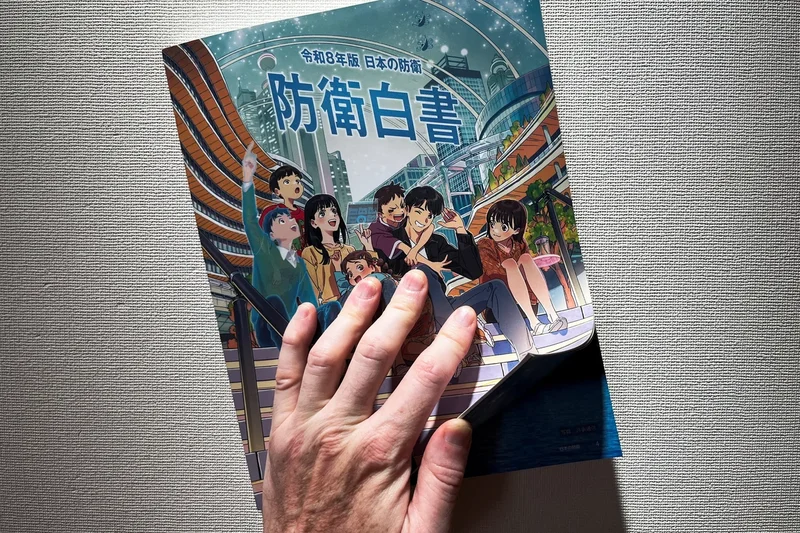
The warnings came in an anime-style cover which Japan’s Ministry of Defence said was intended to convey a “futuristic image”. The image showed a smiling family in a gleaming cityscape rather than the troops, weapons and military insignia featured on many previous editions.
The report identified China as "the greatest strategic challenge" facing Japan, saying Beijing has continued its decades-long military build-up while intensifying activities around Japan, including in the East China Sea and around Taiwan.
Japan also expressed alarm over deepening military ties between China and Russia, pointing to joint bomber flights and naval operations near Japan.
The report specified a December 2025 incident in which Chinese and Russian bombers travelled in the direction of Tokyo, crossing over Japan’s southern islands for the first time. Japanese defence ministry scrambled fighter jets and later slammed it as “serious concern for our national security”.
“Joint Chinese and Russian bomber flights and naval exercises are clearly intended as a show of force against our country and represent a serious concern for national security,” the white paper released Tuesday said.
Russia's strategic partnership with China, combined with its growing military cooperation with North Korea, has further heightened regional tensions, according to the report.
It noted North Korea’s “extremely rapid” progress in missile development over the years, including advanced hypersonic missiles.
“Through military cooperation with Russia, there is a concern that North Korea’s military power will increase in the mid- to long-term,” it said.
Giving an example of their coordination, it said Chinese president Xi Jinping, Russia’s Vladimir Putin and North Korea’s dictator Kim Jong Un stood side by side during a military parade in Beijing in September last year.
The white paper reiterated that North Korea remains an "imminent and grave threat" to Japan, citing continued advances in its nuclear weapons and ballistic missile programmes, including the development of increasingly sophisticated missile systems capable of reaching Japan.
It said the Japan Air Self-Defence Force concluded 595 scrambles between April 2025 and March 2026. They included 366 times for Chinese aircraft and 214 times for Russian aircraft.
To enhance deterrence and response capabilities, Japan is undertaking a fundamental overhaul of its defence capabilities. The strategy focuses on seven priority areas, including long-range stand-off strike capabilities and integrated air and missile defence.
As part of the build-up, Japan is deploying new long-range missiles, including the Type-25 Surface-to-Ship Guided Missile, the Type-25 Hyper Velocity Gliding Projectile and hypersonic weapons, while expanding its ability to collect target information, the paper said.
It is also strengthening its air and missile defence by upgrading interceptor systems, acquiring jointly developed SM-3 Block IIA missiles for Aegis destroyers and constructing new Aegis System Equipped Vessels.
The paper defended accelerating military buildup not only as a way to protect the country but as a route to greater prosperity, arguing arms production can support economic growth.
The paper "stresses that investment in defence benefits the wider economy and people's lives”.
That message aligned with prime minister Sanae Takaichi's broader use of strategic state spending in an effort to drive economic growth. Her government has been attempting to seek support for further military buildup and spending and to attract service members.
China and Russia have not issued any response to the report yet.