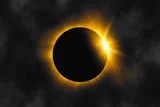
Mark August 12, 2026, in your calendar because there is not one, but two major astronomical events to look forward to.
The first is a solar eclipse, which will appear total from Russia and parts of Europe, and partial from the U.S. The second is the peak of the Perseids — described by NASA as “the most popular meteor shower of the year.” This will appear particularly spectacular thanks to its concurrence with a new moon.
Here’s what you need to know about these spectacular events.
A Total Solar Eclipse Across Europe
Viewers in parts of Europe will be able to witness a total solar eclipse on August 12, 2026. A total solar eclipse occurs when the moon completely blocks the sun, and the world appears to go dark for a moment.
According to NASA, the path of the total solar eclipse will start in a remote region of northern Russia around midday, then hit Greenland and Iceland in the late afternoon, and reach Spain and the northwestern corner of Portugal in the late evening. For those lucky enough to be in its path, totality will last approximately 2 minutes. In Valencia, Spain, for instance, it’s predicted to occur between 8:32 and 8:33 p.m. local time.
This, according to the Royal Museums Greenwich, will be the first total eclipse seen in central or western Europe since 1999.
Other parts of the continent will experience a partial eclipse in which most but not all of the sun is blocked from view. Countries including France, Switzerland, and the U.K. will see maximum coverage of around 88 to 95 percent.
Read More: 2,700-Year-Old Total Solar Eclipse Observations Give Insight to Our Ancient Solar System
A Rare Sunset Eclipse
The event is likely to coincide with sunset in some parts of Europe and Africa, producing an opportunity to observe an extremely rare sunset eclipse.
The eclipse will appear a little more modest in the U.S., but will be visible to viewers in the northern states, from Alaska to North Carolina. Maximum coverage will vary depending on where you are stationed. Viewers in Fairbanks, Alaska, for example, can expect coverage of up to 37 percent, predicted to occur sometime between 7:37 a.m. and 9:18 a.m. local time, whereas those in Detroit, Michigan, will see just a small sliver of the sun blocked (3 percent) between 1:03 and 2:08 p.m. local time.
Elsewhere, in Boston, Massachusetts, and Portland, Maine, the eclipse is predicted to reach a maximum coverage of 16 percent and 19 percent, respectively, and occur shortly after midday. Meanwhile, in Washington, D.C., and New York, maximum coverage of 4 percent and 9 percent will occur in the early afternoon.
Wherever you may be watching, NASA provides guidelines for enjoying the eclipse safely.
Peak of the Perseid Meteor Shower
For those not lucky enough to be on or near the path of totality, there is another event to get excited about.
The Perseid meteor shower takes place every summer and peaks in mid-August. According to the American Meteor Society, this year’s shower is expected to be at its most spectacular on the night of August 12 into August 13, 2026.
The Perseids — so named because their radiant is in the constellation Perseus — boast meteors that are bright, fast and abundant, often leaving long trails in their wake. According to NASA, you can expect to see 50 to 100 meteors per hour, ripping through the skies at approximately 37 miles per second.
These showers produce fireballs that appear roughly as bright as Venus, according to the American Meteor Society. This year, we could be in for a particularly exciting show as its peak coincides with a new moon, meaning darker skies and higher contrast.
Read More: Trees May Not Anticipate Solar Eclipses, Calling Past Research Into Question
Article Sources
Our writers at Discovermagazine.com use peer-reviewed studies and high-quality sources for our articles, and our editors review for scientific accuracy and editorial standards. Review the sources used below for this article: