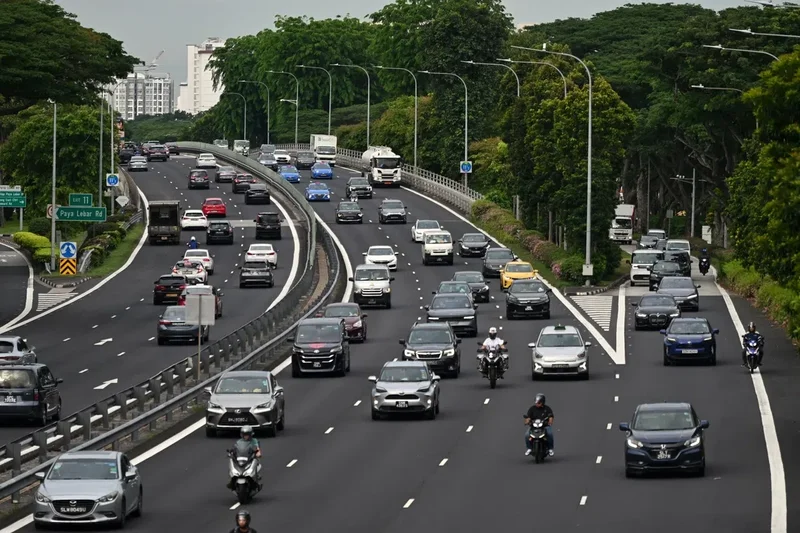
New traffic laws set stage for crackdown on drink driving, phone holding and rogue motorists
AI generated
SINGAPORE - More severe punishments await motorists who put lives at risk.
On Aug 4, Parliament passed new traffic laws that slash the alcohol limits for drivers by more than half, with plans to jail even first-time offenders.
The Traffic (Miscellaneous Amendments) Bill introduces a new offence for purposeful endangerment, specifically targeting those who deliberately use their vehicles to endanger others on the roads.
Laws on phone use while driving have also been tightened, with the Bill making it an offence just to hold a mobile device while driving, even if the motorist is not using it.
A total of 27 MPs spoke during the debate on the Bill, which lasted over six hours.
The new laws pave the way for a harsh crackdown on the roads, with traffic deaths hitting a 10-year high of 149 in 2025, compared with 141 in 2016.
The number of people injured have also been rising, from 9,342 in 2024 to 9,955 in 2025.
The Bill, which was first introduced on July 7, lowers the alcohol limit for drivers, from 35 micrograms (mcg) of alcohol per 100ml of breath to 15mcg.
Blood alcohol limits, which was 80 milligrams (mg) of alcohol per 100ml, will be lowered to 30mg.
This brings Singapore’s prescribed alcohol limits, which have been in force since 1985, in line with jurisdictions such as Japan and South Korea.
There will be upcoming guidelines to recommend jail time for first-time offenders with very high blood alcohol levels.
First-time offenders in cases without aggravating factors like accidents or injuries have typically been given a fine and a two-year driving ban.
But the new law allows for up to 12 months’ jail on top of the fine and ban.
Once the law comes into force, the Traffic Police can prosecute drink drivers with evidence from a new handheld breathalyser.
The device, which has undergone operational trials, captures more accurate alcohol level readings at the roadside. This removes the need to bring the driver to the police-lock up for a breath test.
TP will also no longer need explicit authorisation from a doctor for a blood sample to be drawn.
Purposeful endangerment
The Bill introduces a new offence of purposeful endangerment, for drivers who intentionally use their vehicles to endanger another person, causing death or grievous hurt.
Those convicted of this new offence can be jailed for up to 15 years, fined, caned and disqualified from driving for life, or for at least 10 years if there are special reasons. The vehicle involved can also be seized.
Penalties for dangerous and careless driving causing grievous hurt will be increased. This is because the most serious forms of grievous hurt may cause victims to suffer permanent disabilities, leaving them unable to work, live independently or care for themselves.
For dangerous driving causing grievous hurt, jail time will be raised from five to seven years for first-time offenders, and from 10 to 13 years for repeat offenders.
There are no changes to the maximum jail terms for careless driving causing grievous hurt.
But for both offences, additional penalties due to aggravating factors will be raised.
Serious offenders, such as those who commit offences while drink driving, will face up to 18 months’ additional jail time, up from one year.
Serious repeat offenders will face additional jail time of up to three years and six months, up from two years.
The Bill also makes it clear that when a disqualification order is made against an offender who is jailed, the disqualification period starts only after release from prison, even if the jail term is for an unrelated offence.
Another new offence of drug driving allows the authorities to prosecute an offender who had controlled drugs or intoxicating or psychoactive substances, like etomidate, in their blood. This is regardless of the quantity of the substance detected or whether there was any observed impairment in their driving.
However, drivers will not be liable for drug driving if the drugs taken were legal, medical prescriptions, and they did not know it would impair their driving.
Holding phones an offence
As for phone-use while driving, the new law removes the need to prove the motorist was actively using the device while the vehicle was moving.
Instead, just holding the phone while driving is enough for the authorities to take action. This is because the driver would not only be distracted, but must hold and support the device, reducing his ability to maintain proper control of the vehicle.
First-time offenders can be jailed for up to six months and fined $1,000, while repeat offenders can be jailed for up to a year and fined $2,000.
Second Minister for Home Affairs Sim Ann said the World Health Organisation reported that drivers using mobile phones are four times more likely to be involved in a crash.
She added that violations increased 40 per cent from 3,014 cases in 2024 to 4,214 in 2025.
She said: “We must move decisively against this undesirable driving behaviour and not wait until more accidents or fatalities have been caused.”
This change also allows TP to catch offenders by using cameras, or photos and videos sent in by the public.
The use of mounted devices will not be affected by the changes, and drivers can still hold their devices when the vehicle is stationary.
But if the use of a mounted device distracts the driver or compromises the driver’s control of the vehicle, the driver may be liable for offences such as careless or dangerous driving.
The changes come just after the announcement on July 31 that there will be a stricter demerit points system for motorists from 2027.
Sim said these measures aim to stop the increase in traffic fatalities and injuries, but that laws and enforcement alone are not enough.
“Ultimately, it is the choices made by every road user — every driver, motorcyclist, cyclist, and pedestrian — that will determine whether we can reach home safe every day,” she said.
“We urge all road users to exercise patience and graciousness on the road. When we stay alert, slow down, or give way, we protect not just ourselves but other road users, our families, and our loved ones.”