WASHINGTON — While SpaceX says there is a “significant” amount of life left in its fleet of Crew Dragon spacecraft, the company has hedged on how long it will continue flying the spacecraft as it transitions to Starship.
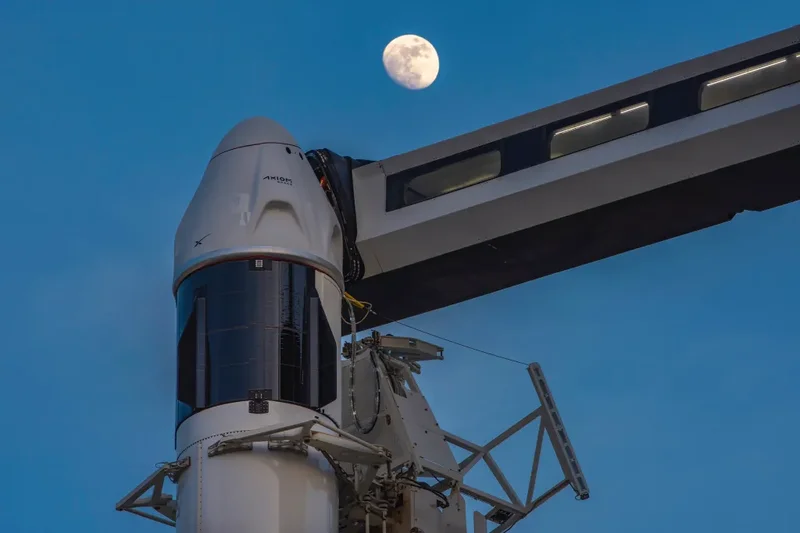
The upcoming Crew-13 mission to the International Space Station, scheduled for launch no earlier than Sept. 12, will be the second flight of this Crew Dragon spacecraft, called Grace, the newest of the fleet. Grace made its first flight last summer on the Ax-4 private astronaut mission to the ISS.
Crew-13 will be SpaceX’s 18th human spaceflight mission to the ISS, noted Julianna Scheiman, director of NASA science and Dragon programs at SpaceX, during an Aug. 3 NASA briefing about the mission. That includes four Axiom Space private astronaut missions and the Demo-2 test flight in 2020. SpaceX has also flown three Crew Dragon missions that did not go to the ISS.
SpaceX does not plan to build additional Crew Dragon spacecraft beyond the five currently in service. While the spacecraft were originally certified for five missions each, the company has been working with NASA to extend the spacecraft lifetimes to up to 15 missions each.
“I see a significant amount of life remaining on our Dragon fleet,” Scheiman said. “We do some of that math between NASA and SpaceX and see many more flights available on the hardware itself.”
Demand for Crew Dragon remains high. In May, NASA filed plans to procure up to six more Dragon missions after the final mission on its current contract, Crew-14, citing delays in certification of Boeing’s CST-100 Starliner. The European Space Agency announced in March it is considering flying a dedicated Crew Dragon mission to the ISS for its astronauts. There are also private astronaut missions to the ISS by Axiom Space, Vast and Voyager Technologies, as well as multiple missions to Vast’s Haven-1 commercial station under contract.
“We anticipate Dragon supporting ISS for years to come,” Scheiman said.
However, there are industry concerns about how long Crew Dragon will be available, particularly for commercial space stations that will succeed the ISS around the end of the decade. SpaceX has hinted it wants to shift crewed missions at some point to Starship.
“I personally am really excited about the Starship vehicle enabling hundreds of people to be launching to space, low Earth orbit and beyond,” she said. “We’re working in partnership with NASA to ensure that we’re continuing to support the NASA mission while developing Starship at the same time.”
Exactly what that transition looks like remains uncertain and has technical implications for those future commercial stations, as Starship is far larger than Crew Dragon.
SpaceX says there will be overlap between Crew Dragon and Starship. “We do anticipate flying Dragon and Starship at the same time,” Scheiman said. “We see those operating at the same time as we continue to develop and make improvements on Starship.”
However, when asked if the company was continuing to sell Crew Dragon missions to commercial space station developers, she declined to explicitly confirm that.
“We have a plethora of missions that we’re supporting and on contract for, to include missions to support the private astronaut missions, both those that go to the International Space Station as well as those to Vast, a private space station,” she said.
NASA has taken a hands-off approach to the issue of Crew Dragon’s long-term future. “It had always been part of the agency’s plan to have two different commercial crew providers, and so we’re committed to that,” said Dana Weigel, manager of NASA’s low Earth orbit program, at the briefing. That involves continuing to work with Boeing to get its Starliner vehicle certified for long-duration ISS missions.
She noted, though, that as NASA transitions to commercial stations, the agency expects to buy services that include both use of the station and transportation to it, rather than buy transportation separately.
“The ultimate plan with the destinations is to have what we call an end-to-end service,” she said. “The transportation side and the destination side are tied together in an end-to-end service, and so commercial industry, the destination providers specifically, are working directly with transportation providers and deciding who they’re partnering with.”
NASA recently received comments on a draft solicitation for the next phase of its Commercial LEO Destinations program to support development of commercial stations and plans to issue a final solicitation “as soon as we can,” she said.
Companies will, in their proposals, offer transportation options based on “what works best based on their architectures and their designs,” she said, “and so I’m looking forward to seeing that in the proposals and their responses back to us.”