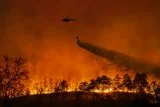
Along the roads through Yosemite National Park, a bend can reveal a field of bare, burned trunks standing where a living forest once grew. It is a scene wildfire researcher Mitchell Hung has encountered repeatedly. Hung, who studied California’s changing fires as a graduate student at UCLA, compares the remaining trunks to “tree gravestones.”
His team has now measured how much more common that destruction has become. Forest fires in California burn about 10 times more land annually than they did in 1985, while the area consumed by high-severity fires has increased thirtyfold.
The study, published in the Proceedings of the National Academy of Sciences, documents how high-severity fires overtook lower-severity fires and examines what is driving the change.
“Fire is a natural process that can be healthy for ecosystems, but most of California’s tree species have a difficult time coming back following fires that kill huge swaths of trees,” senior author Park Williams said in a press release.
High-Severity California Wildfires Have Surged Since 1985
Researchers created high-resolution maps of fire severity for 4,391 California forest fires that burned between 1985 and 2024. They measured severity by looking at how much tree canopy burned away and how badly the soil charred.
During the 1980s and 1990s, most forest fires burned at low or moderate severity, clearing brush while leaving many mature trees alive. Then from 2012 through 2024, high-severity fire burned more forest annually than low-severity fire every year.
The change unfolded during an era of increasingly large fires. Eight of California’s 10 largest wildfires over the past century occurred within the last decade. Across the western United States, 2020 had the largest forest area burned in modern records, followed by 2021.
Read More: For 12,000 Years, Africa’s Rwenzori Mountains Avoided Major Fires — Until a 2012 Blaze
Why California’s Wildfires Are Becoming More Severe
California’s densest forests saw the biggest increase in high-severity fires. Researchers linked the pattern partly to decades of putting out smaller fires, which allowed brush and other flammable vegetation to build up.
Researchers also measured vapor-pressure deficit, which tracks how much moisture the air can pull from plants and soil.
“When the weather is hot and dry, the vapor-pressure deficit is high, which leads the atmosphere to act like a sponge, soaking up surface water,” said Hung. “In general, the warmer and drier the atmosphere, the more high-severity fire we saw over the last 40 years.”
Severe Fires Could Reshape California’s Forests
When severe fires leave large gaps, seeds from surviving trees may not reach the middle of the burned area. Intense heat can also damage the soil and slow the growth of new trees.
Some burned forests could eventually give way to grasslands and shrublands. That shift could reshape wildlife habitat and change how the landscape responds to drought, heat waves, wind, and future fires.
Forest loss could also affect water supplies, flooding, air quality, tourism, and the timber industry.
“The loss of these forests isn’t just, ‘I can’t take a pretty picture,’” explained Hung. “There are profound socioeconomic impacts.”
Clearing brush and conducting prescribed burns could reduce the vegetation available to fuel fires in specific areas. However, these steps cannot stop the increasingly hot and dry conditions across California.
“But even though forest management alone can’t solve the problem statewide, for individual locations, making good forest management decisions can help alleviate the risk of high-severity fire,” Hung shared in the press release.
Careful forest management may help some areas withstand the next blaze. But as California continues to warm, the question is no longer only how much land will burn. It is whether the forests growing there today will recover afterward.
Read More: This Hidden Water System Helps Keep the Grand Canyon Alive — but Climate Change Could Put It at Risk
Article Sources
Our writers at Discovermagazine.com use peer-reviewed studies and high-quality sources for our articles, and our editors review for scientific accuracy and editorial standards. Review the sources used below for this article: