An increasingly competitive market is forming around a capability military satellites have historically used sparingly: propulsion after launch.
Startups and established spacecraft manufacturers are investing in engines designed to give small satellites more freedom to change orbit, maintain lower altitudes and respond to changing conditions in space. Recent tests, product launches and acquisitions suggest that companies see an opening in national security programs focused on what the military calls dynamic space operations — the ability to move spacecraft as part of an operational mission rather than simply keep them in a predetermined orbit.
The development of the market is in its early stages. Many of the systems are still in ground testing, flight demonstration or initial production. The Space Force is also working through how frequently satellites would maneuver, which missions would benefit and what supporting technologies would be required.
The trend is closely tied to the military’s adoption of smaller satellites. Most propulsion systems are intended to perform routine station keeping or minor collision avoidance maneuvers, but not the larger or more frequent orbital changes envisioned in emerging military concepts.
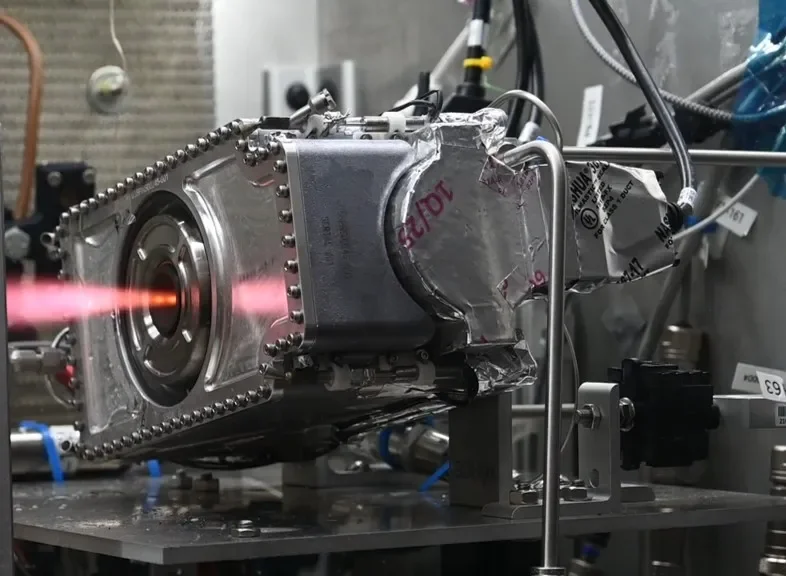
The Space Force recently disclosed that Parabilis Space Technologies had completed hot-fire testing of its Dense Orbital Transfer System, or DOTS, a propulsion module roughly the size of a household toaster developed for cubesats that uses a hybrid engine that combines solid fuel with a liquid oxidizer.
The approach is intended to provide more thrust than many electric-propulsion systems while avoiding some of the complexity of conventional liquid engines. The Space Systems Command, which provided funding for the project, said the system is being prepared for an orbital demonstration.
Companies are pursuing different parts of the market. Rocket Lab introduced Gauss, an integrated Hall-effect electric-propulsion system aimed at large constellations.
Researchers at the Massachusetts Institute of Technology are testing technology that combines chemical propulsion with electrospray thrusters using a common low-toxicity propellant. The chemical mode is intended for faster maneuvers, while the electric mode is suited to slower and more fuel efficient operations.
The use of hybrid systems illustrates one of the central trade-offs in the market. Chemical engines can change a spacecraft’s velocity more quickly but consume propellant at a higher rate. Electric systems provide greater efficiency but generally require more time to complete a maneuver.
Quantum Space is pursuing hybrid propulsion for its Ranger spacecraft, designed to use a single propellant for chemical and electric propulsion. Quantum Space is positioning the vehicle for national security missions that require spacecraft to move quickly without sacrificing endurance.
Investment is also moving through mergers and acquisitions. York Space Systems acquired Orbion Space Technology, a Michigan producer of Hall-effect thrusters. Voyager Technologies acquired ExoTerra Resource, a Colorado electric propulsion company.
These deals suggest that propulsion suppliers are becoming strategic assets as prime contractors and satellite builders position themselves for government and commercial orders.
The competitive environment is being shaped by the Space Force’s interest in dynamic space operations and also by dual-use applications.
Military planners are considering how maneuver could affect operations in a conflict. A spacecraft able to change orbit might be harder to predict or target than one following a fixed path. It could also be reassigned after another satellite is lost or repositioned to support a different geographic area.
Those possibilities remain largely notional.
That said, it’s clear that propulsion has become more strategically important to the satellite market. But like other broad ideas and concepts, it remains to be seen how dynamic operations will shake out.
For example, how will the Space Force cover the idea into specific requirements? And which technologies will gain broader adoption?
Without definitive answers, the private sector is left to build a range of options.
For Space Force leaders, it gives them a wider pool of systems to test as they try to figure out the answers to a bigger question: Can dynamic space operations move from doctrine into deployed constellations?
Industry is taking its cues from the Pentagon, investing in propulsion technologies, manufacturing capacity and acquisitions before the military has settled on firm requirements or a procurement model. Those bets could pay off if maneuverability becomes a standard feature of military small satellites. They could also leave companies competing for a market that develops more slowly or differently than expected.
This article first appeared in the August 2026 issue of SpaceNews Magazine.