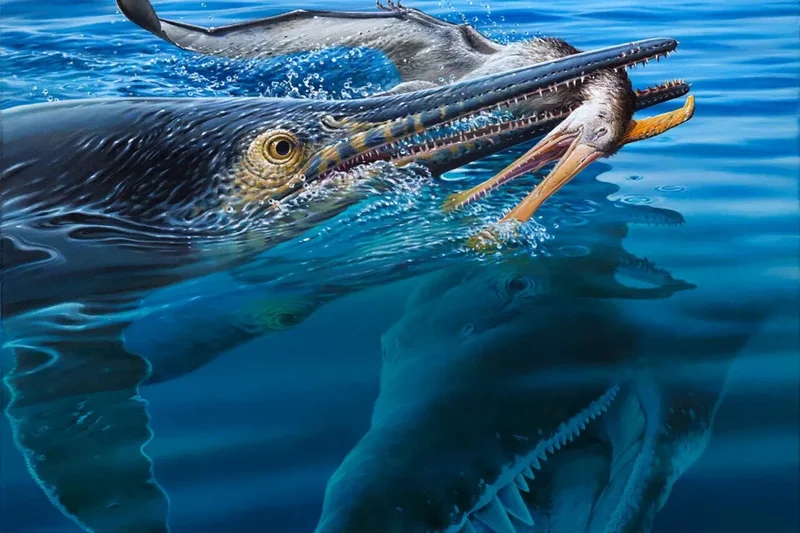
Sometime during the Cretaceous period, an ichthyosaur ate a pterosaur. Then, a kronosaurus violently ripped the ichthyosaur apart. And all this, miraculously, ended up well-preserved enough in a single fossil record.
In 2022, researchers identified a fossil of an ichthyosaur, a dolphin-like marine reptile that lived more than 100 million years ago. Investigations revealed fragments of a pterosaur inside the ichthyosaurâs stomach, making it the first known evidence of an ichthyosaurâa marine reptileâeating a pterosaurâa flying reptile. This on its own would have been a major discovery, but the fossil had more gifts to offer. The ichthyosaur was also ravaged by some creature with a huge bite, as researchers report in a paper published recently in Gondwana Research.
âThis discovery enriches our understanding of these ancient marine reptiles and illustrates the complex interactions that shaped their prehistoric aquatic environment,â Matt White, the studyâs first author and a paleontologist at the University of New England in Australia, said in a statement.
Rummaging through B.O.B.
In 2019, collectors gathered a large trove of fossilized bones at a public fossicking site in Queensland, Australia. According to the statement, the bones were nicknamed âB.O.B.,â a shorthand for âBag of Bones.â A few years later, study co-author and curator Kevin Petersen revisited B.O.B., sending some fossils of interest over for a CT scan.
The collection held many curious, fossilized creatures, but the weirdest of them all was the remains of an ichthyosaur, about 22 feet long (7 meters). For one, ichthyosaurs were known to eat fish and cephalopods, but for the first time researchers identified the remains of a pterosaur in the fossilâs stomach. That indicates that these ancient creatures were opportunistic feeders, the team explained in the study.
Rest in pieces?
But the team also saw that this ichthyosaur looked like it had been through a lotâ¦to put it mildly. To the Australian Broadcasting Corporation (ABC), White recalled that, while the skull and tailbones were relatively intact, the ichthyosaurâs midsection was âjust ravaged by a large predator.â Some monster with an enormous bite fractured nearly half of the ichthyosaurâs spine in a way closely resembling how crocodiles kill their prey, according to the paper.
The ichthyosaur itself was a formidable marine predator, and White explained in the statement that this particular ichthyosaur was fairly large. So, whatever did this to the ichthyosaur must have been a real beast with a crocodilian biteâprobably something like Kronosaurus queenslandicus, a giant, short-necked pliosaur capable of growing up to 45 feet (14 meters) in length, according to ABC.
“They’re quite a formidable animalâbasically the T. rex of the ocean,” White told the ABC.
Case un-closed
Of course, as is often the case for paleontological discoveries, the paperâs conclusions reflect a (likely) interpretation of the fossils. The fossil records provide strong evidence that there indeed was this three-way interaction between Cretaceous reptiles. Other than that, how exactly this happened is more or less left to our imagination.
âBut did the actual kronosaurus leap out of the water and smash the ichthyosaur? Or was the ichthyosaur breaching the water and snatching a pterosaur out of midair to eat?â White mused to the ABC, adding, “What happened in the exact term of events we don’t know, but that’s half the exciting thing [about] palaeontology.”