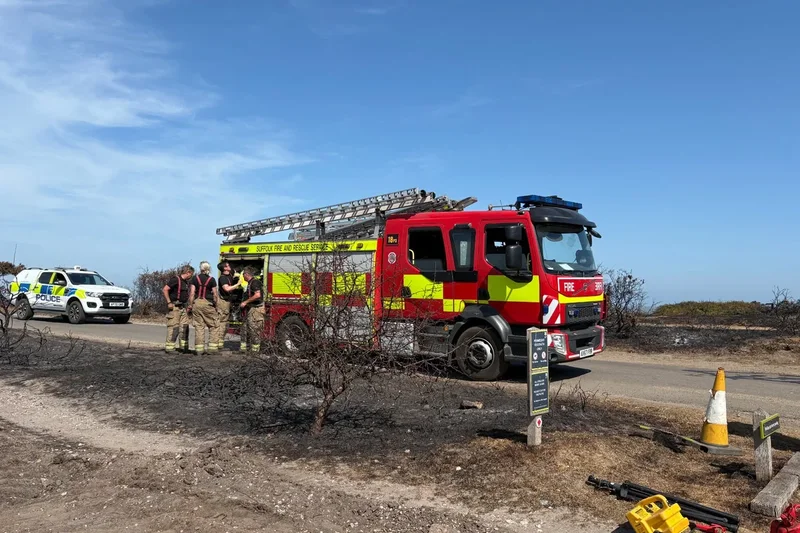
Firefighters have warned dog walkers and members of the public to continue avoiding Dunwich Heath after a wildfire turned the precious nature reserve into a wasteland.
Suffolk Fire and Rescue Service has been forced to escort dog walkers and other people away from the area over the past 24 hours after they entered restricted locations or became lost.
Dunwich Heath was left scorched after a wildfire broke out on Wednesday evening and decimated the National Trust nature reserve and RSPB bird watching hotspot. Holidaymakers were forced to evacuate from caravan parks and campsites as the blaze tore through an estimated 150 hectares of land at its height.
The service warned that “the danger is far from over” despite the incident remaining stable as firefighters deal with hotspots across the site every day. They continued that safe-looking burnt ground could be hiding temperatures in excess of 60C at the surface, with temperatures “significantly higher” only a few inches below.
Hazards could be hidden as underground tree roots, animal burrows and scorched earth continue to smoulder beneath the surface.
Firefighters said they were using drones to locate the source of smoke when spotted from the heath before crews are deployed to tackle it. A firefighting helicopter has been in operation for hard-to-reach areas.
“Today's hot and windy conditions are increasing the likelihood of flare-ups, making this a particularly important time for the public to stay away,” the fire service warned. “Please do not visit Dunwich Heath and do not enter closed areas.
“The landscape has changed dramatically as a result of the fire. Areas that were once familiar can now be difficult to navigate, making it easy to become disorientated.
“Keeping away helps protect your safety and allows firefighters to focus on tackling the incident,” a notice concluded.
The National Trust was forced to launch an emergency fundraising drive after the landscape was left “unrecognisable” by the wildfire. Once a home to wildlife such as nightjars, skylarks, the rare Dartford warbler, adders and slow worms, the lowland heath habitat is one of the UK’s rarest.
The trust’s chief operating officer said on Sunday that signs of life had been observed amid the burning landscape.
"One of our team who was on site [on Saturday], was still observing signs of life already in and amongst the burnt landscape, so we hope some of the species who live there will have managed to escape," he told BBC Radio 5 Live.
"Obviously, we would have lost many things, but we hope in the spring next year we will see where we are in the terms of recovery... but it is a bit too early to tell for that.
"We have faith in nature's dealings in these problems."
As Dunwich Heath remains in a state of wasteland, England and Wales saw the driest July on record. The Met Office reported 19 counties across England that recorded effectively no rainfall – 1mm or less – across the whole of the month.
Southern England saw not only its driest July since data began but also its driest month ever recorded, the Met Office said, as much of the region remains in drought conditions. Wales also declared a drought last month.
England also saw the hottest June since records began in another extreme weather moment. The Met Office warned that climate extremes would soon become the new normal for the UK as global warming continues.