Outer Perth suburbs are leading the way for postcodes with the most home battery installations over the past year.
More than 50,000 batteries have been installed through the federal government’s Cheaper Home Batteries program which aims to help households store more cheap solar energy and use it when needed most.
From April to June this year, Western Australians added enough solar capacity to power 25,000 homes – a new state record.
Armadale suburbs topped the list with 2007 batteries installed across the local government area in the past 12 months.
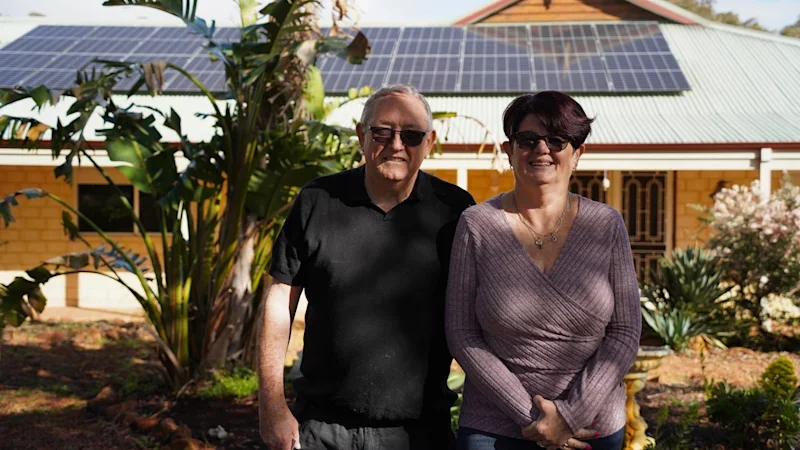
Bedfordale residents David and Ellen Gibbs installed their system in March and have saved almost 50 per cent in power bills to date.
The husband and wife duo regularly foster children, with up to 10 kids living in the house at one time. They say the home battery has been a life changer.
“There’s always two adults [in the house], but the children vary because we foster. So it goes from five to 10 kids. Some of our bills were up around $1200 to $1400,” David said.
“We’re using more power now because we’ve actually had to put two heat pumps in on each end of the house, so we’re using more power, [but because of the batteries] it’s costing us less, so it is a pretty significant gain.”
David said their two 20 kilowatt-hour batteries would have cost them $32,000, but thanks to state and federal government rebates, 50 per cent of the bill was covered.
Their most recent power bill has set them back $650, even with higher electricity usage.
In December, the federal government announced it would expand its program to an estimated $7.2 billion over the next four years.
The program aims to see more than two million Australians install a battery by 2030, delivering around 40 gigawatt hours of additional storage capacity.
As part of the program, home owners are eligible for a discount of around 30 per cent for a range of batteries across different sizes.
In May, the state government launched its WA Residential Battery Scheme which provides access to an additional rebate and a no-interest loan to purchase and install a battery to power their homes.
Applicants are eligible for a $1300 rebate for Synergy customers and $3800 for Horizon Power customers.
Armadale residents Linda and Danny Slob have been adding solar and batteries to their home gradually over time.
Their current system is now 7.2 kilowatt solar and 19.3 kWh battery, with backup power function providing energy independence in the event of a power outage.
“My biggest aim was to first make the home purposeful for us because we work from home, and secondly, to ensure that we weren’t paying high bills because of our age,” Linda said.
The duo has a modular battery system and originally started out two years ago with four batteries and one inverter which set them back around $15,000.
Then around six months ago, they decided to double their setup for $12,000, but this time received a rebate of around $5000.
Before installing the rooftop solar and batteries, the Slob’s power bills came in around $1000 per cycle. Now they cost less than a cup of coffee.
“All I know is it only cost us about $3.60 for our last bill, apart from the normal service charges,” Slob said.
“I’ve actually bought a little hybrid Rav4 Toyota GR, and I’m charging that with the batteries.
“They gave me a full tank of fuel, and I haven’t even used it yet.”
Other local government areas with a big uptick in home batteries installed this year include Cockburn with 1660 installs; Wanneroo at 1555 installs; Canning at 1422; and Mandurah wrapping up the top-five list with 1233 batteries installed.
West State Electrics senior energy consultant Christopher Barnes said he’s seen an increase of 500 per cent for people installing more battery systems in their homes.
“I’ve been doing solar for 11 years, and I think over the five years that batteries were quite exciting and new, we maybe sold 1000 kilowatt-hours of battery, and in the last 14 months, I think we must have done about 10,000 kilowatt-hours as a company already, so the uptake is insane,” he said.
Barnes said cost-of-living is one of the reasons why Perth’s outer-suburb residents have opted to install batteries more than inner-city suburbs.
“I think where people are struggling the most, people are searching for financial relief, and those who are struggling the most benefit from the rebates the most,” he said.
“Not everybody has $10,000 just sitting there waiting to spend on something, so having that government assistance and then also the WA interest free rebate that really makes a massive difference.”
Assistant Minister for Climate Change and Energy Josh Wilson echoed similar sentiments.
“The strongest uptake is happening in some of WA’s fastest-growing suburban communities,
where families are looking for practical ways to cut bills and get more value from their rooftop solar,” he said.
“At a time when cost-of-living pressures remain front-of-mind, batteries are helping households keep more of the free energy they generate and reduce their reliance on expensive power from the grid.”