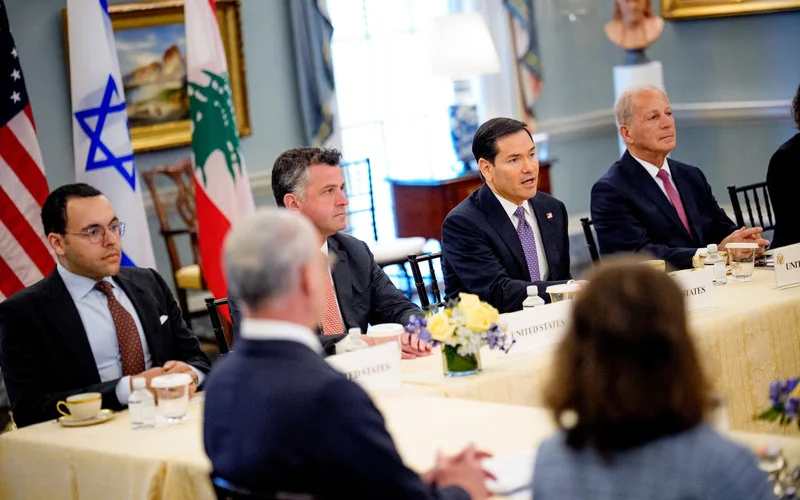
Gradual attrition: The cornerstone of the new US strategy against Hezbollah
TEHRAN — The plan currently being discussed in American and Israeli strategic circles regarding Lebanon is not merely a security initiative aimed at containing an armed actor; rather, it forms part of a multilayered strategy to reshape the balance of power in the country.
Strategic reports published by American and Israeli think tanks and media outlets indicate that Washington has concluded that eliminating Hezbollah through direct military action is neither feasible nor capable of producing a sustainable outcome. The rationale behind this assessment is clear: Hezbollah is not merely a military organization but also a political, social, security, and military actor whose presence within Lebanese society has become closely associated with deterrence, the provision of security, and the preservation of the country's territorial integrity. Consequently, U.S. policy is no longer centered on the "immediate destruction" of Hezbollah; instead, it seeks the "gradual attrition" of this power through a combination of political, economic, social, media, and security instruments.
The first component of this strategy is the transfer of the monopoly over arms from Hezbollah to the Lebanese state. Washington seeks to consolidate the Lebanese government as the sole institution possessing legitimate military and security authority while gradually removing Hezbollah's independent military role from Lebanon's domestic equation. To this end, strengthening the Lebanese Armed Forces, training and equipping selected military units, and exerting political pressure to implement the principle of the state's exclusive monopoly over weapons have all become central elements of the agenda. Although this policy is publicly presented as an effort to reinforce Lebanon's national sovereignty, its practical objective is to diminish Hezbollah's role within the country's power structure.
From the perspective of American strategists, however, the issue extends well beyond Hezbollah's weapons. Strategic assessments indicate that the principal source of the movement's enduring strength lies in its social and ideological base a foundation that, over the years, has enabled Hezbollah to function not merely as a military force but also as a provider of security, public services, and social support for segments of Lebanese society. Accordingly, one of the central pillars of this strategy is to replace Hezbollah with the Lebanese state in performing these functions and to institutionalize the perception within public opinion that security, welfare, and public services should be delivered by a Western-backed Lebanese government rather than through Hezbollah.
Lebanon's economic crisis has likewise been transformed into an instrument for advancing this strategy. The United States and its allies believe that Lebanon's dependence on foreign investment, financial assistance, and reconstruction efforts can serve as an effective lever for altering the country's political and social balance. From this perspective, the economy is no longer viewed merely as a matter of livelihoods; rather, it has become a tool for restructuring Lebanon's domestic landscape and reducing Hezbollah's social influence.
Alongside political and economic pressure, the battle of narratives occupies a prominent place in this strategy. The United States and certain Western circles seek to entrench the narrative within Lebanon's political and media spheres that Hezbollah bears primary responsibility for imposing economic, security, and political costs on the country. The objective of this narrative-building campaign is to erode Hezbollah's social legitimacy, widen the divide between the movement and other Lebanese political forces, and shape public opinion. Within this framework, any tensions along the Syrian-Lebanese border or Israeli strikes against the logistical infrastructure of the Resistance are portrayed in a manner that attributes the source of the crisis not to Israeli aggression, but to Hezbollah's presence and regional role.
Alongside these domestic dimensions, the U.S. strategy also rests on constraining Hezbollah's regional environment. From Washington's perspective, weakening the movement cannot be achieved solely through political and economic pressure inside Lebanon; its strategic depth and surrounding environment must likewise be placed under sustained pressure. In this regard, Syria occupies a pivotal position in American and Israeli calculations due to its geopolitical location and its role as the principal corridor linking Iran, Lebanon, and the Axis of Resistance. Consequently, efforts to redefine Syria's role in regional dynamics, restrict logistical support routes, increase instability in Lebanon's surrounding environment, and compel Hezbollah to devote a greater share of its security and military capabilities to managing border threats form part of a broader scenario designed to intensify geopolitical pressure on the movement a situation that could also increase Hezbollah's social and political costs within Lebanon.
At the same time, restricting Hezbollah's operational environment in Syria provides Israel with the opportunity to target the movement's logistical capabilities and support infrastructure without undertaking a direct and large-scale military incursion into Lebanese territory.
As an extension of this policy, another key objective of Washington is to remove the Lebanese file from the framework of the Axis of Resistance and transfer it to a Western-aligned government in Lebanon. The United States seeks to ensure that decision-making regarding Lebanon's security, reconstruction, the future of Hezbollah's weapons, and the country's political arrangements is pursued through negotiations and engagement with the Lebanese government rather than through coordination with Hezbollah and Iran.
In this context, by offering economic incentives and utilizing the mediation of Arab states, efforts are being made to position the Lebanese government as the principal party responsible for negotiations and the implementation of agreements, thereby reducing the roles of Hezbollah and Iran in this process. Washington believes that if it can manage the Lebanese file through its preferred government, it will be able to gradually implement its political, security, and economic plans at a lower cost and with greater legitimacy.
Taken together, these components can be summarized in four complementary layers. The military layer focuses on restricting Hezbollah's military capabilities and logistical support routes. The political layer seeks to transfer the authority over security and military decision-making to a Western-aligned government. The socio-economic layer aims to weaken Hezbollah's social base by exploiting Lebanon's economic crisis while strengthening the role of the state. Finally, the regional-geopolitical layer seeks to constrain Hezbollah's strategic depth, control its lines of communication, and weaken its ties with the Axis of Resistance.
Therefore, what currently constitutes the core of the U.S. agenda is not the immediate elimination of Hezbollah, but rather the gradual transformation of the balance of power in Lebanon through the restructuring of domestic institutions, the management of the regional environment, and the transfer of decision-making authority from the Resistance to a Western-backed government.