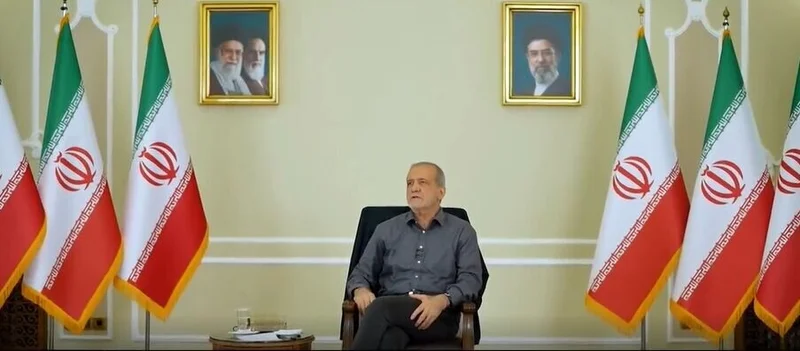
Leader's office rejects attributed comments on Pezeshkian's alleged resignation
TEHRAN - The Public Relations Office of the Leader of the Islamic Revolution has formally repudiated claims attributed to Ayatollah Seyyed Mojtaba Khamenei concerning the alleged resignation of President Masoud Pezeshkian, denouncing such assertions as "fundamentally false" and entirely devoid of truth.
“Any content that, contrary to the Leader’s emphatic guidance, causes division and polarization in society or serves as a basis for false allegations against dedicated officials directly advances the objectives of the ill-wishers and sworn enemies of the Iranian nation,” the office warned in a statement issued Tuesday.
The statement further clarified: “Accordingly, the content published in cyberspace in which an individual raises a claim regarding the Leader of the Islamic Revolution’s reaction to the letter of the respected President is fundamentally false and contrary to reality."
The statement underscored that such fabrications attributed to the Leader “unfortunately, lay the ground for disturbing public opinion and creating division and discord in society”. It emphasized that Ayatollah Seyyed Mojtaba Khamenei has consistently championed national solidarity, urging utmost respect for the dedicated servants of the Islamic system—most notably, government leadership.
This official clarification followed incendiary remarks by a senior Iranian cleric, who claimed President Pezeshkian had repeatedly informed the Leader of his intention to step down due to alleged rifts between political and military officials. Ayatollah Mohammad-Baqer Kharrazi, secretary-general of Iran’s Hezbollah party, alleged that Pezeshkian had tendered or threatened his resignation 28 times. “The Supreme Leader wrote that if Pezeshkian resigns one more time, his resignation will be accepted,” Kharrazi claimed, asserting that this ultimatum was formally relayed to the government, effectively forcing Pezeshkian and his team to drop the matter.
President Pezeshkian has firmly pushed back against these claims. In an excerpt from a video released Tuesday, Pezeshkian made his stance unambiguous: “If I want to resign, I will officially declare that I have resigned. I will not resign.” He vowed to stand firm, dismissing rumors of factional infighting with the military and reaffirming that his administration operates in lockstep coordination with the armed forces.
The Iranian president likewise brushed aside speculation of a breach between himself and Ayatollah Seyyed Mojtaba Khamenei, maintaining that such narratives are engineered solely to drive a wedge between the Leader and the executive branch.
Rumors of Pezeshkian’s departure had previously been amplified across mainstream Western media channels. Iran International—a UK-based Persian broadcaster frequently accused by Tehran of disseminating propaganda and orchestrating domestic unrest—reported in late May that Pezeshkian had submitted an official letter of resignation to the office of Ayatollah Seyyed Mojtaba Khamenei. Citing anonymous sources, the outlet alleged that Pezeshkian voiced frustration over being sidelined from core decision-making processes as the Islamic Revolution Guard Corps (IRGC) expanded its grip over state affairs. The network, widely accused of being funded by Israel, claimed Pezeshkian stated that "under such circumstances he is unable to run the government and carry out his legal responsibilities," prompting an immediate request to step down.
Iranian military and political officials have categorically dismissed those reports as baseless.
Narratives highlighting discord between Iran’s civilian government and military command are far from new. Since the outbreak of war launched by the United States and Israel against Iran on February 28, certain media outlets have repeatedly alleged internal friction among Iranian political and defense elites over strategic operations.
Observers note that the inability of US and Israeli forces to secure a decisive military victory over Iran appears to have driven them toward psychological and media warfare, seeking to sow internal fracturing from within.
Since assuming office following the martyrdom of his father in the US-Israeli strike on February 28, Ayatollah Seyyed Mojtaba Khamenei has maintained steady public backing for the Pezeshkian government. He has reaffirmed his late father’s characterization of Pezeshkian as a wise, honest president with a common touch.