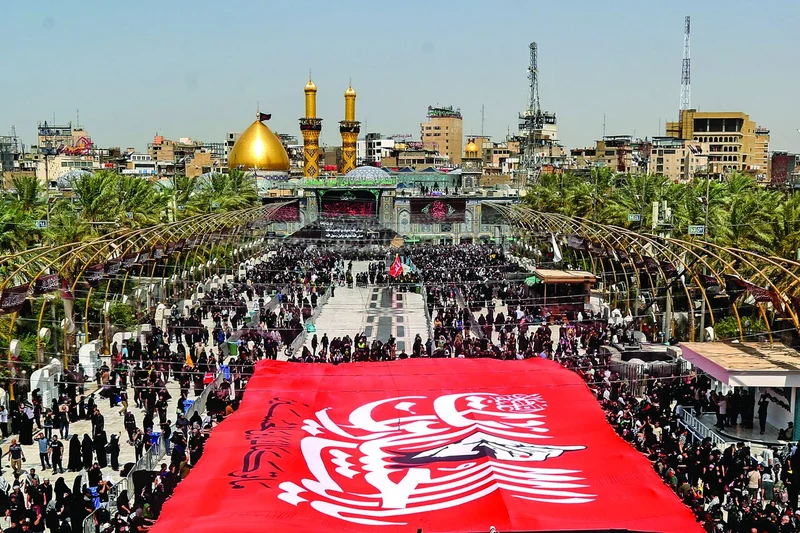
The Biggest Red Banner of Vengeance Rises in Karbala
Up to 22 million pilgrims from tens of nations took part in the Arbaeen pilgrimage, transforming the sacred plaza into a unified demand for justice
TEHRAN — Karbala awoke Tuesday beneath a sweltering August sky and a horizon ablaze with the crimson of vengeance. As millions of black-clad pilgrims converged for the climax of this year’s Arbaeen pilgrimage, the space between the twin shrines of Imam Hussein (AS) and his brother Abbas (AS) became the epicenter of a ritual fusing grief with geopolitical defiance.
In a ceremony, the largest blood-seeking flag ever raised in modern Arbaeen history was hoisted above the undulating sea of mourners.
The colossal red banner, inscribed with the ancient battle cry “Ya Latharat al-Hussein” (O Avengers of Hussein), was dedicated explicitly to the martyred Leader of the Islamic Revolution, Ayatollah Seyyed Ali Khamenei, assassinated in the U.S.-Israeli strikes at the beginning of the recent war on Iran.
For millions of Shia faithful, the flag was a public re-covenanting with the ideals of the fallen Leader and a deafening demand for retribution.
It seamlessly welded the historical tragedy of Karbala to the recent war of aggression waged by Washington and Tel Aviv.
The raising of the banner transformed the pilgrimage’s emotional landscape. Regional media outlets broadcast live images of the Bayn al-Haramayn plaza saturated in red.
For days, pilgrims walking the ancient 76-kilometer route from Najaf to Karbala had carried identical red flags, passing them hand to hand.
At Pole 553, near a mawkib named for the martyred commander Haj Qasem Soleimani, the flags moved continuously among Iranian and Iraqi marchers under a sun pushing temperatures toward 50 degrees Celsius.
The changing fabric and ‘Hubb al-Hussein’
This year’s Arbaeen, marking 40 days since Ashura, unfolded as the first such pilgrimage since the assassination of Ayatollah Khamenei. Iraqi officials anticipated up to 22 million pilgrims would enter Karbala.
Iraqi officials said that more than 4.88 million foreign visitors from 172 nations had already crossed into Iraq by Monday night.
The scale defied Western expectations that war and economic strangulation would fracture the Resistance.
Yet the demographics have changed. The Najaf-Karbala road became a mobile demonstration of the unbreakable Iran-Iraq bond.
Hassan al-Sarai, a 35-year-old pilgrim from Baghdad, observed the difference clearly. He told AP that he has seen countless Iraqi and Iranian flags, calling it a message to Washington that their bombs had permanently fused the two nations together.
Iranian Foreign Minister Abbas Araghchi joined the pilgrimage after arriving in Najaf. He said that the ceremony displays the unbreakable unity of the Iraqi and Iranian nations.
His presence served as a reminder that diplomacy and devotion are inseparable. The Leader of the Islamic Revolution, Ayatollah Seyyed Mojtaba Khamenei, prepared this ground in a July statement.
He praised the generous open arms of Iraq’s tribes and predicted the slogan “Hubb al-Hussein yajma’una” (The love of Hussein unites us) would again show its force.
The pilgrimage also delivered a direct rebuke to American pressure on Baghdad.
Washington wants the Popular Mobilization Forces and other Iraqi Resistance groups disarmed. From the heart of the Arbaeen crowds, Kataib Hezbollah issued a statement explicitly rejecting disarmament. The group vowed to retain the “weapons of the Resistance” as a sacred trust.
**A borderless phenomenon **
The geography of resistance extended far beyond Iraqi borders. In Tehran, the annual “Jamandegan (Those Left Behind from Arbaeen)” march stretched 15 kilometers from Imam Hussein Square to the shrine of Hazrat Abdol Azim in Rey.
Unified under the slogan “We Must Rise,” mourners trampled U.S. and Israeli flags, transforming the procession into an explicit demand for vengeance. They called for swift justice for the martyred Leader and the scores of civilian martyrs, including those lost in the Minab school strike. Over 3,500 volunteer mawkibs lined the route.
Globally, the day saw a synchronized outpouring of allegiance.
In Dearborn, Michigan, approximately 45,000 participants marched in the largest Arbaeen procession in U.S. history. Under heavy police deployment, they carried black banners and red flags of retribution.
In Nigeria, followers of the Islamic Movement braved state repression to stage symbolic treks from Kano and Katsina toward Abuja.
Processions wound through European cities such as Essen, Cologne, and Nuremberg, as well as Västerås in Sweden. From Kuwait to Bahrain and Uganda to Canada, the network demonstrated a planetary civilizational front.
This year’s Arbaeen cemented itself as a powerful referendum. The red flag in Bayn al-Haramayn transformed the sacred plaza into a tribunal where the United States and Israel stand condemned. The Resistance Front crystallized anew as a civilizational covenant.
The blood of the martyrs will rewrite the political architecture of the region. They leave behind a sovereign legacy that no imperial force can ever erase.