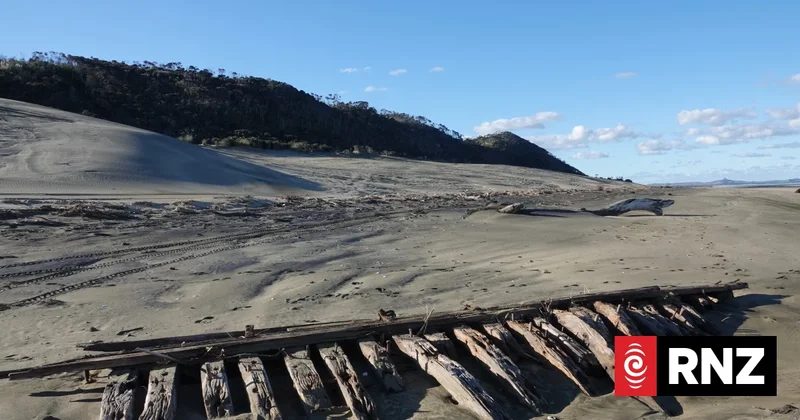
Better signage and a more workable law are needed to protect the shipwrecks that litter a wild stretch of Northland's west coast, a marine historian says.
During the Kaipara Harbour's 19th-century kauri export boom, a combination of powerful tidal currents, sandbars, and rapidly shifting winds doomed many a sailing ship.
The remains of as many as 150 vessels lie buried in the sands of Ripiro Beach, north of the harbour entrance, in an area known as the Ships' Graveyard.
In recent weeks the beach has been thrust back into the headlines by an outcry over the destruction of a freshly washed-up fragment of ship's hull.
Steven Cochrane said he was visiting the beach near Pouto Point on 12 July when he spotted a group of people using a tractor to pull the wreck apart.
"It was a piece of the side of one of the ships, from my understanding. It had all the sideboards and whatnot and a bit of the skeleton of the hull. Unfortunately, by the time I got to it, it was all destroyed. It was just ripped apart. It was just a trailerload of timber by that stage."
Cochrane challenged the men, who told him they planned to use the timber in their gardens and for firewood.
He called police from the beach and, by uncanny coincidence, a vehicle towing the trailer loaded with ship's timbers pulled up next to him at a service station as he was heading home that evening.
Cochrane again called police, who were "on their tail pretty quickly".
He said it was disappointing a piece of history had been lost before anyone even knew which ship the wreckage had come from.
Among those contacted by police for advice on the wreck was Bill Edwards, Heritage New Zealand's Northland manager.
Edwards told RNZ he could not comment on the specific incident in case it ended up before the courts.
However, he said the area became notorious for shipwrecks when huge quantities of kauri logs and spars were being exported from the Kaipara Harbour.
"It's an extremely large harbour. That means there's a large amount of tidal current. There's also sandbars that occur, and the third thing that happens is the wind can change. It's very dangerous for a sailing vessel. Hence, they crash on the beach."
Edwards said wrecks regularly emerged from the sand, then disappeared again.
"The sand is highly mobile. So these wrecks can be covered and not seen for decades, and then there can be a tidal event or a storm that uncovers them very quickly. So they're visible for some periods of time, and other periods of time they're completely covered by sand."
Under the Heritage New Zealand Pouhere Taonga Act 2014, it is illegal to disturb any archaeological site - including shipwrecks - from before the year 1900.
Edwards said most wrecks along Ripiro Beach would be pre-1900, because that was when the kauri trade was at its peak.
"So if you do find a wreck there, the easiest thing is to suppose that it's pre-1900, unless you're told otherwise."
During a recent visit to the beach, RNZ found fragments of two shipwrecks in Midge Bay, near Pouto Point.
Both were clearly from sailing ships and likely to date back to the 19th century.
They were constructed with "tree nails" - wooden pegs used to fix planks to the ship's ribs - and one still had wrought-iron stays used to attach the rigging to the hull.
Edwards believed more education about New Zealand's marine heritage was needed.
"I think people need to know these places can't be interfered with. In this recent case, I must commend the people that spotted this and gathered evidence. It's been invaluable."
Shipwreck expert Ron Halliday, of Dargaville, worked with the likes of Kelly Tarlton and Noel Hilliam to recover many of the artefacts on display in Dargaville Museum.
He said the coast on either side of the harbour entrance was unforgiving for sailing vessels.
"Vicious currents, vicious storms, strong winds. All the west coast is wild, wild coastline."
Now 92, Halliday said the most significant wreck he had dived on was that of the L'Alcmène, a three-masted corvette from the French Pacific fleet.
Built in 1834, it was wrecked in 1851 with 229 men and one countess on board. All but 12 survived.
Although the wreck was only in a few metres of water at spring low tide, it was extremely dangerous due to powerful currents, swirling sand and poor visibility.
"That was an absolutely beautiful ship. That's the most important one that we dived on and recovered cannons and the anchors."
Halliday said he could not be sure which ship the latest piece of wreckage had come from, but he suspected the Cathona, which came to grief in 1899.
Part of the three-masted barquentine last appeared in 2021, before being swallowed up again by sand.
Halliday had no time for anyone who deprived New Zealanders of the chance to learn about their history.
"Those people had a damn cheek, really, to go down there and just hack into it with chainsaws."
Maritime historian and author Don Armitage, also of Dargaville, said the most complete shipwreck recovered to date from the Kaipara coast was the Daring.
The schooner was built at Mangawhai Heads in 1863, wrecked just south of the harbour entrance in 1865, and revealed by shifting sands in what was then a restricted Defence Force weapons range in 2018.
It was now on display in the Mangawhai Museum.
"We know that after it had been exposed by a storm, there were people driving up and hacking into the Daring straightaway, basically. And there's still material that hasn't been returned. We know who took it, and we know where it is, but there doesn't seem to be any urgency to do something about it."
Armitage said the law needed to be improved.
"Human nature being what it is, this sort of thing will always happen, but the law is not clear enough at the moment. If you come along and see a piece of wreckage on the beach, how do you know whether it's over 100 years old or not? And what relevance does that have?"
He also wanted signs installed explaining that tampering with wrecks could be illegal, as well as giving phone numbers people could call if they found something interesting.
While most shipwrecks occurred long ago, one famous example happened at Baylys Beach, near Dargaville, in 1994.
The Askoy II was a steel ketch owned by the popular Belgian singer Jacques Brel, who had sailed it around the Pacific.
It was excavated in 2007, shipped back to Belgium, and fully restored. It is now on display in the port town of Zeebrugge.
Like Armitage, Cochrane wanted to see signs put up alerting beachgoers that most shipwrecks were legally protected.
"Some education via signs or even a display at the entry to the beach would go a long way. A lot of people would then understand that, A, look out for shipwrecks because some of them do show up in some silly places, and B, don't touch them. And if you're wondering what it is, ask someone who knows. Don't just assume."
Meanwhile, Edwards said the recent incident had highlighted the value of New Zealand's marine heritage.
"The big takeaway is if you find something, don't put it on your trailer. Don't take it home. Leave it there for other people to enjoy. Leave it there for a tangible reminder of the past," he said.
"Let people find these things for themselves. Leave them where they are because they contain a huge amount of information that in future generations will be really important."
He also urged anyone with an interest in the sea to visit the remarkable Ripiro Beach.
"There's clusters of shipwreck material scattered up and down the coast. It's quite desolate. It evokes feelings of what it must have been like for some of those people that were aboard those vessels. Most of them survived, but not all did," he said.
"It's a very wild coast, and it's a very lonely coast. It gives you a sense of wonder and beauty at the same time, and makes you look at how fragile human life can be sometimes."
Police said they had visited an address in Ruawai and seized a trailer of material allegedly taken from a shipwreck. Help had been sought to identify it.
Police enquiries were continuing.