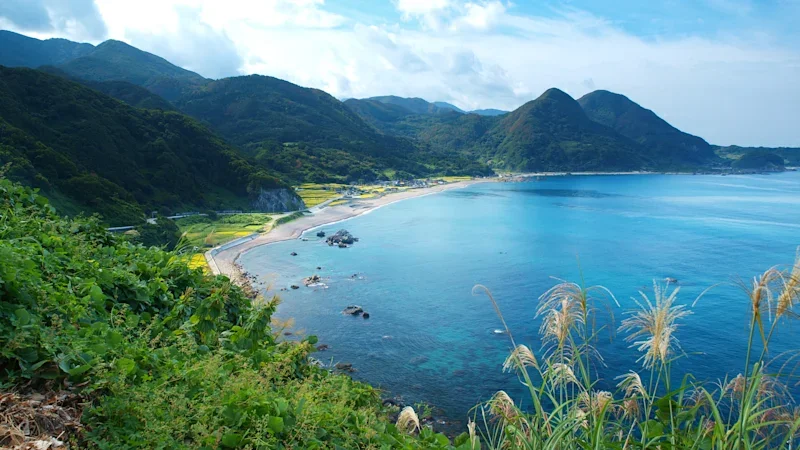
An exile for dissidents, a trading hub and home of Japan’s biggest and most productive gold and silver mine: Sado Island has been many things over the centuries. Lately, however, it is scenery, history and culture that draw visitors here.
For an island slightly off the tourist trail, it’s an easy visit – two hours by Shinkansen north-west from Tokyo to Niigata, then an hour by jetfoil (the levitating hull feels almost as smooth and speedy as the bullet train).
Dominated by two parallel mountain ranges linked by Kuninaka Plain, Sado’s 855 square kilometres are home to 48,000 people and about 580 toki. Once close to extinction, these pink-hued crested ibis were reintroduced through breeding programs, and now the island is pretty much the only place you’ll find them. From Ryotsu Port, we drive what’s informally called Toki Road, across the rice paddies they feed in, though the birds elude us.
The island’s latest claim to fame is Japan’s newest World Heritage site, Sado Island Gold Mines, which was designated in 2024.
Get exclusive travel deals delivered straight to your inbox. Sign up now.
From three prospectors having a poke about in 1601 until its closure in 1989, Sado’s mines produced 78 tonnes of gold and 2330 tonnes of silver making it, during the 17th century, one of the world’s leading gold and silver mines alongside Bolivia’s Potosi Mine.
A mountain split in half by open-cut diggings is the first I see of it during the drive in. Underground are 400 kilometres of tunnels, a few of which are accessible on two self-guided walks.
The tunnels of Sohdayu Mine are dotted with industrious animatronic “miners” re-enacting scenes of earlier times: the chiselling of rock, the clever use of Archimedes screws to direct water out of tunnels. The tour of Dohyu Mine takes in more recent tunnels and the open-cut site and, combined with a well-presented information centre, is an enlightening peek into the island’s history.
But Sado’s appeal extends above ground, too. With only one day to explore, a leisurely three-hour e-bike ride around the Ogi Peninsula proves good bang for money.
Map in pocket, we cruise quiet roads floating above a glorious coastline of craggy black basalt, deep coves, emerald lagoons, temples and cute fishing villages.
A port since medieval times, Shukunegi must rank among the “most quaint towns of Japan”. It flourished in the mid-18th century and more than 100 houses – for shipwrights, shipowners, freight masters and the community that supported them – were squeezed in the tiny cove.
Some streets are only a metre or two wide, and houses are clad in wooden planks to resist sea winds, while wooden roof shingles are held down with stones.
For centuries, wooden freight ships, or sengokubune, arrived in port. A 23-metre-long, seven-metre-wide replica can be found in Ogi Folk Museum. But in 1802, an earthquake raised the coastline a few metres and negotiating the new shallow maze of rocky outcrops, for loading and unloading, became problematic.
Enter the hangiri (also known as tub boats), which were made by cutting miso barrels in half. These round wooden tubs proved stable, had a shallow draft and are still used by fishermen for harvesting turban shells, seaweed and abalone. Numerous places along the coast offer rides.
In Shukunegi, Kaneco-san takes me out for a spin (not literally), and it squeaks like a bathtub and “rides” like a horse. At the bow (as much as a round boat can have a bow), Kaneco stirs the one oar that propels us while I use a glass-bottomed wooden box to peer at the sea floor.
On a still and sunny day, it feels like a moment of history captured. A simple boat, in a peaceful cove, on a relatively quiet island. I could stay longer.
THE DETAILS
VISITTours of Sado Island Gold Mines cost about $13. Rent e-bikes at Marine Plaza Ogi near the port. Tub boat rides are available in Ogi Port, Shukunegi and Yajima. See sado-kinzan.com
FLYANA flies twice daily from Sydney to Tokyo. The Shinkansen to Niigata takes two hours, and the jetfoil to Sado Island departs frequently from Niigata. Rent a car on arrival or, if you already have one, catch the slower car ferry. See ana.co.jp; sadokisen.co.jp
STAYNikko Hotel Niigata is a 10-minute walk from Niigata Port. Rooms from $185. hotelnikkoniigata.jp
MOREvisitsado.com; japan.travel
The writer travelled as a guest of the Japan National Tourism Organisation.