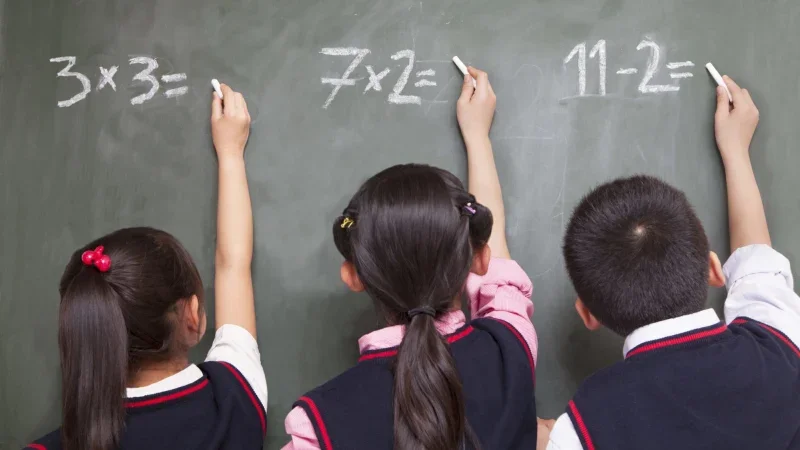
More than one-third of year 9 NSW students failed to meet expected standards in reading, writing or grammar and punctuation in this year’s NAPLAN tests while the performance of year 3 pupils in mathematics has been described as “clearly concerning”.
Official results from the National Assessment Program Literacy and Numeracy test released on Wednesday show that one in three year 3 NSW students who sat the test are failing to meet expected numeracy benchmarks, with those students classified as either “developing” or “needs additional support”.
Recent reports on students’ declining mathematics skills in primary school have pointed to surveys showing one in five primary teachers worry about teaching it more than other subjects, while some analysts have urged a rethink of everything from teaching styles to classroom technology use.
NSW’s poor year 3 maths performance was mirrored nationally, with students across the country recording the lowest average numeracy scores since 2023, when the results reporting system was overhauled.
“The drop in Year 3 numeracy results is clearly concerning,” said Australian Curriculum and Reporting Authority chief executive Stephen Gniel, who oversees NAPLAN tests across the country.
Federal Education Minister Jason Clare said there was some good news for year 5 students’ performance in numeracy nationally but described year 3 maths results as “a different story”.
Australian Education Research Organisation chief executive Dr Jenny Donovan said technology in class and whether schools utilised explicit instruction techniques may be impacting results.
“What is going on in the classroom? Are there things that are distracting from good, explicit instruction, like educational technology?” she asked.
Centre for Independent Studies education director Blaise Joseph described the one-third of students not meeting numeracy benchmarks as an “entrenched problem”.
“In general, student attention spans are getting worse and numeracy is something where you need focus, repetition and practice for an extended period of time. Results may be getting worse for that reason,” he said.
NAPLAN went entirely online in 2022 except for the year 3 writing test. Education ministers recently sought advice on the efficacy of conducting the writing test with pen and paper, given the emerging evidence on the impact of screens and devices on cognitive development.
Education ministers this year accepted the recommendations to conduct a “targeted” review of the nation’s mathematics curriculum in primary school to give more clarity and support to teachers about what should be taught and when in the early stages of primary school.
NSW Education Minister Prue Car noted the state’s students exceeded national averages. She said a maths screening check rolled out this year had assessed 60,000 year 1 students to identify gaps in their number skills.
“While this year’s results are largely stable, they also show there is more to do, and highlight where schools need to continue to focus their efforts with evidence-based teaching and targeted programs,” she said.
Children living in cities significantly outperformed rural and regional students. Around half of students living in outer regional areas in NSW met numeracy benchmarks in year 3, compared to 67 per cent of students in major cities.
At Regina Coeli Catholic Primary School in Beverly Hills in Sydney’s south, every mathematics lesson begins with revision.
“Just when the brain’s about to forget, it’s vital that then we review those concepts again because it helps transfer things to long-term memory,” said maths co-ordinator Tania Melfi.
That approach has worked for the school, where more than 90 per cent of students met year 5 numeracy benchmarks – an increase of 12 percentage points on last year.
Maroubra Public School principal Helen Empacher said her school has worked hard to make maths lessons engaging, and gamified the subject to hold students’ attention. The school has also spent time teaching parents maths so they can confidently help their children at home.
“We make sure that they’re up to date with the strategies that we’re using – we get them to come and play the games as well. So we invite them in. We have open classrooms for them to come and participate in a maths lesson,” Empacher said.
In NSW, year 3 girls significantly outperformed boys in writing. More than 82 per cent of year 3 girls were classified as strong or exceeding, compared to 72.3 per cent of boys.
For year 9 students, the gap was more pronounced, with almost 70 per cent of girls meeting or exceeding benchmarks, compared to just 53.8 per cent of boys.
In numeracy, 69.6 per cent of year 9 boys exceeded the minimum standard compared to 65.5 per cent of girls.
Across Australia, the average reading scores in year 5, 7 and 9 were lower than in 2025 and there was a slight increase in students needing additional support in reading and writing since 2023.