All eyes in the luxury market are fixed on China after Bain reported upwards of an 8% decline in sales there last year. While quarterly losses narrowed as the year progressed, suggesting a gradual recovery, the pullback hit global luxury brands hard because China has been a dependable growth engine over the last decade. The question hanging over the industry now is not just when China will recover, but how its consumers will behave when it does.
So far, many luxury brands are feeling wind at their back in the Asia-Pacific region, excluding Japan. Richemont just posted 19% growth in the first quarter there. LVMH’s first half revenues climbed 6% in the region, after a 9% drop in the same period last year. Hermès fell 1% during the first half, but turned positive in the second quarter, up 3%. Prada Group advanced 15%, powered by Miu Miu. Kering was the outlier with first-half sales off 3%, though results sequentially improved from -4% in first quarter to -1% in the second.
Yet it’s too soon to call it a rebound. TD Cowen cautioned, “We see early signs of stabilization in China luxury”—stabilization, not growth—and noted that gains are anticipated in hard luxury, such as jewelry, as opposed to soft luxury categories, like fashion and leather goods, with “stable engagement and a balanced spending outlook in China beauty.”
In its survey among 2,000 Chinese consumers—54% of whom fall into the high-income or upper-middle-income range of core luxury consumers—Cowen observed, “We believe a consumption revival is elusive,” noting that the Chinese consumer “remains uninspired,” with retail sales growth at its slowest pace since the end of 2022.
Emotions Drive Demand
If the luxury market is going to reach the 4% to 6% annual rate of growth McKinsey projects through 2030—with China outpacing other major regions—brands will need to elevate their China strategy.
And that’s the overriding challenge because the motivations for luxury consumers in the U.S.—the world’s largest luxury market—are diverging from those of Chinese consumers in profound ways. It is especially important to get consumer psychology right as traditional drivers, such as craftsmanship, heritage and exclusivity, are playing less important roles in brand engagement.
While consumer demographics, such as age, income and spending power, place constraints on luxury market growth, consumer psychology ultimately drives demand. And a new study by McKinsey, in association with The Business of Fashion, uncovers four behavioral dimensions—desirability, exclusivity, moments and discovery—in which U.S. and Chinese consumer motivations are moving in different directions.
In both markets, emotional connection is the leading driver of luxury purchases. But how U.S. and Chinese consumers achieve that emotional feeling differs sharply, suggesting strategies that open doors in one market and could create barriers in the other.
What Makes Luxury Worth It?
In the U.S., the desirability dimension has turned inward to emotional connection based on shared values, self-expression and personal rewards. Whereas in China, the emotional drivers turn outward toward social validation and confidence building.
Notably, among the 2,000 U.S. and Chinese luxury consumers surveyed, Americans are increasingly turning to challenger brands rather than established luxury houses. Some 68% said newer or disruptive brands better reflect their identity. On the other hand, heritage brands still hold sway in China where logo recognition is important to 89% of Chinese consumers, compared with 72% in the U.S.
The brand’s visibility is a critical part of the value proposition in China. “Here luxury products help customers feel socially validated,” the report states. And social validation doesn’t come only from the pride one feels in carrying a pricey handbag.
The retail experience itself is a critical part of the social calculus in China as well. “Consumers place much greater emphasis on visibility and high-touch service, reflecting the continued role of luxury as a social tool,” the report continued.
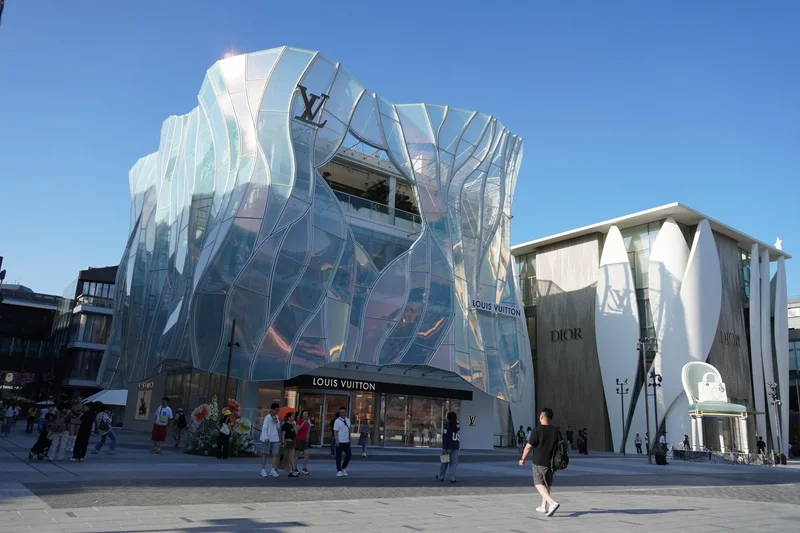
Louis Vuitton leaned into this dynamic with its recent opening of a new four-story Beijing flagship store in Taikoo Li Sanlitun with the first Louis Vuitton café in the city, reflecting what Jing Daily described as a “broader strategy of marrying retail with hospitality to extend customer engagement.” Sister-brand Tiffany & Co has followed suit, opening a flagship in the same shopping district in March.
In China, the in-store experience is a critical part of a luxury brand’s social currency—and that currency carries far more weight there than it does in the U.S.
What Makes Luxury Feel Special?
Exclusivity has long been a dimension of the luxury value equation, but luxury consumers in both the U.S. and China are increasingly skeptical of manufactured scarcity. Just making a product hard to find no longer justifies paying full price. But in the U.S., exclusivity is shifting toward insider recognition—being known to a select few, rather than the many—where challenger brands have an edge.
In China, exclusivity is tied more to the purchase experience that to the brand and product itself. The number-one driver of exclusivity is bespoke, customized client services. As the report explains, “Bespoke services, private appointments and personalized customer service rank among the strongest drivers of exclusivity across client tiers in China. Contrasting with the U.S., exclusivity is less about access and more about unique treatment, making high-touch service a critical differentiator in luxury.”
Exclusivity matters in both markets, but it matters more in China—88% rank it as important, compared with 74% in the U.S. And the meaning of exclusivity contrasts sharply. In the U.S., exclusivity primarily means insider access to products. In China, it hinges on insider access to personalized services—the kind that socially validate and reward the customer.
How Luxury Is Experienced
The moments that matter most for U.S. and Chinese luxury consumers are those that create lasting memories. Travel is the primary way consumers in both markets fulfill that need when considering how to spend discretionary income, way ahead of any luxury product purchase. As the report states, “The broader implication is not that consumers prefer vacations to handbags—it is that they increasingly associate luxury with experiences that feel personal, memorable and difficult to replicate.”
But the ways those experiences take shape differ. In the U.S., luxury clients look broadly to lifestyle experiences, such as travel and wellness-related activities, that compete directly with luxury labels. In China, experiences are more closely bound to the brand itself, putting the store experience front and center as the place where emotional connections and memories are made.
In effect, traveling to visit a luxury flagship store—such as Louis Vuitton’s stunning boat-shaped boutique in Shanghai—becomes the moment that creates the memories.
“Luxury brands are increasingly using physical spaces to deliver experience that blend retail, hospitality, culture and entertainment,” the report explains. “Rather than functioning purely as transactional environments, stores are evolving into destinations designed to deepen emotional connection, increase dwell time and create social participation around the brand.”
While creating memorable brand experiences is important in both markets, it is of a higher priority in China, where stores are expected to function as “immersive brand theatres.” On that stage, the store’s service personnel become part of the story, being performers who bring the brand experiences to life.
How Luxury Is Found
The discovery dimension is splintering across multiple channels in both markets. AI is increasingly shaping luxury inspiration, discovery and exploration. But in China, it plays a more functional role than in the U.S., helping Chinese consumers navigate product specifications, quality and comparisons—further down the line in the typical shopping journey.
The research suggests luxury brands should use AI to strengthen client confidence without diminishing the critical human factor that defines China’s personal service model. As the report advises, “Pairing high-touch advisory services with AI tools that a shopper can navigate themselves can deepen consumer more than either would independently.”
Resale is also becoming a more important discovery channel in both markets, but the motivations diverge. In the U.S., particularly among the established luxury consumers who are the most active pre-loved buyers, the thrill of the hunt is as important—if not more so—as affordability.
In China, neither the “treasure hunt” experience nor gaining access to lower-priced luxury is as important. Trust in the item’s authenticity and quality is paramount. “Resale adoption among Chinese consumers remains more trust-led than thrill-led, making authenticity, provenance and credibility paramount,” the report states.
Resale demand in China is also more concentrated in investment-grade categories, such as bags, jewelry and watches, rather than clothing, footwear and outerwear. For example, 58% of American luxury consumers said they are interested in buying pre-owned luxury clothing compared with only 29% of Chinese.
From Stabilization To Growth In China
While the luxury market in China appears to be stabilizing after a recent downturn, the more important story is how consumer psychology will shape its future trajectory. The four dimensions McKinsey identifies—desirability, exclusivity, moments and discovery—show that Chinese consumers aren’t responding to the same emotional triggers as those in the U.S., and one might assume in other mature Western markets as well.
In the U.S., luxury is turning inward to be more personally rewarding and more lifestyle oriented. In China, it remains outwardly focused, operating within a wider social context. For global luxury brands, the next decade of growth will depend less on product—“Products may be the easier part of the equation for brands to get right,” the report states—and more on tailoring the emotional value to the specific motivations of each market.
As Imran Amed of The Business of Fashion and Gemma D’Aria of McKinsey write: “These shifts are already reshaping markets, setting the terms for the decade ahead. The industry’s future will no longer be defined by a single, global luxury client, but rather the ability of brands to navigate increasingly different expectations across markets.”
See Also: