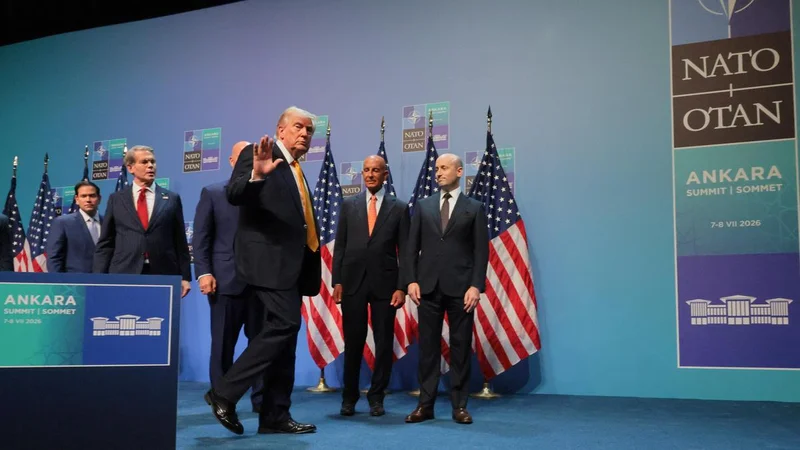
For the first time since the creation of the North Atlantic Treaty Organization (NATO) in 1949, Washington is asking Europe not merely to spend more on defence but also to assume primary responsibility for its own security. This marks a fundamental shift in the transatlantic compact and signals the emergence of a new phase in the Alliance’s evolution. The question is no longer whether NATO will endure, but how it is adapting to a changing strategic landscape.
America’s shift
The National Security Strategy of the United States of America (November 2025) maintained NATO as America’s principal transatlantic alliance while signalling a significant shift in Washington’s expectations of European allies, particularly regarding burden-sharing and collective defence responsibilities. It argued that the era of the U.S. serving as Europe’s primary security guarantor was drawing to a close and that prosperous European allies must shoulder greater responsibility for defending their own continent. While endorsing NATO’s commitment to increase defence spending to 5% of GDP as the new benchmark for burden sharing, the strategy envisaged the U.S. remaining the Alliance’s strategic enabler, nuclear guarantor and political convener rather than its sole military backbone. The objective is a stronger, more self-reliant Europe that allows Washington to devote greater strategic attention to the Indo-Pacific.
This rebalancing is already evident. Following Russia’s invasion of Ukraine in 2022, U.S. troop strength in Europe rose to around 1,00,000 personnel. Since then, Washington has gradually reversed that surge. During 2025-26, it withdrew around 5,000 troops from Germany, cancelled the planned deployment of 4,000 troops to Poland, and reduced Brigade Combat Teams in Europe from four to three, bringing the U.S. military presence in Europe down to approximately 75,000-80,000 troops — close to pre-Ukraine war levels. The 36th NATO Summit in Ankara in July 2026 reinforced this transition. While reaffirming the Alliance’s commitment to Article 5, members pledged €70 billion in military assistance for Ukraine in 2026, committed to sustaining comparable support in 2027, endorsed European-led development of long-range precision strike capabilities and accelerated efforts to strengthen NATO’s defence industrial base. The underlying message was unmistakable: Europe must assume greater responsibility for its conventional defence as the U.S. increasingly prioritises the Indo-Pacific.
Lord Ismay, NATO’s first Secretary General, famously described the Alliance’s original purpose as “to keep the Russians out, the Americans in, and the Germans down”. While that dictum captured the strategic logic of the Cold War, NATO today has entered a distinctly different phase that may be summed up as keeping Russia deterred, America engaged and Europe prepared.
NATO’s evolution over time
The Alliance’s evolution can be viewed in three phases. NATO 1.0 (1949-1991) relied overwhelmingly on American military and nuclear power to deter Soviet aggression and preserve transatlantic unity. NATO 2.0 (1991-2022) followed the collapse of the Soviet Union, expanding eastwards, incorporating former Warsaw Pact members and undertaking operations in the Balkans and Afghanistan. Yet, this period also witnessed declining European defence expenditure and growing dependence on the U.S. for intelligence, logistics, strategic mobility and high-end military capabilities, making burden sharing an increasingly contentious issue.
The Russian invasion of Ukraine has ushered in NATO’s third phase, a more balanced transatlantic partnership in which Europe assumes primary responsibility for conventional defence while the U.S. continues to provide strategic enablers such as nuclear deterrence, intelligence, long-range precision strike capabilities and global power projection. This is less a story of American disengagement than one of strategic redistribution.
The scale of Europe’s response was evident at the 2025 Hague Summit, where NATO members committed to increasing core defence spending to at least 3.5 % of GDP by 2035, with progress to be reviewed in 2029. Germany has doubled defence expenditure since 2023 and aims to reach the same target by 2029 while rebuilding military capability to deter Russia. Moscow, meanwhile, has reorganised its western military posture with new headquarters, formations and bases facing NATO.
The more difficult challenge, however, is not spending but replacing the American military ecosystem. Even as European armies become stronger, they continue to depend heavily on the U.S. for intelligence, surveillance, satellite support, command and control systems, strategic airlift, missile defence, long-range precision strike capabilities and, above all, the nuclear umbrella. Washington’s reduction of rapid reaction assets, including bombers, fighter aircraft, air-refuelling tankers, warships, aircraft carriers and attack submarines, together with the deferred deployment of Tomahawk cruise missiles to Germany, illustrates the extent of that dependence. Europe’s central dilemma is therefore not simply building larger armed forces but developing the integrated capabilities that have long underpinned NATO’s effectiveness. As Poland’s Foreign Minister recently observed, Europe does not need to match American military power; it simply needs to be stronger than Russia.
New Delhi and the rebalance
For India, NATO’s transformation is less about Europe than about the redistribution of American strategic attention. A Europe capable of assuming greater responsibility for its own security would enable Washington to devote more diplomatic attention, military resources and strategic investments to the Indo-Pacific, reinforcing the regional balance amid China’s growing assertiveness. At the same time, a more capable Europe could emerge as an important partner for India in defence manufacturing, advanced technologies, artificial intelligence, cybersecurity, semiconductors and space.
New Delhi should therefore view these changes through the prism of strategic opportunity rather than alliance politics. Closer cooperation with both the U.S. and Europe can complement, not compromise, India’s long-standing commitment to strategic autonomy. If navigated prudently, NATO’s new strategic model can expand India’s defence industrial partnerships, accelerate technological modernisation and strengthen its position as a leading power in an increasingly multipolar world.
Advitya Madan Commanded 15 Punjab in Lebanon under the United Nations Flag, commanded 27 Sector as DIG in Churachandpur, Manipur, and was Brigadier, Operational Logistics, in HQ Western Command. He is currently an analyst on geopolitics, international and defence affairs
Published - August 05, 2026 12:08 am IST