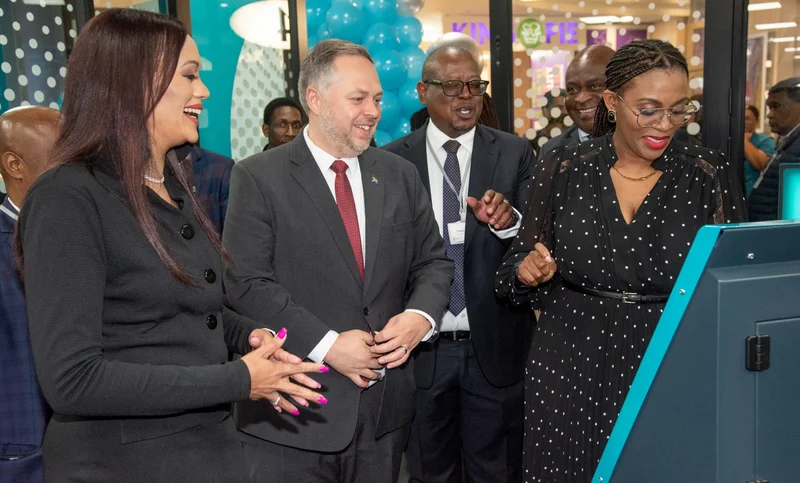
âI think the honest answer is leadership.â That was Home Affairs Minister Leon Schreiberâs response to Daily Maverick questions about the secret sauce behind the rapid roll-out of smart IDs processed through bank branches.
The numbers back him up. Speaking at FNBâs Century City branch, he highlighted the bankâs pioneering role in embedding Home Affairs agents in bank branches (well, all of two) in 2015. Over the next decade, FNB is expecting to issue 312,000 smart ID cards.
Itâs already surpassed 15,000 since becoming a partner in the new system, which has been in operation for under five months and, crucially, doesnât require a Home Affairs agent in the branch.
The truth hurts
âThe answer is having a clear vision and leading in that direction,â Schreiber continued with his deserved victory lap. He added:
âIt is honest and correct to say that none of the technology that we are using only appeared 4½ months ago ⦠it was there. The integration between the banking sector and Home Affairs was also there, through the online verification service. It wasnât working as well as it should have, but banks were using it to verify their clients.â
Crucially, he revealed that the Department of Home Affairs (DHA) is using the same principle to reform South Africaâs immigration system.
The new electronic travel authorisation (ETA) system relies on the same core components: pre-existing biometric technology, document verification systems and machine learning, coordinated under a unified strategic vision to digitise and secure border access.
âSo all the building blocks were there,â he explained. âWhat it required was a vision of how to rearrange these building blocks, of how to invest in the right technology in the right upgrades, and the right people to bring those solutions together to unlock the power of technology that already existsâ¦. That is the thing that changed, and that is a statement of fact.â
Okay, but what is actually different with the bank system?
The DHA operates at a massive scale, serving a client base of 63 million South Africans, and, historically, there were only 240 permanent, modernised DHA offices and 32 bank branches in the entire country capable of issuing smart ID cards.
An additional 90 offices remained unmodernised, only issuing the green barcoded ID books.
The old system required a DHA agent to be present at the branch to process the applications for smart IDs and passport renewals. Today, the DHA simply provides technical specifications that banks can integrate via API (application programming interface) â allowing them to process applications anywhere they have the right hardware.
FNB relies on a dedicated tablet and a multi-purpose photobooth for biometric capturing, whereas Capitec has cut staff out of the loop entirely â building automated kiosks that guide customers through the process without an operator.
What once consumed a full day (or days, when there isnât water at the DHA office) can now be completed at a branch in 15 minutes. Once the application is submitted, it currently takes approximately 13 days for the smart ID card to be delivered, with active work under way to reduce this turnaround time further.
Launched at a single branch on 9 March, the modernised digital partnership has expanded at breakneck speed. Today, 372 active branches across FNB, Standard Bank, Capitec and Absa are live â and more than half a million South Africans have successfully applied for smart IDs. With eight banks signed on, the DHA is eyeing 750 participating branches by year-end.
Bring me the horizon
Next on the agenda is a new website where you can see a real-time database of venues where this smart ID system is available.
You can also book your appointment, and this journalist was quite astonished that it worked largely as advertised from when it was announced.
The next phase of the Home Affairs @ Home initiative focuses on expanding banking services, launching home deliveries (also announced in time for the Post Office receiving its first unqualified audit in six years), and rolling out the voluntary digital ID card system.
âEffectively, where we are going to end up is that we have the smart ID card and digital ID,â Schreiber explained.
âSo the green book falls away, but the digital channel will be added to replace it. In order to make the green book fall away, we have to give the remaining 14.7 million holders of the green ID access to the alternative, which is the smart ID or digital version that is coming.â
Earlier this year, the DHA published the draft regulations for the digital ID, which, instead of being an image of your ID on your phone, acts as a remote authentication tool, enabling secure identity verification for online transactions and statutory services.
Thereâs also a plan to launch a working prototype of the MyMzansi app within the next few months. Schreiber confirmed that he will personally load the very first prototypes of all these digital services onto his iPhone to test their security and build public confidence before the phased national roll-out begins.
This journalist once wrote, after stalking him at the eGovernance Conference in Estonia, that Schreiber is the âminister of good intentionsâ. All these digital services were on display in that foreign land, and now his leadership is bringing it home.
Now if only he could solve xenophobia... DM