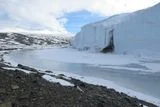
The Taylor Glacier in Antarctica seems normal on the surface, except for one glaring feature: an outflow of blood-red saltwater that makes it look like the glacier itself is sporting a constantly gushing wound. Beneath the glacier, however, lie signs of a hidden community of microbial life.
Even in the extreme cold of Antarctica, microorganisms still manage to thrive. Those living around Blood Falls have now been unmasked in a new Nature Geoscience study, in which researchers found signs of eukaryotes — organisms whose cells have a nucleus. The microbial community here has been sealed beneath ice for over one million years, yet persisted all this time.
“These results point to persistence, not just delivery,” said the study’s senior author Andrew E. Allen, a professor at the University of California San Diego, in a statement. “The molecular signatures we detected point to a localized community shaped by the unusual chemistry and history of Blood Falls. That gives us a biological window into past Antarctic ocean-ice-land connections.”
Microbes Hidden Beneath Blood Falls
Australian geologist Thomas Griffith Taylor first found Blood Falls during the Terra Nova expedition to Antarctica in 1911. In the years since it was discovered, scientists have been wondering what gives the water that deep red color.
The strange coloration, scientists eventually realized, is due to the iron-rich water reacting to oxygen in the air as it flows forth from the glacier. A 2022 study in Frontiers in Astronomy and Space Sciences further explained the answer to this colorful mystery, finding that samples of Blood Falls’ water contained an abundance of tiny, iron-rich nanospheres that color the water red as they oxidize.
While the disturbing sight of red water at Blood Falls has attracted much attention over the years, researchers uncovered another surprise there in 2009, when they detected 17 different types of microorganisms in the waters. This hidden subglacial ecosystem, it turns out, had been submerged beneath Taylor Glacier for nearly 2 million years.
Searching for Microscopic Life in Antarctica
The new study has added another layer to Blood Falls’ microbial community — there aren’t just bacteria in the brine beneath the glacier, but also complex eukaryotes like diatoms, dinoflagellates, and ciliates. These eukaryotes, according to the researchers, provide evidence that ancient seawater may have entered Antarctica’s McMurdo Dry Valleys during warmer periods before becoming sealed beneath ice.
“This is an environment that looks almost completely cut off from the ocean today,” said study author Angela Zoumplis, a postdoctoral researcher at Yale University. “But when we looked at the molecular signatures of the organisms living in the red mud and sediment around Blood Falls, we saw a surprisingly strong marine signal. That tells us this place may be preserving traces of an older connection between the Dry Valleys and the sea.”
To get a clear picture of how the microbial community at Blood Falls stands apart, the researchers analyzed 167 samples from Taylor Glacier, Dry Valley habitats, wind-deposited material, and marine reference sites in McMurdo Sound. They then used molecular sequencing and an RNA-examining technique called metatranscriptomics to identify the organisms and find out whether the community was active.
With these methods, they found the strongest marine signal in the ice, mud, and sediments surrounding Blood Falls; marine-associated diatoms made up between more than 60 and 80 percent of the community in these samples. Diatoms, the researchers say, are key markers of an environment and its past, since different groups of diatoms tend to live in specific habitats. The diatoms of Blood Falls, for example, were not classified in the same group as those in the Dry Valley samples.
An Active Community Since Ancient Times
The researchers note that the microbial community at Blood Falls contained active phototrophic eukaryotes, meaning they use light for energy. These organisms also displayed gene activity tied to photosynthesis, stress responses, cellular repair, and survival in salty conditions.
“That activity is what makes the finding especially exciting,” Zoumplis said. “We are not simply seeing genetic leftovers. We are seeing evidence of organisms responding to a harsh, changing environment — freezing, thawing, salt stress, iron exposure, and long periods of inactivity.”
The Blood Falls microorganisms haven't remained static since they took up residence beneath Taylor Glacier over one million years ago, the researchers emphasize; rather, they've been influenced by ocean dynamics and occasionally transported to Antarctica's polar deserts, leaving behind evidence of ancient swings in climate.
Article Sources
Our writers at Discovermagazine.com use peer-reviewed studies and high-quality sources for our articles, and our editors review for scientific accuracy and editorial standards. Review the sources used below for this article:
- This article references information from a study published in Nature Geoscience:Molecular evidence for a relict marine community in an Antarctic Dry Valleys subglacial brine-fed system
- This article references information from a study published in Frontiers in Astronomy and Space Sciences: A Multi-Technique Analysis of Surface Materials From Blood Falls, Antarctica