This article was written by Almas Kaisar for Vlast.kz and published on July 16, 2026. An edited version is published on Global Voices under a media partnership agreement.
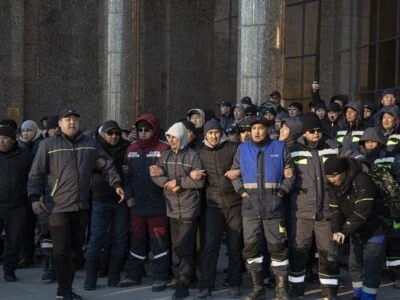
In the first half of June 2026, a wave of labor protests erupted across Kazakhstan, from a Kazakhmys mine in the country’s center to a phosphorus plant in the south, a stark reminder that labor rights issues are never far from the surface.
The strikes were spontaneous, continuing a trend of labor rights actions that officials have termed “illegal,” and which experts say would have been virtually impossible to organize through legal channels.
The government of President Kassym-Jomart Tokayev has introduced several amendments to the Labor Code over the past few years, ostensibly aiming to protect workers’ rights and improve collective bargaining power.
But independent trade union activists, researchers, and human rights defenders argue that these changes have been merely cosmetic and labor legislation remains repressive, largely favoring employers’ interests.
Experts surveyed by Vlast also think that the core issue in Kazakhstan remains the absence of an independent judiciary capable of guaranteeing a fair hearing for any labor dispute that may arise.
A repressive climate
On paper, trade unions serve as the primary institution by which workers’ rights are protected. For more than three decades in Kazakhstan, however, they have been under constant pressure.
“The situation with pressure is very complicated,” said Kospan Kosshygulov, who heads the Fuel and Energy Sector Union, one of the last independent trade unions in Kazakhstan. “In [the western city of] Mangistau, some workers managed to set up a local branch at an oil company. They decided to join our union officially, and all five were immediately fired. Management simply claimed it was because they were doing a poor job.”
According to Kosshygulov, the independent trade union had tried to address the issue of severe understaffing, where a single worker had been forced to do the job of three specialists. He said:
They [workers] tried using the trade union to refuse the duties of those two extra roles, and they were fired for it. We then took the matter to court, but every court — all the way up to the court of cassation [the country’s most senior court] — sided with the employer.
Many other labor activists shared similar stories.
According to Andrey Prigor, who chairs the Amanat Commonwealth of Trade Unions, the smallest of Kazakhstan’s three nationally recognized trade union associations, the country has a long history of such repressive practices.
“These repressions are continuing, and they will go on until the overall power structure changes. In individual regions, for example, the courts always side with the employers; it is almost as if they have the status of a state within a state,” Prigor said.
In his account, another major issue is that, under the national law, an organization must establish branches in at least half of the country’s regions to register itself as a labor union.
This requirement has proven practically impossible to meet for organizers in a wide range of industries, from oil extraction to filmmaking.
Above all, the entrepreneurial code
In theory, as the government agency responsible for enforcing labor legislation, Kazakhstan’s State Labor Inspectorate can review complaints over worker rights violations.
But, as labor lawyer Muslim Khassenov told Vlast, the body has quite weak enforcement powers, especially due to the oversized influence of the Entrepreneurial Code, which was adopted in 2015. He noted:
The Entrepreneurial Code requires businesses to be given advance notice of any visits, and inspectors may examine only the issues included on predefined checklists that cover only a fraction of the requirements set out in Kazakhstan’s labor laws.
The inspection checklist is a decree issued jointly by the ministries of economy and health. It contains only 38 specific items that inspectors are permitted to review.
According to Kosshygulov, this restriction has proven to be one of the most significant obstacles to protecting workers’ labor rights.
“State inspectors have to submit an application to the prosecutor’s office to obtain authorization for an audit. The prosecutor checks the mandatory checklist, and if the inspectors want to look into any [suspected] violation that isn’t on that list, permission is denied,” he explained.
Outside the law
But beyond the Labor Code, several labor activists and experts surveyed by Vlast explained that there are more fundamental issues inhibiting relations between employers and their workers.
According to Prigor, a bigger problem is that employers often simply refuse to engage in any kind of labor negotiations, “stonewalling employees” because they know “full well” that “nobody will punish them for it.”
His points were echoed by Khassenov, who noted:
Employers don’t bear any [serious] responsibility, even if they refuse to implement decisions made by the labor arbitration board [the second level of Kazakhstan’s formal labor dispute resolution process].
Furthermore, Khassenov noted, Kazakhstan’s current legislation fails to distinguish between disputes of a legal or economic nature.
Let’s say an employer fails to pay wages. Workers shouldn’t have to form a reconciliation commission and go through a long arbitration process, which will drag on for a month.
According to Kosshygulov, all these reasons stand behind the decision of workers to start striking. A collective action is the last resort when the legal system fails to provide redress.
In his view, however, strikes are virtually impossible under Kazakhstani law, as a union must obtain the support of two-thirds of the entire workforce before it can declare one.
Decorative reforms
Following the events of Qandy Qantar, the violent repression of urban protests in January 2022, in which numerous labor groups participated, Kazakhstan’s government introduced several new amendments to strengthen labor rights protection and improve the efficacy of collective bargaining.
Even President Tokayev, commenting on an uptick in strikes in 2022, said that he welcomed the “noticeable strengthening of independent trade unions in socio-political life.” But the reforms signed into law by the president thereafter boil down to minor improvements that mostly involve providing increased social protections.
For Khassenov, the amendments don’t go far enough:
These amendments are social in nature, they generally benefit workers, and they represent a way of making up for past mistakes. But they don’t require any real compromise.
According to Khassenov, at the Senate’s initiative, Maqsut Narkibayev University put together a draft piece of legislation designed to act as a “complete reform of [the country’s] collective labor law,” consisting of 37 potential amendments. He noted disappointingly:
But they only chose the 10 most harmless changes. And even if these ten were fully adopted, it wouldn’t change anything in substance. This is particularly true following the [recent] constitutional amendments, which completely erased the right to strike from the text, sending a chilling signal against collective labor rights.
Notably, the latter move goes against a recent advisory ruling by the International Court of Justice, the UN’s principal judicial organ, which recognized the right to strike as a fundamental component of the freedom of association.
However, the country’s new Constitution, which entered into force in July, effectively allows the government to disregard such rulings by giving domestic law precedence over the international treaties to which Kazakhstan is a party.