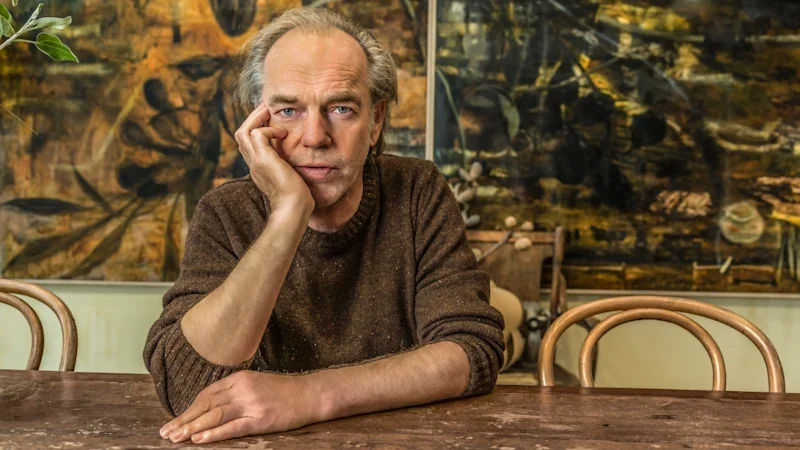
Hugo Weaving is looking for his turtles. “If we can just get them to put their heads up,” he murmurs, squatting at the edge of his turtle pond and throwing food into the water. “They’re Eastern long-necks,” he explains, “a male and a female. They are definitely a couple, but …” he breaks off. “There’s one! See?!” Two tiny nostrils break the surface of the pond, followed by a pair of perfectly circular bright yellow eyes. It’s like being stared at by an extremely small, extremely suspicious alien.
Weaving looks delighted. He’s wearing old trousers and a loose blue jumper, with his grey hair standing out from the back of his head in a wild tangle. “I feel sorry for her,” he confesses, gazing at the turtle. “Every year she wants to lay eggs, and so Harry [Greenwood, his son] and I constructed a big sandbox for her, but there are never any babies. She does lay eggs, but they don’t seem to be viable.” We pause, watching the turtle snap up food in her little muppet mouth.
Weaving, 66, is an unusual figure, and not only because of his turtle enthusiasm. He’s much taller and more solidly built in life than he appears on screen, even taller than his official six foot, two inches (188 centimetres); the sort of person you’d notice in a crowd, even if he wasn’t famous. He also has one of those large actor’s heads: big, expressive features, dramatic widow’s peak, exploding hair. The character he most resembles is Elrond, top elf king, whom Weaving has played in three The Lord of the Rings and two The Hobbit movies. Standing in his Sydney kitchen, he is Elrond post-Rivendell, sans jewellery or an elven hairdresser, enjoying his Sauron-free life.
He’s also much friendlier than Elrond would be. During a career spanning more than 40 years, 100-odd films and TV dramas, and dozens of stage productions, Weaving has played every role imaginable. In Australia, he’s most famous for his role in one of our national classics: The Adventures of Priscilla, Queen of the Desert (which may, Weaving will tell me in due course, at last have a sequel on the way, a mere 32 years after the original). Most recently, he’s added airport chaplain to his CV in the upcoming SBS drama called, yes, The Airport Chaplain.
But whatever the character, be it man or machine or drag queen, Weaving’s main claim to fame is his ability – on screen, or on the stage – to project a kind of riveting, enigmatic tension. He’s a master of the cryptic glance, the Delphic silence: you never quite know if he’s about to belt out a disco hit or hurl someone against a dystopian grey wall.
All of which makes it a surprise to find him so cheerful in real life. (He’s also kind. A confession: about 10 minutes before the end of this interview, I began to get a migraine. I was too embarrassed to say anything at the time, but when I contacted his agent a few days later and confessed, Weaving immediately agreed to speak on the phone to clarify details I’d missed. This is a kindness he need not have offered, and which filled me with gratitude. Which, in turn, means this story may not be as unbiased as I would otherwise wish. You have been warned.)
Weaving leads me from the front door through to the bright kitchen at the rear of his house. It’s actually two houses: a pair of 19th-century inner-Sydney terraces knocked into one. From the outside, each retains its unrenovated façade: two islands of bohemian life in a sea of investment-banker luxury. Inside, they create exactly the setting in which you’d expect to find an old-school, elder-statesman actor: colourful artworks, vintage furniture, untamed double-width courtyard garden and pool.
The turtle pond is right in the middle of the house: a kind of glassed-in light well that illuminates Weaving from behind as he makes mint tea in a battered enamel teapot. “Would you like an Anzac?” he asks. “Kat [Greenwood, Weaving’s partner] made them.” He bustles about, bringing the teapot and a plate of biscuits to the kitchen table.
Weaving is an expert in the small joys of domestic life. He had what he describes as a “wonderfully happy childhood” with his parents, older brother and younger sister, moving around the world in the course of his father’s career as a seismologist (and later a computing company executive). He lived first in Nigeria, then England, Melbourne, Sydney and Johannesburg before he turned nine, but did most of his schooling in England. Then, when he was 16, he and his family returned to Sydney permanently, and he’s lived here ever since.
“Mum and Dad managed to create this life for all of us,” he says, gesturing with his Anzac, “that combined the stimulation of moving around the world with a strong sense of love and stability inside the family.”
Despite this idyllic backstory, Weaving’s parents divorced after he’d finished high school. “I’d actually left home and moved to Woolloomooloo, he recalls. “So I wasn’t damaged by it in the sense I might have been if I was 11 or 12. But it was very, very difficult for my mum and dad, and difficult for the whole family. And I was grateful that I was able, to some extent, to deal with it as a semi-adult.”
Weaving was accepted directly (and unusually) into the National Institute of Dramatic Art from school. After finishing his NIDA training, he was immediately offered a two-year contract with the Sydney Theatre Company, alongside Mel Gibson and Judy Davis, Colin Friels and Ruth Cracknell. At 24, he starred in his first TV series, the 1984 smash hit Bodyline, and endeared himself to Australians everywhere by playing exactly the kind of supercilious, upper-class English villain (Test cricket captain Douglas Jardine) we most love to hate. More iconic roles followed – not overnight, but with reliable steadiness: Proof (Jocelyn Moorhouse’s 1991 low-budget gem); Priscilla in 1994; and then two Hollywood blockbuster trilogies: The Matrix from 1999; and The Lord of the Rings from 2001.
During this period, he also managed to fall in love with artist (and master Anzac biscuit maker) Greenwood and have two children, Harry (an actor, 37) and Holly (an artist, 34) Greenwood. These days, Weaving divides his time between roles in Australia and abroad (London, Ireland and New Zealand in the past couple of years), life in Sydney (he’s a passionate Sydney Swans supporter) and trips to the family property in the NSW Hunter region (where he plants gum trees and, presumably, consumes an infinite number of excellent homemade biscuits and cups of mint tea).
Sitting opposite him at his wide wooden table in his warm, sunlit kitchen, I’m reminded of a phrase he used years ago, in the brilliant Australian film Little Fish. Weaving plays Lionel, the father of Cate Blanchett’s Tracy, whom he calls his “shiny, shiny girl”. And at least on first impressions, this phrase seems appropriate to the scene before me now. Hugo Weaving looks like a man with a shiny, shiny life.
Is it just me, or is The Airport Chaplain a terrible name for a TV show? Still, at least you know what you’re getting. Weaving plays Tobias Wallace, a kindly but enigmatic (surprise!) multi-faith-friendly fixer at Melbourne International Airport. Wallace’s average day is spent dealing with everything from dead bodies to dog poo while helping people through the most horrendously stressful drama life has to offer: attempting to board a plane. Meanwhile, of course, it’s clear he has his own horrendously stressful life drama brewing behind the scenes.
Do airport chaplains actually exist? “Yes!” exclaims Weaving, leaning forward. “Do you know Jude Troy? She’s the producer. She was at Melbourne airport, and she … did she lose her passport? There was some issue like that – something quite dramatic.”
In fact, Troy left her bag – with all her ID, her computer, her phone – in the back of an Uber at the airport. “Oh my god,” she says, recalling the incident. “I remember standing at the Qantas desk, totally frantic, and they introduced me to this man with ‘chaplain’ on his vest. And I was like, ‘I do not need a priest!’ ” And yet, “a few hours later I was on a flight home, bags beside me, upgraded – all thanks to this wonderful man.” No wonder she co-created and produced a TV series based on him.
Working with Weaving, Troy says, was “an honour. I know everyone says that. But he could do the role – any role, really – with his eyes closed, and yet he gave it such care and diligence. He interrogated every line, every setting, every costume – right down to how many lanyards he should wear.”
“I do have this childlike interest in dress-ups,” admits Weaving: “in imaginary games, playing. But what that is, actually, is trying to put yourself in another place, transport yourself inside another human being. It’s a way of understanding the other.” This is what he’s always loved about acting. “Once I tapped into what that creative journey of acting might entail, I think I was really, really interested in it.”
His preparation for roles is famously immersive. “It doesn’t always look like it’s a joy,” confessed old friend and fellow actor Richard Roxburgh recently. “I’m just aware there’s a price that he’s paying in there.”
Weaving grins. “Rox is such a wonderful actor; he just wants to be in the place and play. And I do, too, but I can’t play if I don’t understand. So I will read every book, consult every source I can find.”
This gives his characterisations real richness, say colleagues. Paula Arundell, a close friend and collaborator for more than 20 years, first saw Weaving perform in Sydney in 1995. “My first thought was ‘He’s so tall!’ ” She laughs. “And he’s so full – full and present on stage. It’s like he can gather all the little pixellations of a character and shimmeringly put them together, so you’re witnessing the full vibration of a real human being on stage in front of you – not just an outline.”
“He’s always percolating,” agrees Heather Mitchell, who’s known him since they were both at NIDA in the late 1970s. “He’s never just listening and responding. He’s sharing an idea – a whole world – with you. And that makes you a better actor, because he sort of endows you with sincerity: he believes in you, he believes in the moment.”
One wonders, then, what he believes when he’s playing an objectively terrible person. In 2018, Weaving starred in Patrick Melrose, a fictionalised true story about writer Teddy St Aubyn, who was raped by his own father as a child. Weaving played this father, David Melrose. Does a role like this impinge on his own peace of mind? Weaving looks surprised. “No, not at all. It doesn’t stay with me.” He stops, thinking. “As an actor, you’re trying to embody not just the illness – this hideous, misogynist and abusive paedophile – but the human. You can’t let them off the hook, you can’t sentimentalise. But at the same time, it’s not up to you to judge. It’s up to you to inhabit. But it doesn’t mean you can’t be on set and then when it’s ‘cut’, you can’t have a laugh as Hugo. Because actually it was a very joyful set.”
Weaving loves the collegiate creativity of sets and rehearsal rooms. Back in 2012, he was – unusually for him – critical about his part in three of the four animated Transformer movies, in which he had a voice-over role as arch-villain Megatron. His ire seemed mostly self-directed: he confessed he’d never met director Michael Bay in person or read the script, and that he found his role “meaningless”. “Very rarely have I said I’d do something and I wasn’t really interested in it,” he says now. “Transformers was an example. I said no to it three times, [then] eventually I did it. But when you do make choices like that, you end up …” He pauses. “It doesn’t have the same meaning. So everything I do is something that excites me.”
“He wants the work to be good. And he wants to be good,” says playwright Angus Cerini, who wrote Wonnangatta, in which Hugo starred in 2020. “He interrogates, but with real kindness.”
“He has a kind of gentle command,” is how Mitchell puts it. “He thinks so deeply, not just about his role, but the whole story. He’s never forceful and never selfish, but he’s very decisive. I’ve been working with him when he’s said, ‘No, I really believe this is the way it must be. This is how I see it.’ If something’s truthful for him, he will stand by it.”
Despite his success, and his dedication, you could argue acting is a strange career for Hugo Weaving. He describes himself as a “very shy, very shy little boy. Because we moved so much, I just had to experience the new place, the new school, the new house. And it was wonderful, and my eyes were continually opened. But I was also aware that I always felt like the ground underneath my feet was shifting.”
‘If I had a full seizure, my overwhelming sense was that I was dying … like my brain was blowing apart. So it was quite traumatic.’Hugo Weaving
In addition, when he was 13, Weaving was diagnosed with epilepsy. “It was as if time and space became scrambled,” he says of having a seizure, for which he was medicated for three decades. “Like every electrical impulse in my brain was firing, but in the wrong place. And then that would be combined with me going deaf, and everything closing down. If I had a full seizure, my overwhelming sense was that I was dying.” He pauses. “That’s how it felt, every time: like I knew I was dying; like my brain was blowing apart. So it was quite traumatic.”
Even so, Weaving says it never held him back. His seizures were rare – an average of one a year – and even when he was at his worst, he never had one while filming or on stage – though back in 2000 he did get strangled a little too enthusiastically onstage during the previews for an STC production of The White Devil and passed out, which was mistaken by some people for a seizure. (A colleague of mine who was in the audience certainly remembers the moment as super-dramatic.) “Apparently I was frothing at the mouth,” said Weaving at the time. “So it makes a good story.”
A good story, but not one related to his present-day life. “I completely grew out of it,” he explains (a not uncommon resolution with some forms of childhood epilepsy). “I haven’t had a seizure since, I don’t know, my late 30s?”
Certainly it’s been far behind him in the second half of his career, which has arguably been even more impressive than the first. This year, as well as The Airport Chaplain, he will film a new ABC drama, The Great White. He may even reprise his role as Anthony “Tick” Belrose in a Priscilla sequel. “There’s been some serious talk about revisiting Priscilla for about five years,” he explains. “And there’s a script. And even though Terence [Stamp] died last year, we have factored all of that in, and he did, too.”
Stamp, who played transgender nightclub singer Bernadette in Priscilla, actually recorded scenes and dialogue for director Stephan Elliott before he died, in what Elliott has described as a plot “about old age [...] about what it’s like to get old and to be either gay, trans – I mean, it’s a subject that’s never been explored.” There’s no doubt the original (ageing) audience would love it – and Weaving would, too. “The way in which it’s being planned,” he says hopefully, “it might happen.”
Even in his rare moments off-stage or away from the cameras, Hugo Weaving’s life has a quality of the movie script about it: kid with chronic health condition fulfils his childhood dream and becomes a Hollywood movie star. And also, along the way, manages to create a happy life with childhood sweetheart. Weaving first met Katrina Greenwood when they were preschoolers; their families were neighbours on Sydney’s upper north shore. As young adults, they were share-house mates. Then, when Greenwood returned from a trip overseas when they were in their early 20s, they got together, and 42 years later, they’re still a notoriously happy (unmarried) couple. Surely this means Weaving is as qualified as anyone to explain the secret to true, enduring love?
He laughs. “Well, you just muddle along together, right?” He spreads his hands. “I do think you gravitate towards someone who you think you share certain values and hopes and dreams with. And you just enjoy being with them, right? You just love them. But it’s step by step. After a while [of being together], you both realise: actually, this is the one you want to be with. And then you start thinking about maybe having kids.” He pauses. “I guess it’s a journey: you just keep walking – and hopefully when you come to a fork in the road, you both want to go down the same fork. Or you both want to do a detour, or stop and camp. But also keeping, I suppose, certain principles and ethics and morals in mind, and hoping you look out for each other.”
He seems to have always prioritised family life. When the children were small, he avoided doing plays over the school holidays; when he was away on set, the rule was that Greenwood and the kids would visit for at least a fortnight if he was away for more than six weeks. “They’re a very close family,” agrees Heather Mitchell. “When you ask about Holly or Harry, a big smile comes to his face. He’s also really good at self-care, actually. He knows when it’s time to have a break. So he works, and then they’ve got this wonderful farm, and they go to the farm and it gives them total peace and creativity: they cook and they have a fire and they walk and they do farm things. He just takes delight in all of it.”
The late Sam Neill, an old and generous friend, summed it up in an email a few weeks before his death. “Hugo has always been a very good family man, devoted to his wife and children and good to his friends,” he wrote. “Admirable.”
Hugo Weaving describes his own life as one of privilege and good fortune. “I have been lucky,” he says, pouring the last of the tea into our mugs. And it’s true that not many 60-plus actors in this country are starring in not one but two original dramas this year. Indeed, not many actors of any age are.
But it hasn’t always been easy. As the years have passed, and in contrast to his general cheerfulness, Weaving has come to find the local film scene, especially, increasingly worrying. “We’ve become more interested in the Oscars than in Australian film awards,” he explains. “We’ve lost interest in our own talents, our own capacity. We’ve let our sense of self diminish. And now we’re just a repository for American filmmaking.”
With this decline, he believes, have come others – not least our collective sense of what it is to be Australian, and our ability, as Australians, to talk to each other. In 2024, he took a public stand in support of actors’ rights to speak out after his son and other cast members in a 2023 STC production of The Seagull were criticised for wearing keffiyeh scarves during the play’s opening night curtain call to express solidarity with Palestine after Israel’s invasion of Gaza following the October 7, 2023 attack by Hamas terrorists. He told The Sydney Morning Herald, “I think the problem in our country is we’re all cowed into not speaking out.”
More than two years later, he doesn’t think things have improved. “They’ve got worse. I thought it was getting better: I thought there was such a groundswell, it seemed so clear to me, and there was that amazing march [the March for Humanity across Sydney Harbour Bridge in August 2025]. But since Bondi, that has been totally demonised, and [so it] feels like we’ve gone back into our shells again.
“I think we’re splintering,” he continues. “The world is splintering. There are a lot of forces in politics and in life that are profoundly interested in sowing discord and divisiveness. It’s easy to set people up against each other. And when we lose our ability – which the arts give us – to tell our stories together, we lose our shared reality.”
For a moment, it seems that the cheerful, Anzacs-and-tea optimism of our talk is going to be crushed by end-of-days gloom. Or maybe it’s just that my migraine has suddenly made itself felt: a cloud of doom gathering on the horizon. I know I have about 10 minutes before it hits, and I begin to gather my notes. What are Weaving’s plans for the weekend, I ask brightly, standing up. He stands, too, looking pleased. “So Kat and I will jump in the car and pick up our daughter’s dog,” he explains. (Clearly he’s a dog person as well as a turtle person.) “And we’ll take him up to [the farm], which he absolutely loves.”
Weaving’s main weekend task at the farm, he says as he walks me down the passage, will be to check on two gum trees he planted a fortnight ago. “Hopefully they’ll be OK,” he says. “One of them’s in fairly rocky soil, so it was hard to dig the hole, but it’s good drainage and the tree should love it there. The other one has got quite a lot of clay around it, so it might get waterlogged. But look, I’ve grown things in clay before and they’ve been all right.”
He smiles and, despite my migraine panic, I find his tone reassuring: the tone of someone who trusts that life is good. “I think this tree will be fine,” he says. I believe him.
Read more from Good Weekend: