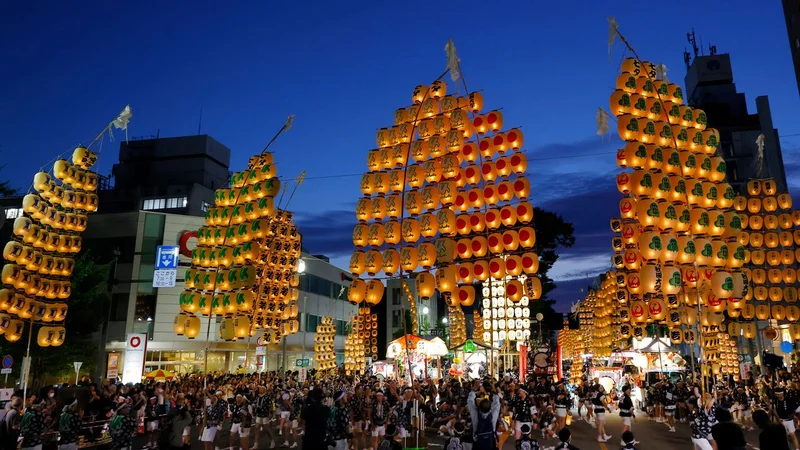
Lantern Festivals Light Up the Evening Skies
Guideto Japan
Culture## No Matsuri Without Lanterns
As evening falls, festival music begins to play and chōchin (lanterns) are lit, one by one. Each candle is a tiny flame, and adorning towers and floats by the hundreds, they contribute to a picturesque festival atmosphere.
Lanterns incorporating candles in bamboo or wooden frames covered in washi paper were an essential element of rites in the past. In their original form, lanterns entered Japan from China toward the end of the Heian period (794–1185) for use in palaces and temples. During the Edo period (1603–1868), warōsoku Japanese candles, with improved wicks and wax from the haze sumac shrub to ensure they would burn longer, were introduced. This development popularized lanterns and they became everyday items with the introduction of a new light, foldable, and portable type.
Today, lanterns are mainly equipped with lightbulbs, but they are still essential for midsummer bon observances. Not merely illuminating darkness, lanterns are viewed as signposts guiding ancestral spirits so that they may find their way home. At festivals, rows of lanterns bearing the names of communities or parishioners are donated to show gratitude to the deities.
The flickering flames in the older style of lanterns can seem like spirits. Here we present three splendid night festivals that continue the candlelit tradition.
Akita Kantō Matsuri
(Akita, Akita Prefecture, August 3–6)
The Akita Kantō Matsuri, along with the Sendai Tanabata Matsuri (August 6–8) and the Aomori Nebuta Matsuri (August 2–7), is one of the three great festivals of Tōhoku, the northern region of the main island of Honshū. These festivals are known for their spectacular scale. They all originated as summer ceremonies to ward off evil, with impurities both real and abstract transferred to their paper decorations and lanterns, which were then washed away in rivers and the sea.
For Tanabata celebrations, the tanzaku paper strips on which people write a wish are also a symbolic way of transferring misfortunes to a physical object. In previous times, the tanzaku were thrown into rivers to be washed away together with the tanabata decorations. In the case of the Nebuta Matsuri, the pronunciation of nemutai (I’m sleepy) gradually morphed into nebuta, referring to the colorful lantern floats used to “wash away” drowsiness into the sea. They were intended to keep farmers awake as they toiled from morning to night during the busy summer planting season.
The Akita Kantō Matsuri is famous for its kantō bamboo frames, holding arrays of lanterns and topped by gohei wooden poles with paper streamers. The kantō bearers perform acrobatic moves as an offering to the deity. Afterward, the gohei, to which impurities and misfortunes have been symbolically transferred, are set adrift in rivers.
These three Tōhoku festivals, full of color and brimming with energy, are staple summertime festivities that were intended to drive away the gods of pestilence. In particular, the Akita Kantō Matsuri is Japan’s largest lantern festival. The illuminated lanterns throw a golden glow in the dark, hinting at the bounty of autumn. At the same time, the event is a prayer for good health and rich harvests.
At dusk, the main street near Akita Station is chock-a-block with 250 lantern frames laid out on the ground, bearers waiting to perform, and spectators. The largest kantō, with 46 lanterns, are 12 meters long and weigh 50 kilograms. Bearers heft them into position all at once to the sound of the festival music, and the procession begins. In total, over 10,000 lanterns will bob in the evening sky, creating an unforgettable scene.
The acrobatic moves performed by the bearers are spectacular too. Balancing the kantō on their hands, they transfer them expertly to their shoulders and hips. Some of the men even have the wherewithal to fan themselves languorously as they perform the most difficult feat of balancing a huge frame on a hip.
As part of their performance, several bearers close in on each other, bringing their kantō together. Spectators hold their collective breath in suspense, hoping that none of the frames will fall over, but if they do, the bearers simply light each of the candles again and continue the show.
Owari Tsushima Tennōsai
(Fourth Saturday and Sunday of July, Tsushima, Aichi Prefecture)
Susanoo no Mikoto, the unruly deity of Japanese mythology syncretized with the Indian god of pestilence Gozu Tennō, is a spirit that must be shown respect and calmed in order to avoid misfortune. Owari’s Tsushima Shrine and Tennōsha are among the 3,000 similarly named shrines throughout the country; here festivals have long been held in the gods’ honor in summer, when epidemics were common, to pray for good health.
The Owari Tsushima Tennōsai of Aichi Prefecture’s Tsushima Shrine includes a night festival of river craft adorned with lanterns. The event takes place at nearby Tennōgawa Park, where a large pond was created by damming the river some centuries ago. In the evening before the night festival, young boys aged five to seven board the boats, where they perform music and pray at the shrine for the festival’s success.
The festival highlight features five straw boats paraded atop floats, with bamboo poles holding lanterns stuck into the frames’ straw-covered roofs. Each pole holds 365 lanterns, and a 17-meter-high pole jutting out from the middle is lined with another 12. These numbers derive from the 365 days and 12 months of the year, but in total there are nearly 500 lanterns when those around the floats are included.
As the sun goes down, the sounds of shamisen and drums fill the air and the lanterns are lit. Their reflection on the waters creates an enchanting fantasy atmosphere. The boats leave the shore one by one, heading toward the north, where they worship the deity Tennō, who has arrived on a mikoshi portable shrine to observe the festival.
After the evening festival ends, all the lanterns are removed from the boats, which are redecorated with gorgeous curtains, carvings, and figures from nō dramas. The organizers work through the night to ready the boats for the next morning’s procession. The flotilla now consists of six boats, which are rowed toward the island in the middle of the pond. Ten men from the lead boat leap into the water, carrying cloth banners. They swim to where the mikoshi is waiting, pay their respects to the deity, and run all the way to Tsushima Shrine, where they present the banners as offerings.
Sixteenth-century warlords Oda Nobunaga and Toyotomi Hideyoshi, who were from Owari Province (present-day Aichi Prefecture), supposedly attended this festival, which originated some 600 years ago. Spectators observing this magnificent tableau today may feel transported back to centuries ago.
Nihonmatsu Chōchin Matsuri
(First Saturday, Sunday, and Monday of October, Nihonmatsu, Fukushima Prefecture)
At the annual festivalof Nihonmatsu Shrine in Fukushima Prefecture, shrine parishioners play distinctive shangiri festival tunes atop floats. Children and adults alike have spent the previous year practicing the music, whose energetic sounds fill the town.
This festival began early in the Edo period; as the years went by, several lantern-decorated floats were added to the procession. Today, seven neighborhoods provide floats decked out with over 2,000 lanterns, making this festival one of the largest lantern processions in the country.
The festival’s highlight is the departure ceremony. As the sun sinks behind Mount Adatara, men chosen by their neighborhoods set torches alight with the sacred flame from the shrine and speed off to the floats waiting in the city center. Reaching the floats, they vie with each other to be the first to use their torches to light eight lanterns dangling from bamboo poles. These lanterns, called suginari and representing the deity, tower 11 meters above the ground when raised atop the floats.
The festival reaches a climax when the seven floats are pulled through the streets. As they move up one hill and down another, the shangiri changes key, and the musicians, intent on preserving their respective communities’ prestige, play on even more resolutely.
As the clock moves past midnight, the floats congregate in the square fronting the local rail station and the festival’s first day concludes. Throughout the two remaining days of festivities, the sounds of festival music will fill the air, and this pageant of sound and light will continue to delight spectators.
(Originally published in Japanese. Dates given are those on which the festivals are usually held. Banner photo © Haga Library.)