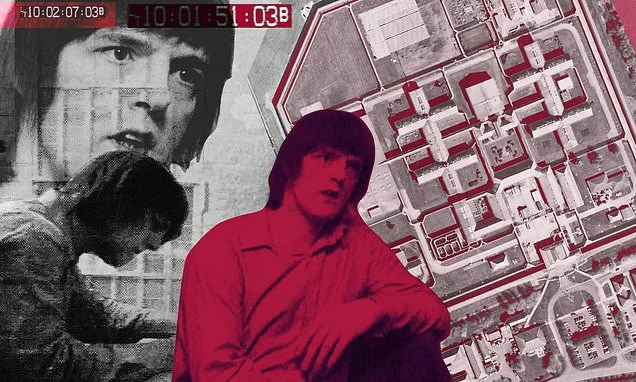
Robert Maudsley’s unkempt hair dangles over jagged cheekbones, his skin has an unmistakable prison pallor and deep bags hang under dark, lifeless eyes.
Wearing a standard issue striped shirt, the four-times killer stares into the camera, baring yellowing teeth as he moans that the stress of solitary confinement that has turned his Scouse accent into a slurred drawl.
‘A good friend of mine finds it difficult to comprehend what I say. No officer takes any interest and I resent that,’ he complains.
This, from a television documentary filmed in the early 1980s, was the last time the British public saw or heard from Maudsley – aka ‘Hannibal the Cannibal’ – one of the nation’s most notorious serial killers.
In the years that followed, Maudsley is believed to have set a world record for the longest time spent in solitary confinement, 48 years and counting, with wild rumours that he had been caged in a bespoke ‘glass cell’ in the bowels of HMP Wakefield.
But now, for the first time in decades, the truth behind Maudsley’s life behind bars can finally be revealed by the killer himself after a relative passed a recording of one of his calls from jail to The Daily Mail.
The ageing serial killer (pictured, in a documentary) has been for the last year housed in a special unit for 70 dangerous offenders with personality disorders on F-wing at HMP Whitemoor, a Category A security prison in March, Cambridgeshire
He committed his first murder in 1974 at the age of 21, and since then Maudsley has killed three times more in prison.
He is now housed in a unit for Britain's most problematic inmates at Category A security prison HMP Whitemoor in March, Cambridgeshire.
His crimes are horrific and his guilt is indisputable but incredibly, he and his fiercely loyal family believe the conditions he is kept in are too inhumane for anyone to endure.
Yet there is good reason why the team of hardened prison officers who guard him are on constant high alert and will impose harsh punishment for any transgression, however minor. Something as innocuous as a pen left by his pillow might signal their lives - or those of other prisoners - are at risk.
The grim details of Maudsley's first murder inside included claims that a spoon was found hanging out of the skull of his paedophile victim, after it had been ‘cracked like a boiled egg’ – as if he had been eating the brain.
Maudsley was originally nicknamed ‘Spoons’ by other inmates, despite denying any cannibalism. Small wonder that to this day he is only allowed plastic cutlery in his cell.
Given his blood-curdling history, it is no surprise that earlier this year when he broke rigid guidelines by slowing to glance at a noticeboard in a corridor while being escorted to the exercise yard, and by leaving that pen on his bed instead of in a cup, action was taken.
Officers feared he could be plotting to attack, and kill, yet again, with his bare hands in the corridor or with the ballpoint pen as a stabbing weapon in his cell. And so a fresh, even harsher, regime was introduced for Maudsley.
Last month on his 73rd birthday, he made a phone call from Whitemoor to his nephew Gavin Mawdsley - his relatives have changed the spelling of their surname. He gave permission for it to be recorded and passed on.
The multiple-murderer moaned that his security level had been increased.
It means a senior prison officer has to be present whenever his cell is unlocked and must join the team of several other staff already needed in the brief periods when he is escorted around his high-security unit.
He raged on the call: ‘The fact is, for the last 13 months, they've not allowed me to have any visits whatsoever, because they put me on closed visits [where inmate and guest are separated by a glass screen].
‘What they're actually saying is, we want you to talk to staff.
‘I'm locked in my cell 22 hours a day, and the only exercise I get is on the exercise yard.
‘I'm not going to use my time in the fresh air and on the exercise yard, talking to people who are actually abusing me.'
Maudsley was last pictured more than 40 years ago for a documentary on his prison life after killing three behind bars. To this day his pens and pencils are considered potential weapons
Maudsley (pictured, as a child) was born in deprived Toxteth, Liverpool, in 1953, the fourth child of a local lorry driver
He seemed baffled that guards did not come to his cell to chat.
‘That’s actual insanity, the way they are treating me. I'm stuck in my cell 22 and a half hours a day. If they want to talk to me, all they have to do is come to my cell and say, “Bob, do you want to have a talk?”, or “Bob, do you want to engage?”
‘For 13 months, not one member of staff has ever come to my cell asking me to talk to them or asked me to engage with them – not one, Gavin.
‘That's how they treated me, and they expect me then to actually speak to them.’
His rant was sympathetically received by his family, some of whom refer to him as ‘Uncle Bob’ and even claim his horrifying violence which has targeted sex offenders and paedophiles should be respected rather than punished.
Nephew Gavin has pledged to help his uncle fight for more rights, and at the same time is running a public appeal for £30,000 in donations so a ghost-writer can produce a book telling the tale of his decades of ‘torture’ in solitary confinement.
He and other relatives are keen for their uncle’s name to be preserved for posterity, with his tale told through his letters and calls.
Few members of the public are convinced. Just £833 has been donated so far, the total currently rising by an average of only £20 a month.
Prison psychiatrist Dr Bob Johnson, who treated Maudsley at HMP Parkhurst on the Isle of Wight, has however spoken up for the killer, suggesting he is a ‘very intelligent, very cultured’ man who ‘could benefit society… and could have contributed enormously’, if he was not kept in solitary confinement.
There is talk of Maudsley’s love of music, of Schubert in particular, and enjoyment of playing chess.
But ‘Uncle Bob’ does not play chess with anyone else any more, as we shall hear from his phone conversation last month. Indeed, the fact that he has taught his prison guards how to play chess has become a source of conflict and resentment.
Neither is he happy with his current prison psychologist, or speaking to warders, at all.
Yet the reasons this pensioner is kept so locked down are legion.
Even if it is hard to have sympathy with Maudsley now, it is easy to see that his troubled childhood must have twisted his mind.
He was born in Toxteth, a deprived suburb of Liverpool, in 1953 as the fourth child of a local lorry driver. Both his parents were accused of neglecting their total of 12 offspring, most of whom were removed by social services at various points.
Along with his three older brothers Robert, Paul and Kevin, and sister Brenda, Maudsley spent his infancy at Nazareth House, a Roman Catholic orphanage run by nuns in Liverpool.
But he was then returned home and suffered horrific physical abuse at his parents’ hands.
‘Once I was locked in a room for six months - and my father only opened the door to come in to beat me, four or six times a day,’ he once claimed.
Maudsley later became addicted to drugs and sold his body to older men for sex.
The four times killer was moved to HMP Whitemoor (pictured) last year after complaining about having his Playstation taken away while at HMP Wakefield, known as 'Monster Mansion'
The serial killer committed his first murder in 1974, when labourer John Farrell showed him pictures of several children he had abused. Maudsley flew into a rage and garrotted him
He was placed in a psychiatric hospital more than once after attempting suicide and told doctors he was hearing voices instructing him to kill his parents. He then returned to the streets of London.
His first murder was committed in 1974, when labourer John Farrell picked him up for sex then – Maudsley said – showed him pictures of several children he had abused.
Maudsley flew into a rage and garrotted him, before handing himself in and making a full confession.
He was declared unfit to stand trial and sent to Broadmoor Hospital for the criminally insane in Berkshire, where he remained for three years, initially as a model inmate.
But in 1977, he and another psychopath, David Cheeseman, took paedophile patient David Francis hostage.
The pair barricaded themselves inside a cell for nine hours, and tortured Francis at leisure, including with electric shocks, occasionally lifting him to the ceiling so the guards could see his spreading injuries through the spy hatch.
It was when their victim’s body was finally recovered that his head was found, according to one psychiatric nurse, 'cracked open like a boiled egg' with that infamous spoon hanging out of it.
He had been strangled. A post-mortem examination found no evidence of cannibalism.
Maudsley was convicted of manslaughter and sent out of the healthcare system to Wakefield Prison in West Yorkshire, nicknamed the Monster Mansion thanks to the nature of its inmates.
The next year, he embarked on a killing spree.
His first victim was Salney Darwood, imprisoned for killing his wife, who he lured into his cell before slashing his throat and hiding the body under his bed.
Maudsley spent the rest of the morning searching for more victims.
Inmates claimed he spoke of wanting to kill seven people that day and had ‘madness in his eyes’.
The next to die at his hands was 56-year-old Bill Roberts – who had sexually abused a seven-year-old girl – whose skull he hacked at with a makeshift knife before he repeatedly smashed his head against the cell wall.
Once he was finished, Maudsley calmly walked into the prison office, placed his bloodied improvised knife, or ‘shank’, on the desk, and informed the guards: ‘There will be two fewer at roll call.’
Convicted of double murder, he began his long spell in solitary confinement in Wakefield and was accompanied by a phalanx of four guards whenever he left his cell.
His furniture was made of compressed cardboard to limit his ability to craft shanks or other weapons, and a Perspex door to the cell ensured he could be viewed by guards in safety. He was locked inside for 23 hours a day.
Depressed by his solitude, he mounted a failed legal battle from inside for the right to die.
Things only changed significantly 47 years on – when, after staging weeks-long hunger strikes over the confiscation of his PlayStation games console, he was moved to Whitemoor.
While in solitary in Wakefield he had received regular visits from his ageing brothers and his nephew Gavin, his move to East Anglia made for a difficult trip from Liverpool and Yorkshire for them.
By his account, the prison governor has ruled he is now not allowed visits and he has become even more isolated.
And it is from his near total solitude in Whitemoor that he updated his nephew last month in that phone call. He was vowing to launch another hunger strike.
Maudsley said over the phone: ‘I'm going on hunger strike to protest against the way I'm being treated – because I feel I'm being treated inhumanely.
Maudsley notoriously wrote while he was at Wakefield (pictured) that his conditions of solitary confinement were like being 'buried alive in a concrete coffin'
Maudsley (pictured, in a documentary) complains he is struggling in his new conditions at HMP Whitemoor, with his elderly brothers unable to travel to visit him
‘I've been discriminated against and I've been victimised and they think they can get away with it.
‘It’s the only way I can protest. I’ve told them that.’
His anger was evident as he continued: ‘I opened up when I first got here, teaching all the staff on the unit chess, for months.
‘That was a sufficient time for them to assess whatever risk I pose to other people. I told them when I arrived here, “Yes I would have group association, but I want no association whatsoever with paedophiles or sex offenders.”
‘They already know that, Gav. Wakefield knew that for the last 40 years. Wakefield didn't mind, I wasn't required to see any psychologist, I wasn't required to do any case work or what have you.
‘But even at Wakefield, they let me have an hour’s exercise from 2pm to 3pm every day, and an hour’s gym from 3pm to 4pm every day. And half an hour for a shower, at 4pm to 4.30pm every day.
‘And if the kitchen was available, or not being used, I could go in the kitchen and cook a little meal.’
Maudsley went on: ‘All I get here is the hour which they call my “regime”.
‘I spent months of my regime teaching these f***ers chess, and all I get in return is, you know, "we stick to your single unlock".
‘So I turned around on January 1 and I told them, “Look from now on, I'm taking my regime period in the exercise yard, and that's it”.
‘You know, “I'm not going to teach you f***ers any more chess”. I'm going to go in the yard, and that's it.
‘And that's what they're annoyed about. They’re annoyed I'm taking my exercise and ignoring them.
‘They're the ones ignoring me.
‘How the hell can I engage with them when I'm locked behind the door? They're the ones with the keys.
‘They're the ones who should be coming to me.
‘“Tell me Bob do you want to talk? Bob, do you want to engage?”
‘They're not doing that, Gav. They haven't done that for the last 13 months.’
He added that his new high security grading had a severe impact on his already restricted life.
Maudsley said: ‘Instead of my being allowed on the community yard, which has a garden and a fishpond, I have to take my exercise period in the punishment segregation yard, which has 20 ft high walls on all four sides.
‘I'm not able to talk to anybody, and I'm not able to speak to anybody, or see anybody.
‘It [the report] then goes on to say the multidisciplinary team [the group of psychology and incarceration experts overseeing Maudsley’s regime inside] “encourage you to engage with all staff to help you move forward and reduce your unlock level.”’
One of Maudsley's brothers previously told of how he would meet the killer at HMP Wakefield (pictured) once a month while sat in an adjoining cell and talk through the bars
He goes on to say that he applied to have ‘group association’ with two fellow prisoners but did not even receive a reply.
And he told his nephew that he was particularly keen to be allowed to play chess with a fellow prisoner who, disturbingly, shares a similar background.
Maudsley’s favoured chess partner is Kevan Thakrar, 39 – himself serving life for murdering three men in 2008, in a drug-related storming of a house in Hertfordshire.
Similarly to Maudsley, Thakrar has spent more than a decade in solitary confinement, in his case after stabbing a female prison officer in the back, as well as knifing two other warders, at HMP Frankland in County Durham.
Astonishingly, Thakrar last year won compensation after complaining through the European Convention on Human Rights about the details of his treatment – something Maudsley would doubtless hope to replicate.
Maudsley said in his phone call last month: ‘Mr Thakrar and myself are the only single unlock [where an officer unlocks the door manually] inmates in F Wing, HMP Whitemoor.
‘If we were unlocked together to play a game of chess, this will be beneficial to our mental health.’
Maudsley said his current psychologist has only told him he needs reassessment – and that he has responded by refusing to attend further one-on-one meetings with her, as well as launching what appears to have been a short-term hunger strike, claiming the authorities were trying to crush him.
The killer said: ‘I'm standing up for my rights.
‘I want to be treated humanely, with dignity and respect, and because I'm fighting for that, they've got annoyed and upset. It’s a joke.’
But while Maudsley moans about chess, strolls around a fishpond and small talk with guards, few will have any sympathy, not when they remember the horrifying brutality with which he murdered his victims.