- See more Daily Mail on Google - save us as a Preferred Source
To this day, I still remember the colour of the cream envelope, embossed with the insignia of Cambridge University – and how I felt opening the letter that, I knew then, would determine my future.
I only had to read the initial three words inside before I let out a yell of relief and jubilation.
'We are pleased…' ran the start of the first sentence from the Admissions Tutor, indicating that I had won a place at Sidney Sussex College at Cambridge. It was the proudest moment of my young life.
I adored Cambridge. So much so that, after I graduated in 1985, I felt that I should give something back in the form of an occasional donation.
But pride has now given way to regret, due to the University's immersion in the creed of political correctness. Once a renowned seat of learning, Cambridge is in real danger of becoming a citadel of fashionable groupthink.
As a result, in the past decade, I have abandoned my role as a minor philanthropist. In fact, I now would not dream of giving a penny to my old university. The money would just be squandered on more gesture politics and achingly right-on social justice initiatives.
Tragically, the institution that produced figures such as the biologist Charles Darwin, the mathematician Sir Isaac Newton, and the novelist EM Forster is now more interested in parading its political virtue than in upholding academic rigour.
No longer a byword for excellence, Cambridge now represents the worst kind of posturing vanity.
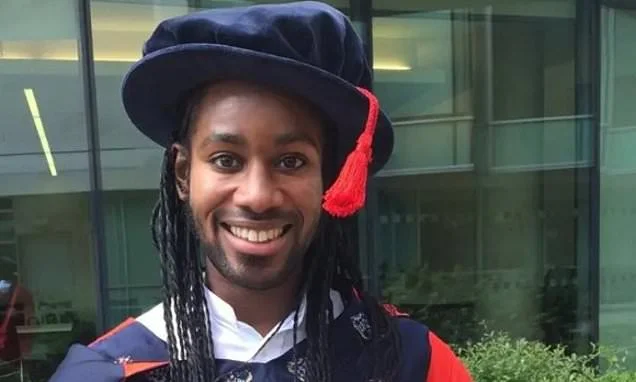
Cambridge's decline is encapsulated in the extraordinary case of Jason Arday, who has been caught up in a plagiarism scandal, writes Leo McKinstry
The institution that produced figures such as the biologist Charles Darwin is now more interested in parading its political virtue than in upholding academic rigour, writes Leo McKinstry
That decline is encapsulated in the extraordinary case of Jason Arday. Readers will now be aware that his appointment in 2023 as Cambridge's 'professor of the Sociology of Education' sparked a wave of self-congratulation among the university's smug ruling hierarchy. For Arday was not only the youngest black professor in Cambridge's history but also seemed to have overcome a remarkable series of obstacles to reach the top.
His 'autism', he claims, meant that he did not speak properly until the age of 18, while he claimed to have suffered from a brain tumour when he was completing his PhD.
Woke propagandists portrayed him as the intellectually dazzling, record-breaking neuro-diverse son of Ghanaian immigrants, brought up on a housing estate in Clapham, south London, before he conquered the groves of academe.
Garlanded with honorary degrees, shortlisted three times for a 'Pride of Britain' award, he was even commissioned to write his autobiography – which is coming out in September – another milestone on the path to becoming an icon of modern Britain.
His amazing achievements, however, inevitably provoked suspicions, though until recently he was protected by his rottweiler lawyers issuing libel threats and his allies inevitably accusing his critics of racism.
But his defences are now crumbling, due to the sheer weight of allegations against him, including credible charges of plagiarism.
Amid calls for a full inquiry, Cambridge is struggling to hold the line against Arday's critics. The university describes the attacks on him as a 'vile smear campaign'. But that dismissal no longer convinces.
Dogma has been prioritised above the quest for the truth – and not for the first time in recent years.
Cambridge has displayed this ideological partisanship before. This is the same organisation that, in 2019, withdrew an offer of a visiting fellowship to the globally renowned psychologist Jordan Peterson, just 48 hours after first making it, after woke staffers complained about his views on gender.
That same year, Cambridge research fellow Noah Carl – who defended the right of intelligence researchers to examine whether IQ is genetically influenced – had his contract terminated at St Edmund's College after a letter by academics accused him of 'racist pseudoscience', despite failing to produce any evidence to back up that charge.
'Diversity and inclusivity are fundamental values of the college. There are lessons we must learn about how we demonstrate the importance of those values', said Matthew Bullock, the Master of the College; nothing there about the importance of academic freedom.
And take Jesus College's bid to rip out a 300-year-old memorial to Tobias Rustat – a benefactor and courtier of Charles II – based on spurious claims that it was an odious memento of the transatlantic slave trade and 'incompatible with the chapel as an inclusive community and a place of collective wellbeing'.
Mercifully, the Consistory Court concluded in 2022 that the attempt was based on a 'false narrative' that 'Rustat had amassed much of his wealth from the slave trade, and that it was moneys from this source that he used to benefit the college'.
Worse still, Cambridge has failed to learn the lessons of a similar sordid affair at another hotbed of academic wokery, University College London, which failed to protect the Nobel Prize winner Professor Tim Hunt – a pioneer in the discovery of the protein cyclin which is key to cell division – when he was engulfed by controversy after a lecturer in science journalism, Connie St Louis, reported that he made allegedly sexist remarks at a conference in South Korea in 2015.
He was said to have told the conference that his 'trouble with girls' was they 'cry' when you criticise them and 'fall in love' with their male counterparts. He later stressed he was being 'sarcastic' – but that was completely lost on St Louis, who sensed a golden opportunity for global media attention.
Despite his distinguished record and a profuse apology, Sir Tim was forced to resign from his honorary fellowship, claiming he was 'hung out to dry' by his employer, University College, and other institutions such as the Royal Society. Shattered by this lack of support, Hunt moved with his wife to Japan.
But his destroyer, Connie St Louis, was also hit by the fallout from the row she generated. As the spotlight of inquiry was shone on her own record, she was exposed as another dodgy academic with a habit of exaggeration – including a claim on her CV that she 'present[ed] and produce[d]' a range of programmes for BBC Radio 4, which was demonstrably false. Meanwhile Mrs St Louis claimed she had an 'upper second' BSc (Hons) in applied biology – although it was not clear where this was awarded.
Soon after the Hunt affair exploded, her City University course was dropped.
The Establishment's shameless cheerleading for Arday, compared to its cruel abandonment of Hunt, says everything about the ethos of the modern university sector, where all decisions are viewed through the prism of identity politics.
Only a culture warped by dogma would accept Jason Arday's bogus claims. In fact, his so-called research into the sociology of education is almost worthless.
Even if he is not found to have been a plagiarist – something I highly doubt on current evidence – his output, riddled with obscure jargon and meaningless pap, is itself an exercise in academic navel-gazing, compared to Professor Hunt, who genuinely advanced the frontiers of human knowledge.
Cambridge speaks of its 'pride' in Arday. Shame would be a more appropriate word given what we've learned in the past fortnight.