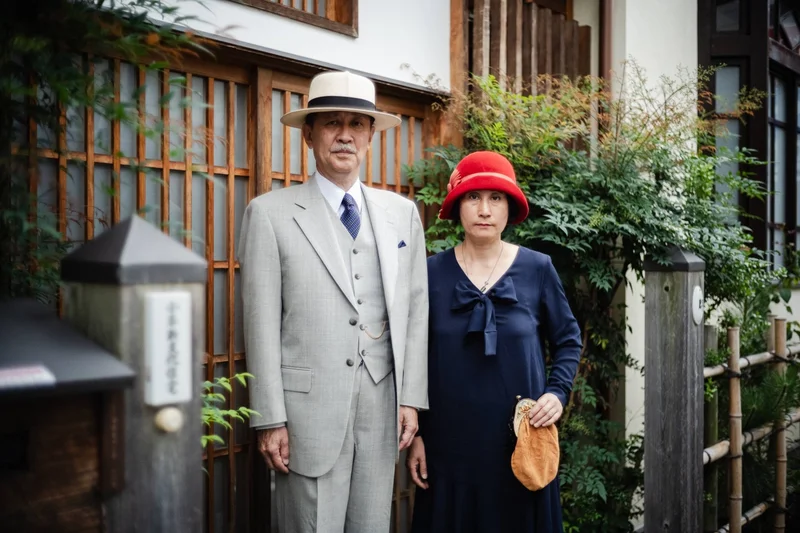
Even before meeting Kayo Asai and Haruhiko Kohri, it is clear their devotion to Japan’s past runs deep. Asai replies to my emails in prewar Japanese orthography — rather as though one had received an electronic missive commencing, “My dear sir…”
The couple have devoted themselves to re-creating the lifestyle of the Taisho Era (1912–26) and the early Showa years of the late 1920s and early ’30s. The period was one of cosmopolitan energy, with cafes, jazz and department stores shaping a new urban culture. It was also a time of rapid social change that gave rise to the “mobo” (modern boy) and “moga” (modern girl), before Japan’s turn toward nationalism and militarism.
Amid a broader revival of interest in this period — reflected in everything from retro fashion and architecture to the use of Taisho Era settings in works such as “Demon Slayer” — Asai and Kohri’s dedication goes much further. Asai collects original clothing from the period, and the couple’s pursuit of authenticity extends to every aspect of their lives, from using a wooden refrigerator cooled with blocks of ice and an old-fashioned hand-cranked washing machine to building a home modeled on the architecture of the period.