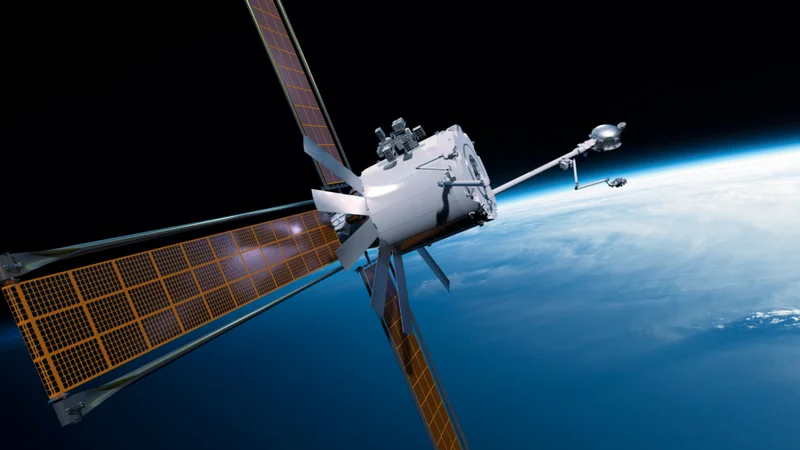
WASHINGTON — Voyager Technologies remains upbeat about the prospects for its Starlab commercial space station but is hoping for some tweaks to NASA’s plans to support the station’s development.
During an Aug. 4 earnings call about the company’s second-quarter financial results, Voyager executives emphasized the strong commercial demand for Starlab, with more than $500 million in agreements in place to use the station.
“This demonstrates that Starlab has progressed well beyond a development concept and is already attracting meaningful government and commercial commitment,” said Phil de Sousa, Voyager’s chief financial officer.
The initial design of the station is supported by a funded NASA Space Act Agreement valued at $218 million. In the call, de Sousa said the company completed milestones in the second quarter worth $4 million, bringing the total received to about $211 million as the company nears the end of the agreement.
Voyager, the majority shareholder in the Starlab Space joint venture responsible for the station, is among the companies awaiting the next phase in NASA’s Commercial Low Earth Orbit Destinations, or CLD, program. The agency issued a draft request for proposals, or RFP, on July 6, with feedback from companies due July 27.
“While NASA continues to refine the timing and structure of the Phase Two procurement process, our long-term outlook for Starlab remains unchanged, and we continue to believe the program is exceptionally well positioned within NASA’s commercial LEO strategy,” de Sousa said.
Later in the call, Dylan Taylor, chief executive of Voyager, said the company had raised some issues in the draft RFP regarding requirements NASA proposed imposing on commercial stations.
“You want the requirements to be robust because it’s human-rated hardware, of course. But you don’t want them to be so robust that nobody can build it on time and on budget,” he said. “So, I think there are going to be elements of the requirements that, in the final RFP, will be either changed or relaxed a bit.”
He didn’t elaborate on the specific concerns about the requirements, but they mirror private comments by other industry officials who raised concerns about the number and specificity of the requirements included in the draft RFP.
Taylor, though, praised NASA for its decision in June to return to its original plans for supporting commercial space stations, backing away from a concept announced at the Ignition event in March to instead develop a government “core module” for the International Space Station that commercial modules would attach to.
“The general consensus from the industry was that that was not the right approach, and to NASA’s credit, they reversed course on that particular approach,” he said.
He said he felt Voyager was “very well positioned” even if the final RFP is little changed from the draft version. “We’re hopeful that additional changes from the draft to the final RFP will only enhance our competitive position.”
One question is the schedule for the final RFP. At an Aug. 3 briefing about the upcoming Crew-13 mission to the ISS, Dana Weigel, manager of NASA’s low Earth orbit program, said the agency was reviewing the feedback on the draft Phase Two RFP and planned to release a final version “as soon as we can.”
“Obviously, we would prefer that a decision be made sooner rather than later,” Taylor said, citing the time pressure to get one or more commercial successors to the ISS launched before the scheduled retirement of the ISS at the end of the decade. “We want to make sure that we have a commercial solution in plenty of time before the ISS no longer has functionality.”
Taylor estimated that the final RFP will be released “shortly,” with proposals due to NASA in mid- to late fall, followed by awards early next year.
Astrobotic impacts
Voyager reported $52.7 million in revenue in the second quarter and a net loss of $46.5 million. Revenue increased 15% from the same quarter a year ago, although the net loss was also larger than in the second quarter of 2025.
The company, which previously offered revenue guidance of $230 million to $255 million for 2026, announced in the earnings call that it was raising that target to $275 million to $305 million.
The major factor in that change is the acquisition of Astrobotic Technology, announced June 2 and which closed July 13. Voyager paid $171 million for Astrobotic, with $129 million in additional earnout payments based on meeting performance milestones.
Voyager executives said they expect Astrobotic, now Voyager Lunar Systems, to contribute $40 million to $50 million in revenue to Voyager post-acquisition this year.
“Astrobotic strengthens Voyager’s leadership across one of the fastest-growing areas of the future space economy while expanding our addressable market and increasing our participation across critical lunar infrastructure,” Taylor said. “We believe the acquisition accelerates our pathway toward profitability while strengthening our competitive position across the rapidly expanding space economy.”
The company added that it will hold its annual investor day event Dec. 3 in Pittsburgh, the home of Astrobotic.