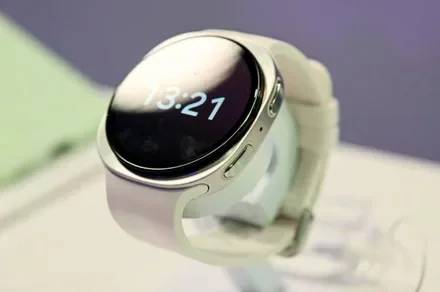
The Galaxy Watch 9 went official today, and it’s not just a smartwatch that ships with a new nametag. Samsung has equipped it with a new chipset and improved the battery capacity, especially on the smaller variant.
The Galaxy Watch 9 is available for pre-order in the US starting July 22, 2026, and general availability commences August 7, 2026.
Nadeem Sarwar / DigitalTrends
So what’s actually new here?
Watch 9 arrives in the usual 40mm and 44mm sizes, priced at $379.99 for Bluetooth and $429.99 for LTE, which is a $30 jump over last year’s entry price. While the former is available in Cream and Graphite colors, the latter is available in Graphite and Silver.
The most significant shift, however, is under the hood. Samsung has swapped out its own Exynos W1000 chip (that’s powered its watches for years) in favor of the Snapdragon Wear Elite chipset, which now powers both the Watch 9 and the Watch Ultra 2.
For those catching up, the Wear Elite offers substantially faster processing speed, a dedicated NPU for handling on-device AI compute, and superior battery efficiency compared to the W1000 chip.
Nadeem Sarwar / DigitalTrends
Software-wise, Watch 9 ships on Wear OS 7 with One UI 9 Watch. It inherits Samsung’s new AI health suite across the board, including FDA-cleared Sleep Apnea detection, a Heart Health Score, Daily Cardio Load, and Hearing protection alerts.
Watch 9 vs. Watch 8: How does it stack up?
Battery gains depend on the size you buy. The 40mm jumps from 325mAh to 390mAh, a genuinely noticeable 20% bump. In my opinion, buyers will notice the most significant battery life improvement on this one.
The 44mm barely moves, going from 435mAh to 445mAh, though its battery life was already quite good. Brightness holds flat at 3,000 nits for both, so Watch 8 owners aren’t missing a display upgrade here. Despite the chipset upgrade, the Watch 9 will ship with the same amount of memory and storage: 2GB and 32GB, respectively.
Nadeem Sarwar / DigitalTrends
It also retains all the familiar sensors, including Samsung’s BioActive Sensor, a dedicated temperature sensor, accelerometer, and a light sensor, among others. Water resistance remains the same at 5 ATM and IP68, though a MIL-STD-810H certification also comes along.
The rumors about the price hike were real
New Sports, Misty, and Fabric band options join the lineup, alongside free trials for Strava and iFIT (both for two months), which might help get the units off the shelves at launch. Moreover, the Galaxy Watch 9 isn’t quite the lackluster upgrade that early rumors made it out to be. However, its price hike might end up disappointing many potential buyers.
Nadeem Sarwar / DigitalTrends
What I’m noticing, however, is that Samsung’s pricing creep is becoming a real pattern. It’s not a one-off thing, climbing $50 from Watch 7 to Watch 8 and now another $30 here: that’s $80 in two years. Further, it also looks like Samsung doesn’t trust its own Exynos chip for AI workloads, and finalized Qualcomm as the chipset of choice for its latest lineup.
I wouldn’t go as far as to say that the Galaxy Watch 9 isn’t worth buying at $379.99, but the larger variant, especially when you club the cellular connectivity premium, could be much heavier on your wallet than a companion smart device should be.