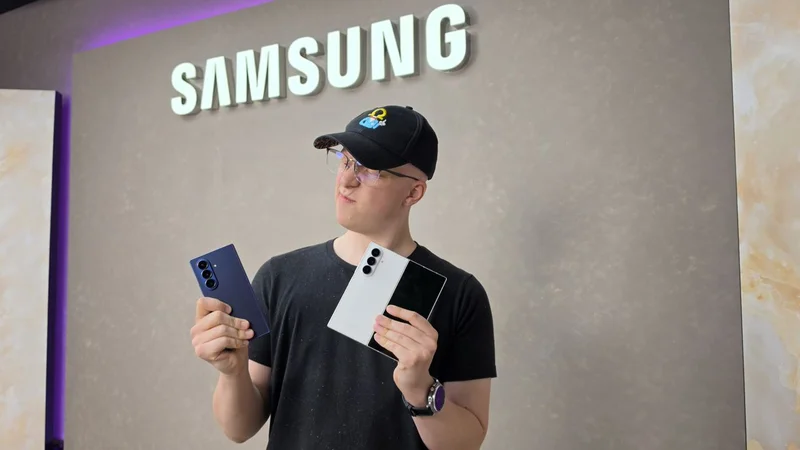
I’ve been using, and loving, my Samsung Galaxy Z Fold 7 for the past year — for me it's simply the best phone money can buy.
The foldable form factor is perfect for watching videos — either on the massive inner screen, or using the design to prop the phone up and watch on its outer display — and also for gaming, productivity, or capturing selfies with the 200MP main sensor rather than the lower-res selfie cam.
Its thin design is comfortable to hold and easily slips into any pocket, and the design has been durable enough to survive without me using a case; I did have a case for a few months but I hated it, so I’ve reverted back to my screen-protector only strategy.
Latest Videos From
(Image credit: Peter Hoffmann)
As great as the Z Fold 7 is, though, it isn't flawless. The cameras could be better (a fact highlighted by the excellent cameras Samsung put in the Galaxy S26 Ultra that I also carry with me), the battery life isn’t as good as I need at times, and the crease can be quite noticeable in certain lighting thanks to annoying reflections on the inner display.
Thankfully, Samsung looks to have addressed a lot of my issues with the new Galaxy Z Fold 8 Ultra — the true successor to last year's Fold 7 (the new non-Ultra Z Fold 8 adopts a squatter design this year), and the frontrunner to be my favorite phone of 2026, after spending just an hour or so with the new device.
Ultra by name, Ultra by nature
The Samsung Galaxy Z 8 phone lineup (Image credit: Lance Ulanoff / Future)
At first glance, the Samsung Galaxy Z Fold 8 Ultra looks almost identical to the Galaxy Z Fold 7.
Unlike the Z Fold 8, the Z Fold 8 Ultra offers the exact same screen dimensions as the Z Fold 7, with an 8-inch inner display and 6.5-inch cover display.
Sign up for breaking news, reviews, opinion, top tech deals, and more.
It’s supremely thin and light, so that even when folded it doesn’t feel like a brick, and it offers a similar camera array to the Z Fold 7 (more on that in a moment).
The only design change you’ll notice is the redesigned hinge. It makes it easier to open the Z Fold 8 Ultra, and allows the phone to sit more flat when open — which in combination with the inner screen’s new matte coating makes the crease less noticeable.
Instead of reinventing the wheel in areas where the Z Fold 7 already shines, such as its superb form factor, Samsung has introduced upgrades with the Z Fold 8 Ultra that make this phone even more capable.
(Image credit: Future)
My favorite improvement is new silicon carbide battery tech that allows for a much larger 5,000mAh battery than the Z Fold 7’s 4,400mAh cell, despite the Z Fold 8 Ultra being (very slightly) slimmer.
The battery life of the Z Fold 7 isn’t ideal. I frequently find that my typical usage — which admittedly involves streaming a lot of video, gaming, and multitasking to watch and work at the same time while on the go — leaves my battery running low by late afternoon.
The larger capacity of the Z Fold 8 Ultra probably won’t save me from needing to carry a charger with me ‘just in case’, but I’m hoping it’ll mean that I rarely, if ever, run out of juice completely — which can happen with my Z Fold 7, even when I adapt my usage to be more conservative.
(Image credit: Future)
The Z Fold 8 Ultra's cameras are a solid upgrade too. Alongside the Z Fold 7 I also use the Samsung Galaxy S26 Ultra, because its cameras are so impressive — in particular, I’m in love with its 5x 50MP telephoto lens.
The Z Fold 8 Ultra doesn't, unfortunately, improve on the Z Fold 7’s 12MP 3x telephoto camera, but the existing 200MP main sensor has been enhanced with new HDR abilities to match Samsung’s S26 lineup, and the 12MP ultra-wide has been upgraded to 50MP, making the new phone's array feel more 'Ultra'.
It also gets the impressive Horizontal Lock video stabilization tech which I've loved on the S26 Ultra.
Having tried out the new cameras, the Z Fold 8 Ultra is certainly a major upgrade, and I’m keen to test them out further. Sure, the Z Fold 8 Ultra won’t win any prizes for best camera phone of 2026, but the versatility offered by the new camera array should help to make this foldable feel like a supremely capable all-round device, and not a phone with so many compromises that you can’t appreciate its incredible design wins.
A sort of silver lining
(Image credit: Future)
There's also a new chipset — the same Snapdragon 8 Elite Gen 5 for Galaxy the S26 series is outfitted with — that powers a suite of new AI tools, and a brighter 3,000-nit display, which should help to make colors more vivid on the Z Fold 8.
As you might expect from a phone that's packed with upgrades and sporting a new Ultra moniker, and which is launching in the middle of the ongoing RAM crisis, the Samsung Galaxy Z Fold 8 Ultra will cost more than the Galaxy Z Fold 7.
The silver lining is that the price hike isn't as big as I and many others feared — the Galaxy Z Fold 8 Ultra starts at$2,099.99 / £1,899 / AU$TBC, where the Z Fold 7's launch price started at $1,999 / £1,799 / AU$2,899.
No price increase is ever ideal, but considering how much worse I was expecting it to be, I’ll happily take the $100 / £100 increase on the chin.
I can't wait to spend more time with the Samsung Galaxy Z Fold 8 Ultra. I love my Z Fold 7, but after spending just a short time with its successor, I already know that it’s time for an upgrade.
Follow TechRadar on Google News andadd us as a preferred source to get our expert news, reviews, and opinion in your feeds.