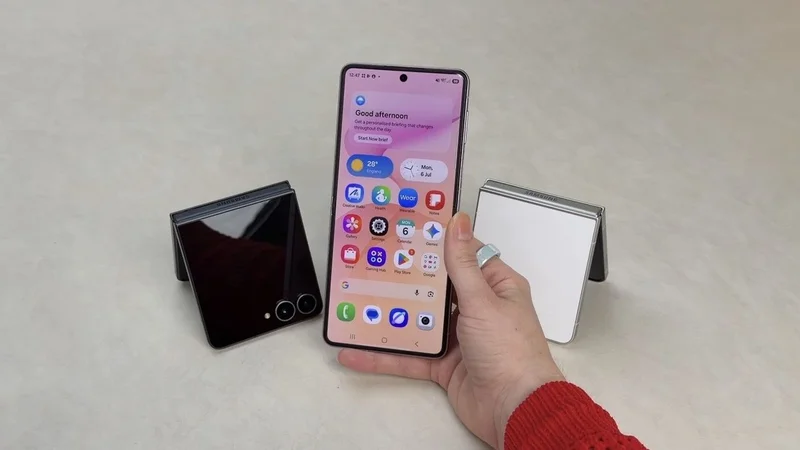
Every year I espouse my admiration for flip phones, and in particular Samsung's foldable devices, but I've yet to make the leap away from the brick form factor.
While there's nothing more satisfying than snapping shut your phone to end a call, and I'm a real sucker for the more whimsical design and customizable software features on cover screens, the simple fact is that flip phones just aren't as powerful as the flagship devices I'm used to.
This year, though, Samsung has come tantalizingly close to converting me with the new Samsung Galaxy Z Flip 8, despite not making very many changes in the hardware department over last year's model.
Latest Videos From
The Galaxy Z Flip 8 launches at $1,199.99 / £1,149 / AU$TBC, which is a $100 / £100 increase over the Z Flip 7, a price hike that owes much to the ongoing RAM crisis. It's the thinnest and lightest Galaxy Z Flip yet, its improved hinge makes it noticeably easier to open and close, and some neat upgrades to the cover screen iterate on the Z Flip 7's similarly light-touch improvements.
But what I'm most excited about is two new video features that will help me capture the moment.
(Image credit: Future)
Earlier this year, Samsung introduced an impressive new feature with the new Galaxy S26 series: Horizontal Lock, which impressed us in our testing. It works by utilizing the phone's built-in gyroscope and accelerometer to measure your movement and rotation while filming, and the camera sensor then crops and shifts the frame to compensate.
The result is that even if you rotate your phone by 360 degrees, the footage will remain level. It's no miracle worker, and you'll lose some image quality if you push it too far, but if you use it as intended to stabilize footage while you or your subject are moving, it can save you an editing headache, and let you focus on the moment while you're recording a live event.
Sign up for breaking news, reviews, opinion, top tech deals, and more.
Another neat feature that makes the Z Flip 8 feel even more primed for capturing the moment is Fan Cam mode. If you're a K-Pop lover, you'll know exactly what this one's for: using subject tracking, the software crops in and reproduces videos at your chosen aspect ratio with just your selected subject in the frame.
I go to a fair few live performances, and this one is a game changer for making sure I can enjoy the moment through my own eyes without making sure my camera is constantly perfectly framed through energetic dance numbers and crowds. It's also great for sporting events, whether that's at an international scale or when you're capturing the moment your little one scores their first goal in a soccer game.
The elephant in the flip
However, there's one thing holding the Z Flip 8 back from true video greatness: the cameras themselves. Offering the same 50MP wide lens, 12MP ultra-wide lens, and 10MP selfie camera as both the Galaxy Z Flip 7 and Z Flip 6, the Z Flip 8 does little to impress. In stark contrast,I've been spoiled by the iPhone 17 Pro's fantastic camera array of late; a recent holiday was made all the more special for the fact I could capture incredible shots without a hulking great big camera in hand.
Lower-spec cameras aren't a shortcoming that's exclusive to Samsung's Z Flip phones; squeezing in powerful rear cameras alongside the windowed display while also keeping the device slim and affordable continues to pose a challenge for designers of flip phones. Even so, compared to the Motorola Razr Ultra 2026 (aka the Razr 70 Ultra in some regions) with its triple 50MP front and rear cameras and a mere £50 price premium in the UK (the pricing gap is wider at $300 in the US), Samsung is lagging a little here.
Everything about the flip-phone form factor lends itself to content capture. The folded camcorder and tabletop mode are intuitive and versatile, and these new features are a huge boon — they're just not enough to tear me away from a flagship phone's stellar array.
Slow-going, but still showy
It's another safe year for the Galaxy Z Flip line, and that might be a sensible move for now. Shaving 0.4mm from the previous phone's thickness and thinning the cover-screen bezels to just 1.2mm seems about as far as Samsung can push the form factor for now, and the new hinge and advanced armor aluminum frame feel, at least based on my brief one-hour testing period, robust. Plus, I just adore the pink and cream colorways, even if they are an unsure bet for its target audience of younger women.
The Flex Window also finally feels complete, with new software features that make it genuinely useful, rather than a customization-first screen; Samsung Galaxy AI is running on all cylinders here, displaying AI automations as well as new Now Brief and Now Nudge features.
For example, hay fever sufferers can have personalized Now Brief cards with a quick glance of the day's pollen forecast, and Now Nudge can show contextual suggestions, like the details of your dinner reservation when the restaurant is calling you.
As mentioned, the Samsung Galaxy Z Flip 8 costs $100 / £100 more than its predecessor at launch. It's a shame, then, that in return for that price hike we're only getting another iterative upgrade, but until some grand breakthrough allows flip phones to pack in better cameras without compromising on form and functionality, we're unlikely to see any radical upgrades — look instead to the Samsung Galaxy Z Fold 8 Ultra for such bold strokes. I'll be testing the Galaxy Z Flip 8 thoroughly in the coming weeks, so stay tuned for my full verdict!
Follow TechRadar on Google News andadd us as a preferred source to get our expert news, reviews, and opinion in your feeds.