Your support helps us to tell the story
From reproductive rights to climate change to Big Tech, The Independent is on the ground when the story is developing. Whether it's investigating the financials of Elon Musk's pro-Trump PAC or producing our latest documentary, 'The A Word', which shines a light on the American women fighting for reproductive rights, we know how important it is to parse out the facts from the messaging.
At such a critical moment in US history, we need reporters on the ground. Your donation allows us to keep sending journalists to speak to both sides of the story.
The Independent is trusted by Americans across the entire political spectrum. And unlike many other quality news outlets, we choose not to lock Americans out of our reporting and analysis with paywalls. We believe quality journalism should be available to everyone, paid for by those who can afford it.
Your support makes all the difference.
Read more
Spain is set to face its third brutal heatwave of an already record-breaking summer, with temperatures expected to hit highs of up to 47C.
The country’s meteorological agency AEMET warned the heatwave is expected to last all week, with temperatures approaching Spain’s all time record of 47.6C five years ago.
Areas most severely affected will include much of the southeastern interior of the country, pushing wildfire dangers to extreme levels.
Parts of Spain will be hotter than North Africa this week. Map shows expected temperatures on Thursday afternoon around 4pm (Windy.com)
Popular tourist destination Malaga is currently forecast to reach 45C, while potential highs of 44C in parts of southern Spain and 42C in Catalonia.
The heatwave is caused by ‘heat dome’, which sees hot dry air moving north from parts of Africa including the Sahara Desert, creating what Severe Weather Europe (SWE) have called a “unforgiving atmospheric furnace”.
SWE suggests it could be one of the “most intense and dangerous early-summer thermal anomalies in recent history”.
AEMET has set the country’s wildfire threats as “extreme” for much of the remainder of the week.
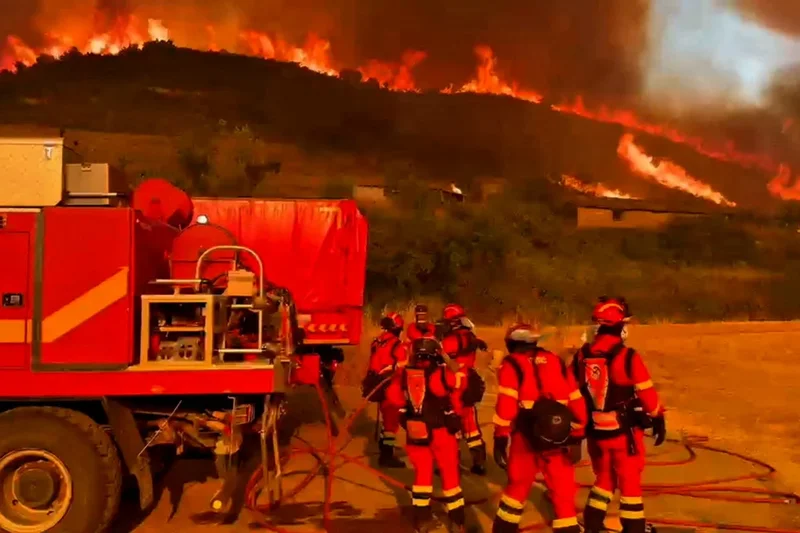
Firefighters battle a wildfire in the Ores municipality after temperatures soared past 40C (Reuters)
A tree burns during the La Mierla wildfire in Albendiego, Guadalajara (Reuters)
The agency has also warned of the possibility of dry thunderstorms in the mountainous areas of eastern Spain.
They include “the southeastern third, the Guadalquivir Valley, the Ebro Valley, the northeast depressions, the Pyrenees valleys and the interior of Mallorca until Thursday”, according to AEMET.
Spain has already been facing devastating wildfires that have destroyed more than 26,000 hectares of land on Monday alone, with over 1,000 people evacuated from their homes. On Tuesday firefighters battled a major blaze north of Madrid.
At least 13 people were killed near Bedar in Almeria province in one of the country’s deadliest fires in decades.
Spain is the European Union's most fire-affected country this year. According to the EU's Copernicus wildfire monitoring service, 104,423 hectares had burned across Spain in 2026, compared with 41,781 hectares in France.
It comes after an exceptionally destructive fire season last summer, when Spain recorded 354,747 hectares burned and 63 large wildfires, the highest annual burned area of the past decade.
Regional health minister Antonio Sanz has warned people to take the conditions very seriously and said that there had been “nearly 1,300 emergencies due to heat-related illnesses”.
Smoke from a wildfire is seen near the town of Albendiego, in the Guadalajara province north of Madrid (AFP/Getty)
“I want to emphasise the need for caution, awareness, prevention and responsibility on the part of citizens.”
The country’s Carlos III Health Institute said that at least 1,028 people had died of heat-related issues during last month’s heatwave in June before a second hit earlier this month.
Spain’s highest temperature on record was 47.6C in the Guadalquivir basin in La Rambla, Cordoba on 14 August in 2021. The highest temperature in Europe was recorded in Syracuse in Sicily, Italy, that same month at 48.8C.
Europe has seen sweltering temperatures this year with France recording its highest ever temperature on record at 43.8C.