What are you most proud of? New card deck encourages seniors to share personal memories
Ho Yoon Sim
AI generated
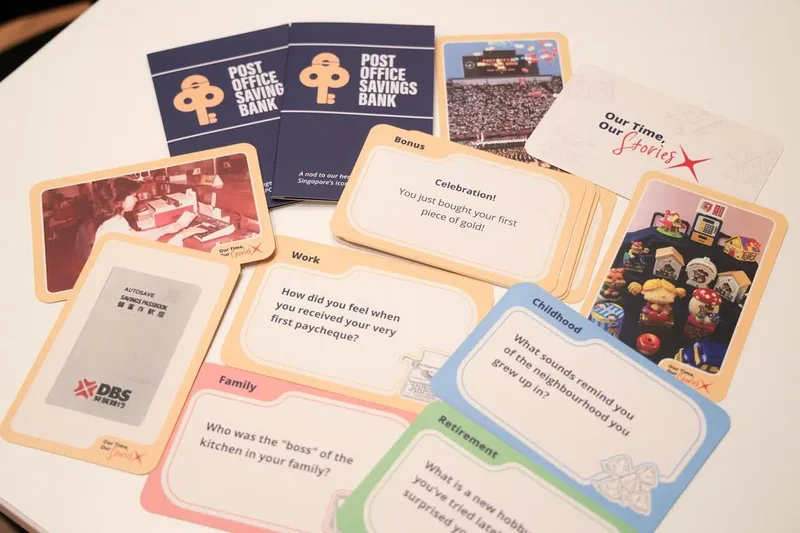
SINGAPORE - “Who was your best friend at school?” or “What are you most proud of when you look back today?”
These are among conversation starters from a new deck of 90 cards designed to help older adults recall memories and share life stories.
Called “Our Time, Our Story”, the card game features open-ended questions about five life stages - childhood, education, work, retirement and family. It was officially launched on Aug 4.
The initiative was developed under the four-year DBS Foundation X Singapore University of Social Sciences (SUSS) Memory and Cognitive Health Community Programme. The programme started in April 2025 with funding support of $8.95 million from DBS Foundation.
The aim is to help older adults, caregivers, volunteers, and families connect through reminiscence, or the sharing of personal stories. Research has shown this can ease symptoms of depression and slow the progression of dementia.
A total of 500 decks will be distributed to 18 community partners, like Lions Befrienders, Touch Community Services and People’s Association.
The programme aims to introduce reminiscence activities to 11,500 older adults across six Asian markets: Singapore, Taiwan, Hong Kong, China, India and Indonesia. This is part of a regional and longitudinal study on reminiscence and healthy ageing that began in Aug 2025.
Speaking at the launch event on Aug 4 with around 200 attendees, Senior Minister of State for Digital Development and Information and Health Tan Kiat How, was asked to share about a mischievous thing he did with his friends in the neighbourhood in his childhood.
The East Coast GRC MP said he would catch spiders with friends and swim in a canal while growing up in a kampong in Jurong.
In a speech, he said that reminiscence is not just about remembering the past, but also about strengthening relationships in the present.
“Every memory reminds someone that their life experiences continue to matter,” he said.
“For persons living with dementia, reminiscence is especially powerful because it reminds us that they are much more than their diagnosis. They are parents, grandparents, neighbours, colleagues and friends, each with a lifetime of memories, experiences and wisdom.”
Tan added that the healthcare system alone cannot deliver healthy longevity, and requires stronger communities that help people age well in their neighbourhoods.
The card deck is the second resource developed under the SUSS programme. __The first was a card game called “My Home, My Singapore” released in Nov 2025 __ that features nostalgic local items that spark memory-sharing.
Led by Associate Professor Carol Ma, head of SUSS Gerontology Programme, the regional study involved 688 older adults and 169 reminiscence facilitators across Singapore, Hong Kong, and Taiwan, all super-aged societies.
These facilitators went through an online learning course, followed by in-person training and 12 reminiscence sessions with older adults.
The latest findings showed a 4.6 percentage point increase in the proportion of Singaporean participants who passed a depression screening after attending the sessions. Participants also recorded an improvement on the Montreal Cognitive Assessment, a widely used screening tool for cognitive function.
Ma said that reminiscence activities have two-way benefits.
“Not only do the reminiscence facilitators learn knowledge and skills but the programme also significantly helps them to reduce loneliness,” she explained.
To date, a total of 315 facilitators have been trained, including 152 in Singapore. The programme has so far reached over 2,100 older adults, including 1448 here.
One facilitator here is How Kim Chin, who first took an interest in reminiscence activities when she was an associate chaplain at St Andrew’s Nursing Home where she provided spiritual and emotional support.
Now retired, the 69-year-old conducts one-hour sessions with seniors at Active Global at Ghim Moh Edge Active Ageing Centre twice a week. She gets $20 per session as part of the programme’s remuneration scheme.
“What is most heartwarming is that as the session continues, I can sense that the relationship gets deeper because they are willing to reveal more about themselves,” she said.
How noted that while the cards could help, facilitators need to use them sensitively and adapt on the spot. For example, some seniors may have never gone to school, so questions about school life would need to be adjusted.
Michael Fok, 76, another facilitator at Fei Yue Holland Close, started his training in Feb 2026. He retired from a financial consultant role three years ago.
He had spent two to three days researching topics like music in the 1960s or Chinese New Year, to prepare conversational prompts. He hopes that the card game will help to cut down this preparation time.
Recalling an 88-year-old man who attended his sessions, Fok said: “I feel very touched that he still comes in a wheelchair with a helper and that’s actually very encouraging for me.”
“They enrich my life when I listen to their stories.” he added.