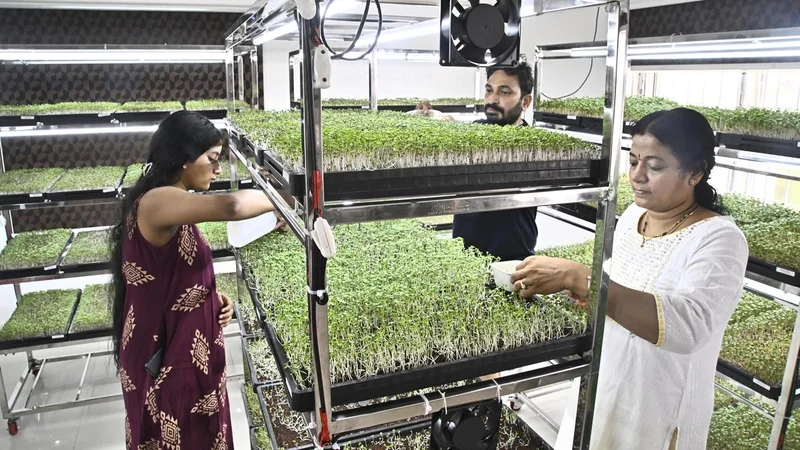
Small is a superfood at Dr. Swathi V’s house in Nallagandla, Hyderabad. For the past five months, the dentist has been harvesting four varieties of microgreens — black gram, broccoli, sunflower and purple radish — for a family of four. Once she was convinced of the nutritional content and her children became curious, she attended a workshop in December 2025 and converted a bedroom of their house into a microgreen setup using an old iron book rack, two lights and four trays. “Watching the seeds sprout and grow into vibrant microgreens is fascinating and a stage of learning for children,” she says.
Dr. Swathi is not alone as the trend of growing microgreens at home is steadily gaining momentum across Hyderabad.
Nutritional intake
A few years ago, these tiny nutrient-packed greens first emerged as edible garnishes in the culinary world and soon became popular for their nutrient profile. In Hyderabad, the trend picked up when urban farming became a hobby for those who wanted to grow chemical-free vegetables during lockdown. In the last five years, there has been a growing awareness about cultivating and consuming microgreens.
But this is not enough, says Srinivasulu Dhanala, founder of Microgreens de Manikonda. A former banker, Srinivasulu grew microgreens at home for three years before launching the company in 2025. “We advocate the concept of ‘One Tray, One Family,’ encouraging every household to either grow or consume fresh microgreens as a simple and sustainable way to improve nutritional intake,” he says.
Housed on the fourth floor of a complex in Manikonda, the harvesting room is a green zone in his office. Tiny greens jostling for space in 70 trays made of food-grade plastic shine bright under the tubelights. These trays layered with cocopeat have holes for aeration and water supply. “It is important to create an environment for microgreens to grow,” says Srinivasulu. The company operates on a subscription model, delivering nearly 200 boxes of microgreens such as broccoli, pink radish, sunflower, turnip, red cabbage, kale, purple kohlrabi, cauliflower and red radish across Hyderabad.
What started as a small urban farming experiment for Srinivasulu has evolved into a community-driven effort involving workshops, awareness sessions and workshops in their premises, corporate companies and gated communities engaging families interested in healthier food choices and sustainable living. “We do not have a Telugu word for microgreens, so some assume it to be premier and exclusive. But menthikura (fenugreek) is something that families have been harvesting for long,” he says, looking forward to the company’s expansion into Vijayawada and Visakhapatnam. “We hope to fill the gap between demand and supply in these two cities through our network with individuals who got trained in Hyderabad.”
Microgreen workshops in offices are also being conducted as part of wellness trends. Srinivasulu recently conducted a corporate workshop facilitated by NGO Nirmaan at Synchrony while a multinational firm’s ‘Tiny leaves healthy life’ session included 25 employees who harvested radish, mustard and red lentil seeds as part of an employee network activity. With ‘Sustainable living won’t cost much’ as a theme, the session also had 446 members attending virtually to learn cheat sheets, seed germination — how and when to harvest and consume — a few recipes, nutrition, flavour profile and misconceptions.
Short shelf life
While microgreens are labelled as superfood potential, their short shelf life, mould formation and wilting due to humidity and watering are areas of concerns. Harvesting microgreens is rather simple but selling remains a challenge. “People grow microgreens easily by watching online videos but they do not know whom to contact and where to sell them. Greens decompose quickly, leading to a bad odour. Our team delivers in airtight containers lined with tissue papers for proper refrigerator storage. “These boxes contain approximately 100gm microgreens that can be consumed over five days“ adds Srinivasulu.
At Nallagandla, one of Hyderabad’s residential hubs, Swastha Microgreens has a capacity to grow 40 kilograms of microgreens in its 500-square feet space. “But we are growing only three kilograms of broccoli, mustard greens, cauliflower, cabbage, mustard yellow, amantras and peas afila. The awareness is yet to grow,” says Lakshman Cherukuri, who co-founded the company along with Ramakrishna Janga. The company supplies to residential areas in the city including live microgreens grown in designer bowls to a restaurant.
Setup is vital
Shweta Darbarwar, co-founder of ZeroHarm Sciences, says hygiene plays an important role. A business woman, Shweta and her husband Sachin had earlier launched Simply Fresh, an urban farming company that has since been sold. Shweta grows different varieties of microgreens using a dehumidifier glass setup at home and says, “Every seed is unique and a great nutrition addition but needs the right humidifier and lighting set-up to avoid fungus, especially seeds of rocket leaves and other baby lettuces. Smaller seeds such as alpha alpha grow easily, but bigger ones require more room and a longer incubation time. One might assume the seeds are not germinating and pour more water leading to fungus.”
These cumulative, small actions are adding up to the homegrown microgreen trend in the city.
Published - August 05, 2026 10:40 am IST