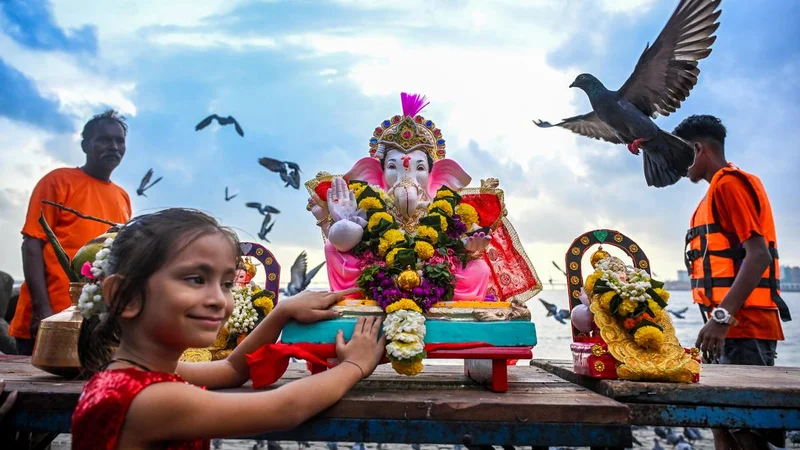
The Bombay High Court is hearing a Public Interest Litigation filed in 2024 seeking the effective implementation of the Central Pollution Control Board (CPCB) guidelines against the immersion of Plaster of Paris (PoP) idols in natural water bodies. The matter has seen multiple hearings and interim orders over two years, with the case now pending ahead of this year’s Ganeshotsav.
The PIL was filed by Rohit Manohar Joshi along with clay-idol craftsmen. The petitioners have sought a prohibition on immersion of PoP idols in natural water bodies, irrespective of height, as well as action against idol-makers using PoP under the Water Pollution Act.
The CPCB guidelines and their legal status
The CPCB issued revised guidelines on May 12, 2020, prescribing that idols made of natural, biodegradable and eco-friendly material be encouraged, and that idols made of PoP be banned.
In June 2025, the CPCB told the Court that its guidelines were advisory rather than statutory, and that its expert committee had clarified the State Government could draft its own immersion policy. The Court expressed displeasure at this position.
“If you say you don’t have powers, then why did you issue such guidelines? If you say you don’t have powers, then withdraw these guidelines,” Justice Gadkari observed in July 2026. The Bench noted that other states, two High Courts (Madras and Telangana) and the National Green Tribunal had passed orders based on these guidelines.
Key developments in 2024
On August 30, 2024, the High Court directed the Maharashtra Government to inform all Sarvajanik Ganesh Mandals to mandatorily follow CPCB guidelines and refrain from installing PoP idols. The Bench expressed displeasure at the lack of implementation by municipal bodies.
“In cases where permissions have been granted, they must be told that PoP idols are not to be installed. Where permission is not granted, let the authorities take an undertaking from the Mandals that they will not use PoP idols,” the Chief Justice said.
The Court suggested the State Government introduce a statutory mechanism with deterrent measures, including fines. “There is no deterrence, no fine. You need to introduce some penalty or at least put some fine, otherwise this will continue,” the Bench noted.
The January 2025 interim order
On January 30, 2025, the High Court issued an interim order against the manufacture, sale and immersion of PoP idols, prohibiting sale and immersion by artisans and vendors ahead of the Maghi Ganesh festival.
The June 2025 modification
On June 9, 2025, the High Court modified its January order. The Bench of Chief Justice Alok Aradhe and Justice Sandeep Marne allowed the manufacture of PoP Ganpati idols, with the caveat that they could not be immersed in natural water bodies without the Court’s permission.
The Court directed the State Government to take a policy decision on immersion of PoP idols in light of the CPCB expert committee’s recommendations. “Such idols shall not be immersed in natural water bodies without the leave of this Court,” the Bench observed.
The State Government’s 2025 policy
On July 21, 2025, the Maharashtra Government formulated a policy permitting immersion of only idols above five feet in natural water bodies, with idols up to five feet to be mandatorily immersed in artificial ponds.
The Government told the Court that around 1.96 lakh idols were up to five feet and would be immersed in artificial tanks, while over 7,000 idols above five feet would be immersed in natural water bodies. It said civic bodies would remove the idols from natural water bodies the following morning.
The Court expressed concern. “Seven thousand is a huge number. Such a large number of idols going into natural water bodies can cause environmental hazard,” Chief Justice Aradhe observed.
The July 2025 interim order
On July 24, 2025, the High Court directed that PoP idols up to six feet in height must be “mandatorily” and “necessarily” immersed in artificial water tanks, an order effective until March 2026 for all festivals involving idol immersion.
The Court noted that the BMC had created 204 water tanks for 1.95 lakh Ganesh idols below five feet the previous year, but only 85,000 idols were immersed in these tanks, with the rest going into natural water bodies. “This Court has to make an endeavour that the impact of immersion of idols on the environment is kept to a bare minimum,” the Chief Justice said.
The Bench directed the State to constitute a committee to suggest reuse and recycling of PoP idols and examine scientific methods of faster, eco-friendly dissolution.
The manufacturers’ position
Manufacturers’ associations have opposed a complete ban, arguing that the CPCB guidelines lack statutory backing and that any restriction would require legislation. They have contended that their fundamental right to carry on business would be affected.
In July 2026, manufacturers suggested a compromise: symbolic immersion of large PoP idols by touching their feet to water, followed by transport to designated recycling facilities. The Court endorsed the suggestion and asked the State to consider it.
The commercial interest argument
On July 16, 2026, the Court questioned manufacturers on whether their commercial interests could override environmental concerns. “Can the interests of a group of persons override the interests of society?” Justice Gadkari asked.
Justice Khata observed that the core issue concerned larger idols immersed in natural water bodies. “We go abroad, we see good and clean water. The manufacturers must consider all this. Why can’t they be more conscious? They too must think of protecting the environment,” he said, adding that citizens have fundamental duties alongside fundamental rights.
The petitioner’s arguments
Senior Advocate Mihir Desai, representing the petitioner, has argued that PoP idols do not dissolve easily and that the colours used on them are toxic. He pointed out that alternatives to PoP had historically been used to make Ganesh idols, and that even the Lalbaugcha Raja idol had not always been made of PoP.
Desai argued that the Maharashtra Government’s 2025 policy, permitting immersion of PoP idols above six feet, was intended to operate only until March 2026, after which a complete ban was envisaged. He submitted that the State’s position was inconsistent with its own studies showing environmental damage.
In July 2026, Desai told the Court that the State was trying to protect “big mandals” by pressing for continued immersion of PoP idols above six feet in natural water bodies. He cited orders by the Madurai bench of the Madras High Court and the Telangana High Court, which held that CPCB guidelines were binding.
The State Government’s position
Advocate General Dr Milind Sathe has argued that a complete ban on PoP idols this year is not practical, as preparations for the festival are already under way. The Government has sought continuation of the 2025 policy allowing PoP idols above six feet to be immersed in natural water bodies.
The Government told the Court that the number of PoP idols above six feet had fallen from 7,863 in 2024 to 4,194 in 2025, and argued that change must happen gradually, comparing the issue to vehicular air pollution. It also pointed to Prime Minister Narendra Modi’s appeal, in his Mann Ki Baat programme, urging devotees to use clay idols instead of PoP.
Current status
The matter remains pending before the Court. On June 9, 2026, the Bench of Chief Justice Alok Aradhe and Justice Sandeep Marne said it would not permit any PoP idol to be immersed in natural water bodies, and directed the State to take a decision on the matter within three weeks.
The Court observed that while it is good that people believe in God, they must also be taught to respect nature. Justice Khata remarked: “We have to protect the environment for our next generation and the next to next generation.”
The case is listed for further hearing.
Published - August 05, 2026 11:22 am IST